Checked by [Dr. Aravind Chander - Best IVF Specialist]. First published [9/10/2026].
The trigger shot in IVF is a precisely timed injection given near the end of stimulation. It helps the eggs finish maturing and lets the clinic book egg retrieval before your body would ovulate by itself. Retrieval usually follows about 34 to 36 hours later, but your clinic will give you the exact clock time to follow.
Taken the trigger at the wrong time, or missed it? Call your clinic straight away, including the after-hours number if you have one. Do not repeat the dose. Our guide to a late or early trigger shot explains what the clinic may do.
Key takeaways
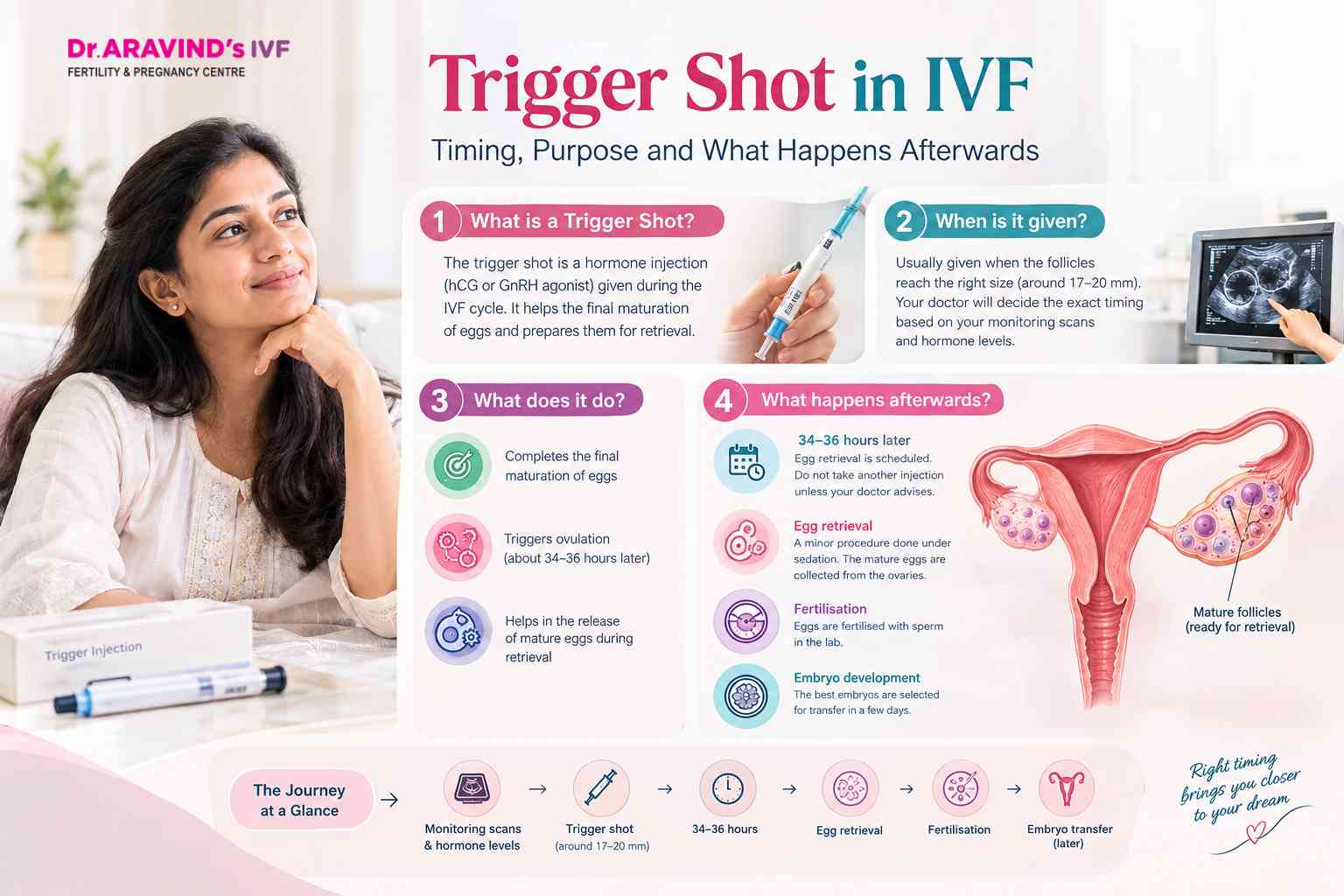
During IVF stimulation, fertility medicines help several ovarian follicles grow. Ultrasound scans and sometimes blood tests help your doctor assess follicle development and hormone levels. When your response is appropriate, your fertility specialist schedules the trigger injection, followed by egg retrieval at a carefully planned time.
To understand the medicines and treatment plans used earlier in the process, read our guide to IVF stimulation protocols.
You may hear the trigger shot referred to as:
Although “egg rupture injection” is a common term, the main purpose of the trigger in an IVF cycle is to support final egg maturation. Egg retrieval is timed before the eggs would normally be released through ovulation.
The trigger provides a hormonal signal that helps eggs complete their final stage of maturation. This increases the opportunity to collect eggs that are mature enough for fertilisation, although not every egg will mature or fertilise successfully.
The injection also helps your clinic plan egg retrieval within a specific time window. Without carefully timed treatment, ovulation could occur before the planned procedure, potentially reducing the number of eggs available for collection.
That is why your clinic gives you an exact injection time rather than simply telling you to take it in the evening.
Your fertility specialist decides when to give the trigger after reviewing your ultrasound findings, hormone results, and response to stimulation. Egg retrieval commonly takes place around 34–36 hours after the trigger injection, although the timing can vary depending on the medication and treatment protocol.
For example, if egg retrieval is scheduled for Wednesday morning, your clinic may tell you to take the trigger on Tuesday evening or at another specific time. Always follow your own written treatment calendar rather than using an example to calculate your injection time.
If you miss the injection, take it at the wrong time or are unsure whether you administered it correctly, contact your fertility clinic immediately. Do not take an extra dose or change the schedule without instructions. Read our guide to what to do if an IVF trigger injection is early or late.
The choice of trigger depends on your treatment protocol, hormone levels, ovarian response and risk of ovarian hyperstimulation syndrome (OHSS).
Unsure which trigger your plan uses? Bring your treatment calendar and scan reports to your appointment. Your fertility specialist can explain why a particular medication has been selected for you.
The decision depends on your overall response to IVF stimulation, not just one follicle measurement. Your doctor may consider:
Learn more about how many follicles may be needed for IVF egg retrieval and how ultrasound monitoring tracks IVF progress.
The injection method depends on the prescribed medication. Some trigger medicines come in pre-filled syringes or pens, while others require mixing a powder with a supplied liquid. Depending on the product, the injection may be given under the skin or into a muscle.
Your nurse should explain the correct technique and demonstrate how to prepare and administer your specific medication. Ask for another demonstration if you are unsure.
To prepare for trigger night:
For more information about injection routines and possible reactions, read our guide to IVF injections and side effects.
After the injection, follow your clinic's instructions while waiting for egg retrieval. Depending on your procedure and medical history, these instructions may include:
After several days of ovarian stimulation, you may notice bloating, pelvic heaviness, breast tenderness, or tiredness. Tell your clinic if symptoms worsen or concern you, as the significance depends on your individual response.
Egg retrieval is usually performed with sedation or anaesthesia. Using ultrasound guidance, the doctor passes a fine needle through the vaginal wall into the ovarian follicles and collects their fluid. The embryology team examines the collected material to identify the eggs and assess their maturity.
Depending on your treatment plan, suitable eggs may be fertilised through conventional IVF or ICSI.
Not every follicle will yield an egg, and not every retrieved egg will be mature. The trigger supports final maturation but cannot guarantee egg collection, fertilisation or embryo development.
Read more about IVF egg retrieval and anaesthesia during IVF.
Possible side effects vary according to the medication and your individual response. Some people experience:
Some trigger medicines, particularly hCG, can increase the risk of OHSS in patients whose ovaries respond strongly to stimulation.
Seek urgent medical advice if you develop severe abdominal pain, rapidly increasing swelling, repeated vomiting, difficulty breathing, faintness, rapid weight gain or markedly reduced urine output. These symptoms should not be dismissed as routine IVF side effects.
For further information, read our guide to OHSS symptoms and treatment.
Ask your fertility clinic before having sex after the trigger injection. During an egg-retrieval cycle, your ovaries may be enlarged and tender, and your doctor may advise avoiding intercourse because of discomfort, the risk of ovarian complications, or the possibility of an unintended pregnancy.
Advice may differ for IUI or timed-intercourse cycles, where intercourse may be part of the treatment plan. Follow the instructions for your specific cycle rather than relying on general advice.
If your trigger injection contains hCG, a pregnancy test taken too soon afterwards may detect the injected hormone and show a positive result even when pregnancy has not been established.
For this reason, follow the pregnancy-test date provided by your fertility clinic instead of testing early and trying to interpret the result yourself. Read our guide to IVF pregnancy test timing.
After embryo transfer, continue or stop progesterone and any other prescribed medication only as directed by your fertility specialist.
The IVF trigger shot is an important step that helps prepare eggs for retrieval. The type of medication, dose, and exact timing are chosen according to your ovarian response, hormone results, and treatment plan.
Follow your clinic's instructions carefully, and contact the team immediately if the injection timing is incorrect or you experience concerning symptoms. Understanding the purpose of the trigger can help you feel more prepared for egg retrieval, but your fertility specialist remains the best person to guide decisions about your individual cycle.
Medical disclaimer: This article is for general educational purposes and is not a substitute for individual medical advice. Trigger medications and their timing must be prescribed and supervised by a qualified fertility specialist.
Many people call it that. In an IVF cycle, though, the point is to let the eggs finish ripening so the clinic can collect them just before your body would release them by itself. Which medicine is used depends on your protocol.
Usually a day and a half or so, often quoted as 34 to 36 hours. Your clinic will give you the exact clock time, and that is the one to follow.
Expect a quick prick, and perhaps a tender spot for a while. The feel of it varies with the medicine and the way it is given, so have the nurse demonstrate before the night itself.
It can, if your trigger contained hCG. Home tests detect that same hormone, so an early positive may simply be left-over medicine. Wait for the blood test date your clinic has set.
No. It supports the final stage of maturation, but how many eggs are mature and fertilise still depends on several biological factors.


