Checked by [Dr. Aravind Chander - Best IVF Specialist]. First published [7/10/2026].
IVF stimulation protocols are the medicine plans doctors use to help several follicles grow in the same cycle, so more than one mature egg can be collected. The main types are the antagonist protocol, the long agonist protocol and mild (mini) IVF, with natural-cycle and individualised plans for some patients. No protocol is best for everyone. Your doctor picks one using your age, AMH, antral follicle count, past response and health history.
Key takeaways
In a natural menstrual cycle, usually one follicle becomes dominant and releases an egg during ovulation. During IVF, controlled ovarian stimulation uses fertility medicines to encourage multiple follicles to develop. This gives the fertility team an opportunity to retrieve several eggs, which may provide more eggs for fertilisation and embryo development.
An IVF stimulation protocol is the personalised treatment plan that explains how your ovarian stimulation will be managed. It generally sets out:
There is no single IVF protocol that is suitable for everyone. Even two women with a similar diagnosis may respond differently to fertility medicines and therefore require different doses, medications or monitoring schedules.
Your fertility specialist may consider factors such as:
The purpose of an IVF protocol is to create a treatment plan that is appropriate for your individual circumstances and expected ovarian response. The protocol itself does not indicate how severe infertility is or determine the quality of a fertility clinic.
Your doctor may also modify the plan during treatment based on your ultrasound findings, hormone levels and how your ovaries respond to stimulation. This monitoring allows the treatment team to make decisions based on your response rather than simply following a fixed schedule.
Read more about the scans in how ultrasound monitoring tracks your IVF progress, and about the whole sequence in the IVF process timeline.
Wondering which protocol could suit you? Bring your AMH, scan, and treatment history, and our doctors will explain the options in plain language.
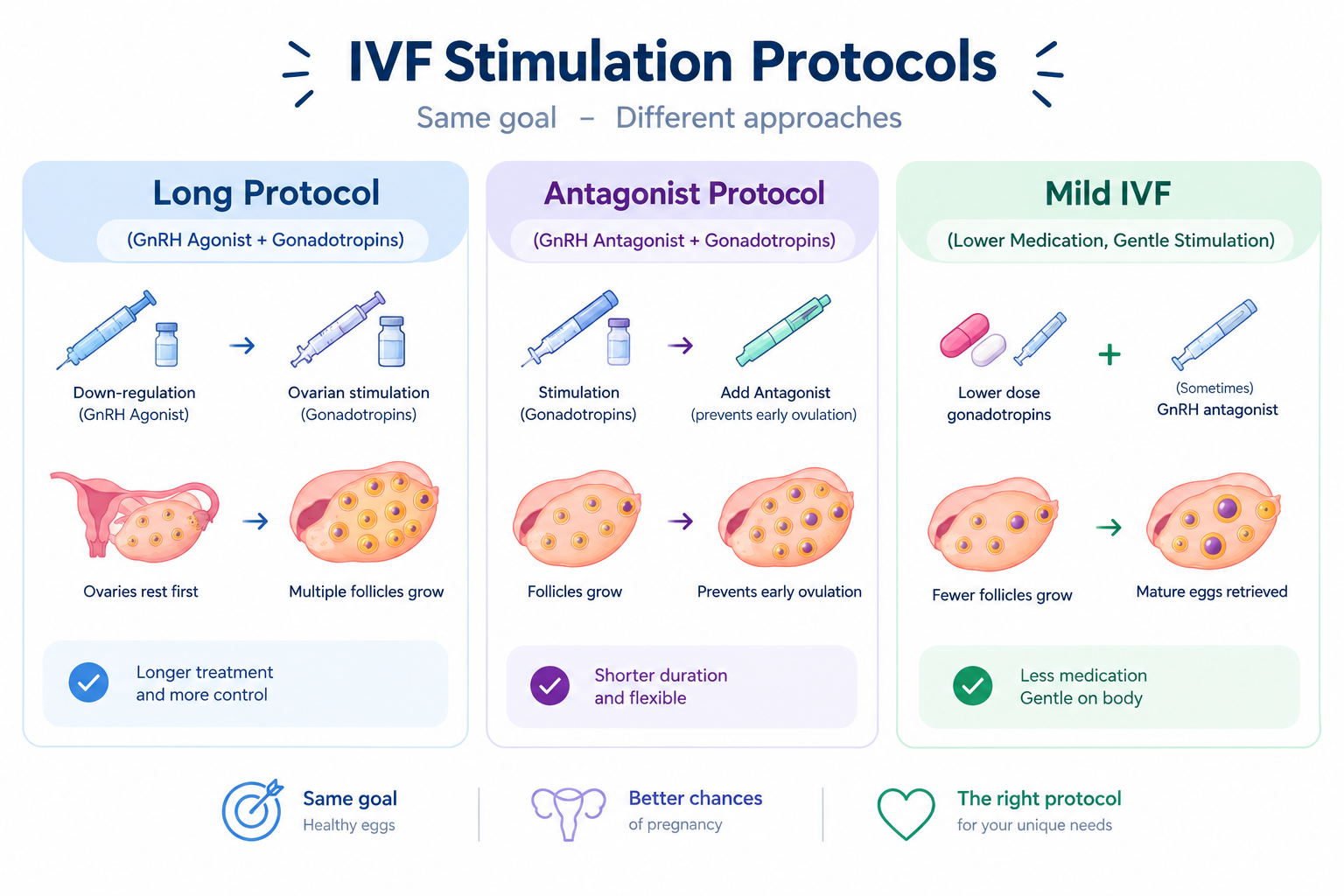
Book an IVF consultation →The GnRH antagonist protocol is one of the commonly used approaches to IVF stimulation. Stimulation medicines are started first, and a GnRH antagonist is introduced during the cycle to help prevent premature ovulation. Depending on the treatment plan, the antagonist may be started on a particular cycle day or when the developing follicles reach a certain stage.
Choosing an antagonist protocol does not automatically make a cycle safer or increase the chance of pregnancy. The medication doses, monitoring schedule and trigger strategy still need to be selected according to your individual response.
The long agonist, or down-regulation, protocol uses a GnRH agonist before ovarian stimulation to temporarily suppress the body's natural reproductive hormone signals. Stimulation medicines are then used to encourage follicle development under controlled conditions.
Your doctor may consider this approach when greater control over the timing of the cycle is useful or when your previous treatment history supports its use. Because it includes a preparation or suppression phase, it may take longer than some other protocols. Temporary effects such as hot flushes, headaches or mood changes can occur.
The long agonist protocol is not automatically better than an antagonist protocol. The choice depends on your individual circumstances, treatment history and your fertility specialist's assessment.
Mild IVF, sometimes called minimal stimulation IVF or mini-IVF, uses lower doses or fewer days of ovarian stimulation medicines than conventional stimulation. The goal is generally to obtain a smaller number of eggs while reducing the amount of medication used.
Mild IVF should not simply be viewed as a cheaper version of conventional IVF. It is a different treatment approach with its own potential benefits and limitations. Ask your doctor what egg and embryo numbers may be realistic for your particular situation.
For some patients, particularly those who have previously had a lower-than-expected ovarian response, a fertility specialist may consider a microdose flare protocol or another individualised stimulation approach.
The exact protocol may combine different types or doses of fertility medicines depending on the patient's history and expected ovarian response. Rather than focusing only on the name of the protocol, ask your doctor why it has been selected, what response is expected and how the treatment will be monitored.
In natural-cycle IVF, the treatment team attempts to retrieve the egg from the follicle that develops naturally during the menstrual cycle. Modified natural-cycle IVF may use a small amount of medication or a trigger injection to help coordinate ovulation and egg retrieval.
These approaches generally aim to retrieve one egg rather than stimulate the ovaries to produce multiple follicles. As a result, there may be a higher chance that a cycle does not result in an egg being retrieved or an embryo being available for transfer.
Natural or modified natural-cycle IVF is therefore suitable for only some patients, and your doctor will consider your age, ovarian reserve, previous treatment response and personal treatment goals before recommending it.
People with PCOS may have a high number of small antral follicles and can sometimes respond strongly to ovarian stimulation. Because of this, the fertility specialist may choose a protocol and medication dose designed to reduce the risk of an excessive response.
An antagonist protocol is commonly considered in this situation because it can provide flexibility during stimulation, and a GnRH agonist trigger may be an option for selected patients when clinically appropriate. Depending on the circumstances, the doctor may also recommend freezing embryos and transferring them in a later cycle.
Having PCOS does not mean that every patient needs the same IVF protocol. Monitoring and medication doses are tailored to the individual's response.
There is no single IVF stimulation protocol that is proven to be best for everyone with low AMH. A lower AMH may indicate reduced ovarian reserve, but it does not by itself determine egg quality or whether pregnancy is possible.
Your fertility specialist may discuss conventional stimulation, mild stimulation or another individualised approach based on your age, AFC, previous treatment response and overall fertility history. The discussion should include realistic expectations about the possible number of eggs and embryos rather than relying on AMH alone.
For more context, read our guide to low AMH and pregnancy.
Important: Brands, doses and timings differ. Never copy another patient's schedule or change a dose based on an online chart. Our guide to IVF injections and side effects covers what to expect.
During ovarian stimulation, your fertility team uses ultrasound scans and, when appropriate, blood tests to monitor how your ovaries are responding to the medicines. The team may assess follicle number and growth, hormone levels, the uterine lining and any symptoms you are experiencing.
The goal is not simply to produce the highest possible number of follicles. Instead, your doctor aims for an ovarian response that provides a reasonable opportunity to retrieve mature eggs while keeping treatment risks as low as possible.
If the ovaries respond more slowly than expected, your doctor may adjust the medication dose or reconsider the treatment plan. If too many follicles develop or your risk of OHSS becomes concerning, the team may modify the trigger strategy, consider freezing embryos for a later transfer or, in some circumstances, recommend stopping the cycle if continuing would not be medically appropriate.
The trigger injection helps coordinate the final stage of egg maturation before egg retrieval. Depending on your treatment plan and risk of OHSS, your doctor may use hCG, a GnRH agonist or a combination approach.
Egg retrieval is usually scheduled approximately 34–36 hours after the trigger, although the exact timing depends on your treatment protocol. Your clinic will tell you the precise time to take the injection because timing is important for the planned egg collection.
If you take the trigger earlier or later than instructed, take the wrong dose or miss it completely, contact your fertility clinic immediately. Do not make changes to the timing yourself.
Ovarian hyperstimulation syndrome (OHSS) can occur when the ovaries respond too strongly to fertility medicines. The risk may be higher in people with PCOS, a high number of developing follicles or high estradiol levels, although OHSS can occur in other circumstances as well.
Your fertility team monitors your response and may adjust the treatment or trigger strategy when appropriate to reduce the risk.
Contact your fertility clinic urgently if you develop symptoms such as:
Our guide to OHSS symptoms and treatment explains the warning signs and when medical attention may be needed.
Fertility medicines can make up a significant part of the overall IVF expense. The amount you spend can vary depending on the stimulation protocol, medication dose, brand, number of treatment days and how your ovaries respond.
A lower-medication approach may reduce medicine costs for some patients, but the overall treatment cost should be considered rather than comparing medicine prices alone. If more than one cycle is needed, the total expense can also change.
When comparing IVF treatment estimates, ask whether the quoted amount includes:
For more information, see our IVF cost guide.
Before starting stimulation, make sure you understand why the protocol has been selected and what may happen if your response is different from expected. You can ask:
Remember: an IVF stimulation protocol is not necessarily fixed from the first injection to egg retrieval. Your fertility team may adjust medication doses, monitoring or the trigger strategy based on your scan and blood-test results. This individualised monitoring is an important part of making IVF treatment as appropriate and safe as possible for you.
IVF stimulation protocols are personalised treatment plans, not fixed recipes. Antagonist, long, mild, natural and other individualised approaches can each have a place in fertility treatment. Your doctor may choose or adjust a protocol based on factors such as your ovarian reserve, diagnosis, age, previous IVF response, and the risk of complications.
Before starting treatment, it can help to understand what happens during your first IVF consultation and review our IVF preparation checklist. If you are comparing IVF treatment packages, also check whether the quoted cost includes medicines, monitoring scans, blood tests, laboratory procedures, embryo freezing and other possible additional charges.
Your IVF plan should be based on your individual history and treatment needs. Bring your latest scan reports, blood test results and previous fertility treatment records to your appointment so your doctor can review them and discuss the most appropriate approach with you.
Ready to discuss your IVF treatment plan? Book a consultation with Dr. Aravind's IVF Fertility & Pregnancy Centre to understand your options and ask questions before starting treatment.
Medical disclaimer: IVF medicines and stimulation protocols should be prescribed and monitored by a qualified fertility specialist. This article is intended for general educational p
Neither wins in every situation. Each fits some patients better than others, and the choice rests on your age, ovarian reserve, diagnosis, how you responded before and how high your risk of over-response is.
No. Pushing the dose up does not reliably bring more eggs or better embryos. Your doctor balances how your ovaries respond against your age, your reserve and the chance of overstimulation.
Commonly around 8 to 14 days, but the real number follows your follicles and hormone results. The last injection day is decided from your scans, and your clinic will confirm it with you.
Sometimes. A low AMH alone does not decide the protocol. Your doctor should explain how many eggs to expect with a mild approach, and how that compares with a conventional one.
Yes. A cycle may be changed or stopped if the response is too weak, ovulation happens early, too many follicles grow, or retrieval would be unsafe.


