Checked by [Dr. Aravind Chander - Best IVF Specialist]. First published [8/10/2026]
There is no minimum follicle count that guarantees a successful cycle. Some patients go ahead to retrieval with only a few follicles when the doctor thinks it is worthwhile, while others with many follicles need a safer, modified plan. Large studies suggest the chance of a live birth tends to rise as more eggs are collected, up to roughly 10 to 15 eggs, after which the gain levels off and the risk of over-response grows. That is a pattern across many patients, not a target for you.
Think of a follicle as a tiny pocket of fluid in the ovary where an egg may be growing. Counting pockets on a scan is not the same as counting eggs, and the eggs collected are not the same as embryos you will end up with.
Key takeaways
A follicle is a small fluid-filled structure in the ovary that contains an immature egg. In a typical menstrual cycle, one follicle usually becomes dominant and releases an egg during ovulation.
During IVF treatment, fertility medicines are used to encourage multiple follicles to grow at the same time. This allows the fertility team to collect more than one egg during egg retrieval. To understand more about the medicines and treatment approaches used during stimulation, read our guide to IVF stimulation protocols.
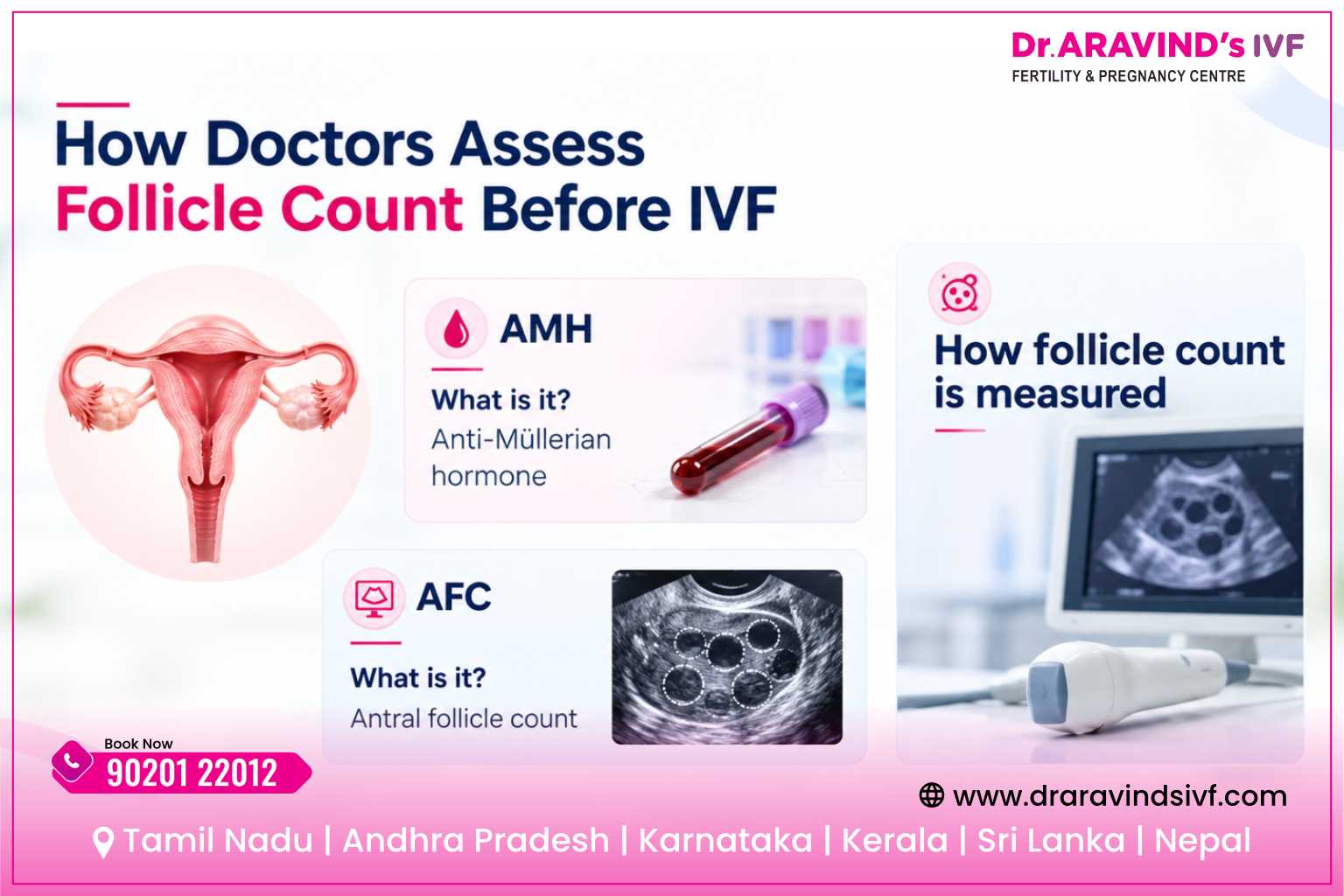
During monitoring, ultrasound scans allow your doctor to measure the size and number of developing follicles. However, follicle size alone cannot tell whether an egg is mature or whether it will successfully fertilise.
After retrieval, a follicle may contain a mature egg, an immature egg, or occasionally no egg that can be collected. Even when an egg is successfully retrieved, fertilisation and embryo development depend on several other factors.
That is why IVF monitoring looks at more than follicle size. Your doctor considers the number of follicles, their growth pattern, hormone levels and your overall response to stimulation when deciding the next steps.
Antral follicle count (AFC) is the number of small follicles visible on an ultrasound scan at a particular stage of the menstrual cycle. It is one of the indicators doctors use to estimate ovarian reserve and understand how the ovaries may respond to IVF stimulation.
However, AFC does not measure egg quality, cannot tell you exactly how many eggs will be retrieved, and cannot predict whether an IVF cycle will result in pregnancy. For a more detailed explanation, you can read our guides on the baseline scan before IVF and antral follicle count.
There is no single follicle count that is ideal for everyone. A moderate response to stimulation may provide enough eggs while keeping the risk of excessive ovarian response lower. Even with a smaller number of follicles, an IVF cycle can sometimes produce a usable embryo.
On the other hand, a very high follicle count may require closer monitoring and adjustments to the treatment plan, particularly when there is a higher risk of ovarian hyperstimulation.
Be cautious with online charts that label a particular follicle number as “normal.” The significance of your follicle count can vary depending on factors such as age, cycle day, AMH level, PCOS, ultrasound findings, previous IVF response and laboratory results.
The goal is not simply to produce the highest possible number of follicles. Your fertility team aims for a response that is appropriate for your situation, medically monitored and capable of giving you a reasonable opportunity to obtain mature eggs and embryos.
There is no universal minimum number of follicles required for an egg retrieval. Your doctor considers the number of developing follicles, their growth pattern, follicle size, hormone levels, your age, the expected egg maturity and your overall risk profile.
If only a few follicles are growing, your doctor may still recommend proceeding with retrieval after discussing the potential benefits and limitations with you. Depending on your circumstances, the team may instead consider adjusting the protocol, continuing monitoring or discussing another treatment approach.
A Useful Question for Your Doctor
Worried about a number on your scan? Bring your report to your fertility consultation. Your doctor can explain what the findings mean in the context of your age, AMH, medical history, and overall treatment plan.
Follicles do not all grow at the same speed during IVF stimulation. Before deciding when to give the trigger injection, your fertility specialist considers the size of the leading follicles, the overall pattern of follicle growth and your hormone levels, rather than relying on one measurement alone.
In many IVF cycles, doctors begin considering the trigger when a group of leading follicles reaches the late teens to low twenties in millimetres. However, there is no single follicle size that applies to every patient. The timing is individualised according to your response to stimulation and your treatment plan.
Follicle size provides an indirect indication of possible egg maturity, but it cannot confirm whether the egg inside is mature or whether it will successfully fertilise. The trigger injection is carefully timed so that egg retrieval usually takes place approximately 34–36 hours later.
Because trigger timing is important, take the injection at exactly the time instructed by your fertility clinic. If you take it late, early or miss it altogether, contact your clinic immediately for guidance.
It is possible for the number of eggs retrieved to be lower than the number of follicles seen during ultrasound monitoring. This does not necessarily mean that anything went wrong. Several factors can explain the difference:
The follicle count on a scan is therefore not a promise of how many eggs will be collected. Your embryology team can explain your retrieval results and help you understand what they mean for the next stage of treatment. You can also learn more about the procedure in our IVF egg retrieval guide.
Not every egg collected during retrieval is mature enough for fertilisation. Eggs develop at different rates, so the embryology laboratory examines the retrieved eggs and determines their maturity.
Mature eggs are generally the ones that can be considered for fertilisation through standard insemination or ICSI, depending on your treatment plan. Immature eggs are usually not suitable for fertilisation on the day of retrieval.
Egg maturity can be influenced by several factors, including follicle development, ovarian response to stimulation, trigger timing, age and individual biological variation. As a result, the number of follicles seen on a scan, the number of eggs retrieved and the number of mature eggs can all be different.
Each stage in IVF narrows the number. The sequence runs like this: Scan count → Eggs collected → Mature eggs → Fertilised eggs → Embryos growing → Blastocysts → Transfer or freezing
These numbers are invented only to show the pattern, not to predict your result. The drop from one stage to the next is normal, even though it can be upsetting to see. Follicle count alone cannot tell you how many embryos you will have, or whether you will get pregnant. Age strongly affects this (see impact of age on egg quality ).
A lower follicle response during IVF can happen for several reasons, including age, lower ovarian reserve, previous ovarian surgery, endometriosis or other individual factors. A smaller number of developing follicles does not automatically mean that treatment cannot continue.
Depending on your circumstances, your fertility specialist may discuss options such as:
With a low follicle count, the focus is on understanding what may be achievable rather than simply focusing on a number. Your doctor can explain the expected benefits, limitations and available options so you can make an informed decision.
A high follicle response can occur more commonly in people with PCOS or a higher ovarian reserve. Having more developing follicles may provide an opportunity to retrieve more eggs, but a high response can also increase the risk of ovarian hyperstimulation syndrome (OHSS).
If your doctor feels you are at increased risk, the treatment plan may be adjusted. This could include reducing stimulation medicine, choosing a different type of trigger injection or freezing suitable embryos for transfer in a later cycle, depending on your individual circumstances.
Contact your fertility clinic promptly if you develop significant symptoms after stimulation or egg retrieval. Severe abdominal pain or bloating, repeated vomiting, difficulty breathing, faintness, rapid weight gain or markedly reduced urine output can require urgent medical assessment.
For more information, read our guide to OHSS symptoms and treatment.
Not necessarily. A higher number of follicles may provide more opportunities to retrieve mature eggs, but it does not guarantee better egg quality, embryo development or a live birth.
IVF outcomes depend on several factors, including age, egg and sperm factors, embryo development, embryo genetics, uterine factors and overall health. The aim is not simply to produce the largest possible number of follicles. Instead, your fertility team aims for a response that is appropriately managed and gives you a reasonable opportunity to obtain suitable eggs and embryos.
When you are considering egg freezing, the number of mature eggs you may want to store can depend on factors such as your age, ovarian reserve and future family-building plans.
Your fertility specialist can assess your expected response and discuss whether one cycle may be reasonable or whether more than one cycle could be considered. There is no single number of eggs that can guarantee a future pregnancy.
If you are unsure what your scan results mean, consider asking your fertility specialist:
Remember, a follicle count is one part of the IVF picture. Your doctor will interpret it alongside your age, AMH, ultrasound findings, hormone levels, previous treatment history and overall fertility goals.
There is no magic follicle number for IVF egg retrieval. The follicle count is only one part of the picture. What matters is how the follicles develop, how many eggs are retrieved, how many are mature, and what happens through fertilisation and embryo development.
If a number on your ultrasound report worries you, try not to compare it with someone else's IVF cycle. Ask your fertility team to interpret the result in the context of your age, AMH, ovarian reserve, previous treatment response and individual fertility goals.
You can also read our guide to the first IVF consultation to prepare questions and understand what to discuss with your fertility specialist.
Bring your latest scan, blood reports and treatment details to your consultation at Dr. Aravind's IVF Fertility & Pregnancy Centre. Your doctor can explain what your follicle count and growth pattern mean for your individual IVF plan.
Medical disclaimer: Follicle numbers, stimulation plans and egg-retrieval decisions are individual. Do not compare your scan results with another patient's cycle or change, stop or adjust fertility medicines without speaking with your fertility team.
In some situations a doctor may talk about retrieval with one or a few follicles, but the likely benefit and the alternatives need to be weighed. No rule fits every patient.
Again it is individual. How old you are, and how many mature eggs you would like to store for later, count for the most. A specialist can say whether one cycle or more could be sensible.
Ten may be a useful response for one patient and a modest one for another. Age, follicle size, hormone levels, maturity and earlier cycles all change what the number means.
No. A follicle may not yield an egg, and a retrieved egg may be immature or may not fertilise.
They may keep changing, but retrieval is timed carefully. Never delay or repeat the trigger without speaking to your clinic.


