An endometrial scratch is a minor procedure that deliberately irritates the womb lining in the hope of helping an embryo implant. Large, well-designed trials and reviews have not shown a dependable improvement in live birth for most women, and major guidance does not support it as a routine IVF add-on. It carries small risks, costs money, and can delay treatment. If your clinic offers one, ask what evidence supports it for you and what it would change.
Key points
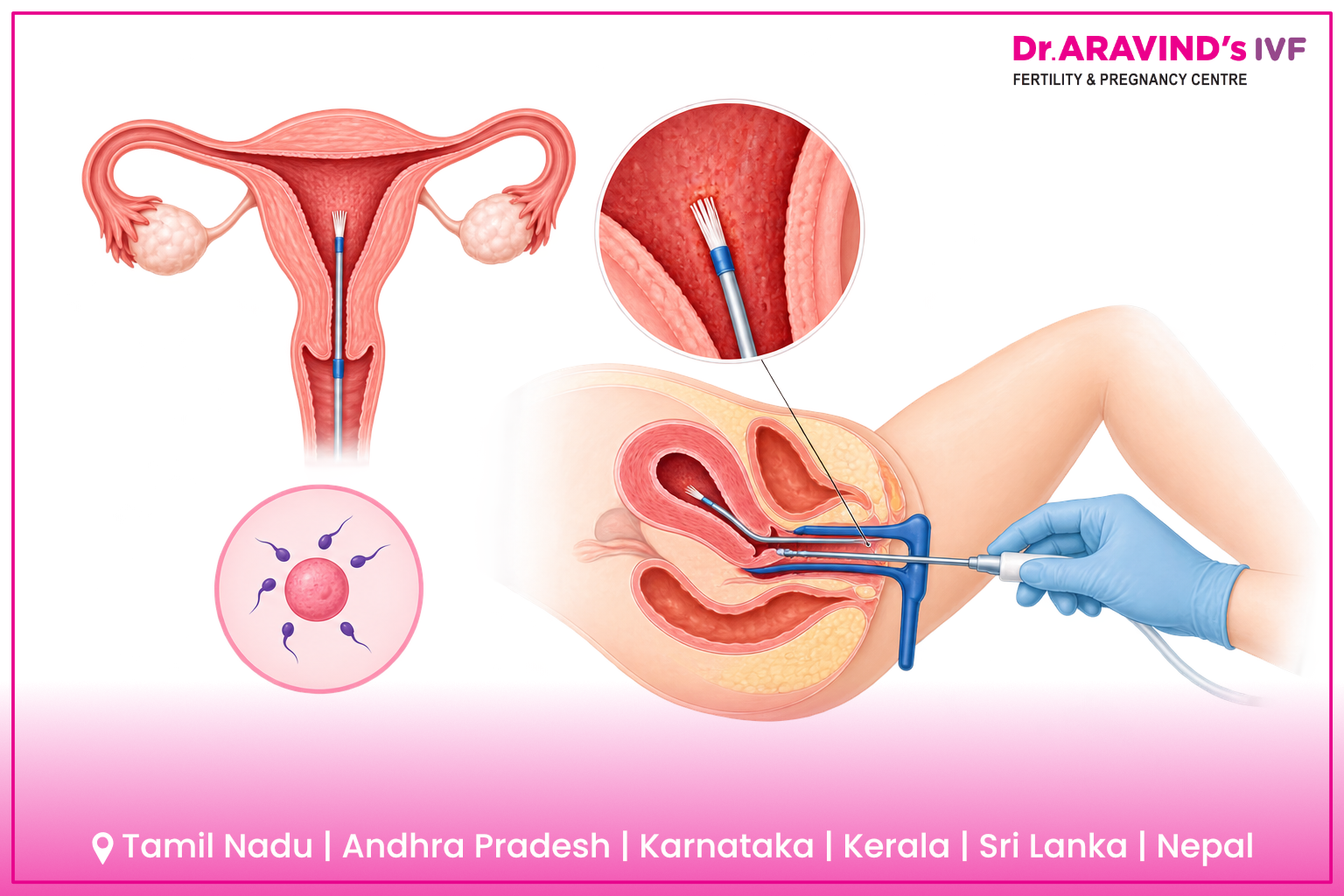
It is a small, intentional injury to the lining of the womb (the endometrium), usually made with a thin catheter or biopsy instrument passed through the cervix. When tissue is also collected, it may be called an endometrial biopsy.
The theory is that healing after the injury changes local inflammation and growth signals, and makes the lining more welcoming to an embryo. That idea led to scratches being offered as an IVF add-on, especially after failed transfers. But a proposed mechanism is not evidence that the treatment improves the chance of a baby.
| Procedure | Purpose | What it does |
|---|---|---|
| Endometrial scratch | Add-on aimed at helping implantation. | Intentionally irritates the womb lining, sometimes while taking a small tissue sample. |
| Endometrial biopsy | Diagnosis. | Takes a tissue sample to test for a condition such as chronic endometritis. See chronic endometritis and IVF failure. |
| Hysteroscopy | Diagnosis and treatment. | Uses a camera to inspect the womb cavity and can identify or treat polyps, adhesions or cavity-distorting fibroids. See hysteroscopy before IVF. |
| ERA-type test | Tries to time implantation. | Analyses gene activity in a womb-lining sample. See ERA test in IVF. |
Remember: An endometrial scratch cannot replace a proper assessment for structural problems inside the womb. If your doctor suggests hysteroscopy, ask whether it is intended for diagnosis, treatment or both.
The honest answer is: not reliably. Some early, smaller studies suggested a possible benefit, particularly in women with earlier failed IVF. Later and larger research, including a large randomised trial published in the New England Journal of Medicine, did not show a consistent improvement in live births compared with no intervention, and systematic reviews, including Cochrane, rate the certainty of the evidence as limited or low. Results may differ with how patients are chosen, timing, the type of embryo and whether the transfer was fresh or frozen.
A clinic should never promise that a scratch will make an embryo implant.
Guidance wording varies, but major evidence-based sources do not support the scratch as a universal add-on. The UK regulator HFEA includes it in its add-on ratings and does not describe it as a proven treatment, and ESHRE's recurrent implantation failure recommendations do not support its routine use. In practice, that means:
Sometimes after repeated implantation failure, once other relevant causes have been looked at, or within a research setting. Even then, your doctor should say clearly that the benefit is uncertain, and you should be able to say no without being told your IVF cannot work without it. For the wider review, see how doctors investigate failed embryo implantation.
Some women feel period-like cramps. Others find it more uncomfortable, especially if the cervix is narrow. Timing differs between clinics, so never copy another woman's schedule.
Contact the clinic for heavy bleeding, fever, worsening pain, foul-smelling discharge or fainting afterwards. Anything that enters the womb carries some risk, so a scratch should not be described as harmless just because it is minor. Repeating it without proven benefit means repeating those risks.
An add-on should never distract from correct transfer timing or an untreated womb problem. See endometrial preparation for FET and progesterone before embryo transfer.
[Doctor to write 3 to 4 honest sentences on the centre's policy: for example, that add-ons are discussed only when there is a clear clinical reason, how patients are told about the evidence, and that patients can decline. No success figures or unprovable claims. Delete this note.]
Endometrial scratching is a proposed IVF add-on, but current evidence does not show a consistent improvement in implantation or live birth for most women. It should not be routine, should not replace proper womb and embryo evaluation, and should never be presented as a guaranteed fix after IVF failure.
For evidence-based IVF planning, contact Dr. Aravind's IVF Fertility & Pregnancy Centre.
Discuss your IVF history, available treatment options and any proposed add-ons with our fertility team.
Book for ConsultationDr. Aravind's IVF Fertility & Pregnancy Centre
Next read: Chronic endometritis and IVF failure · Why IVF implantation fails · Repeated IVF failure
Endometrial scratching is a medical procedure and should not be done without a clear clinical discussion. Evidence and recommendations may change as new trials are published. This article is for education only.
A reliable improvement in live birth has not been established for most women. The evidence is conflicting, so it should never be sold as a guaranteed way to improve implantation.
Routine scratching before a first cycle isn't supported by strong evidence. Ask why it is being offered and whether the result would change your treatment.
It may be discussed in selected cases, but evidence remains uncertain, and it isn't routinely recommended. A structured review of embryos, womb, timing, and other factors matters more.
Some women feel cramps, while others have significant discomfort. It varies with cervical anatomy and individual sensitivity.
It depends on your clinic's protocol and the reason for the procedure. Don't use a generic online schedule. Ask your fertility team.
No. A scratch creates a small injury. An ERA-type test analyses gene activity in a lining sample, and its usefulness also depends on the situation and evidence.


