First published [17/10/2026]
Endometrial preparation helps your clinic prepare the womb lining for a frozen embryo transfer (FET). It uses either your own ovulation or prescribed estrogen and progesterone, so that the lining is in step with the age of your embryo on transfer day. Many clinics prefer a lining of about 7 to 8 mm or more, with a layered, three-line look, but thickness is only one piece. Your clinic's written schedule always comes before any protocol you read online.
Key takeaways
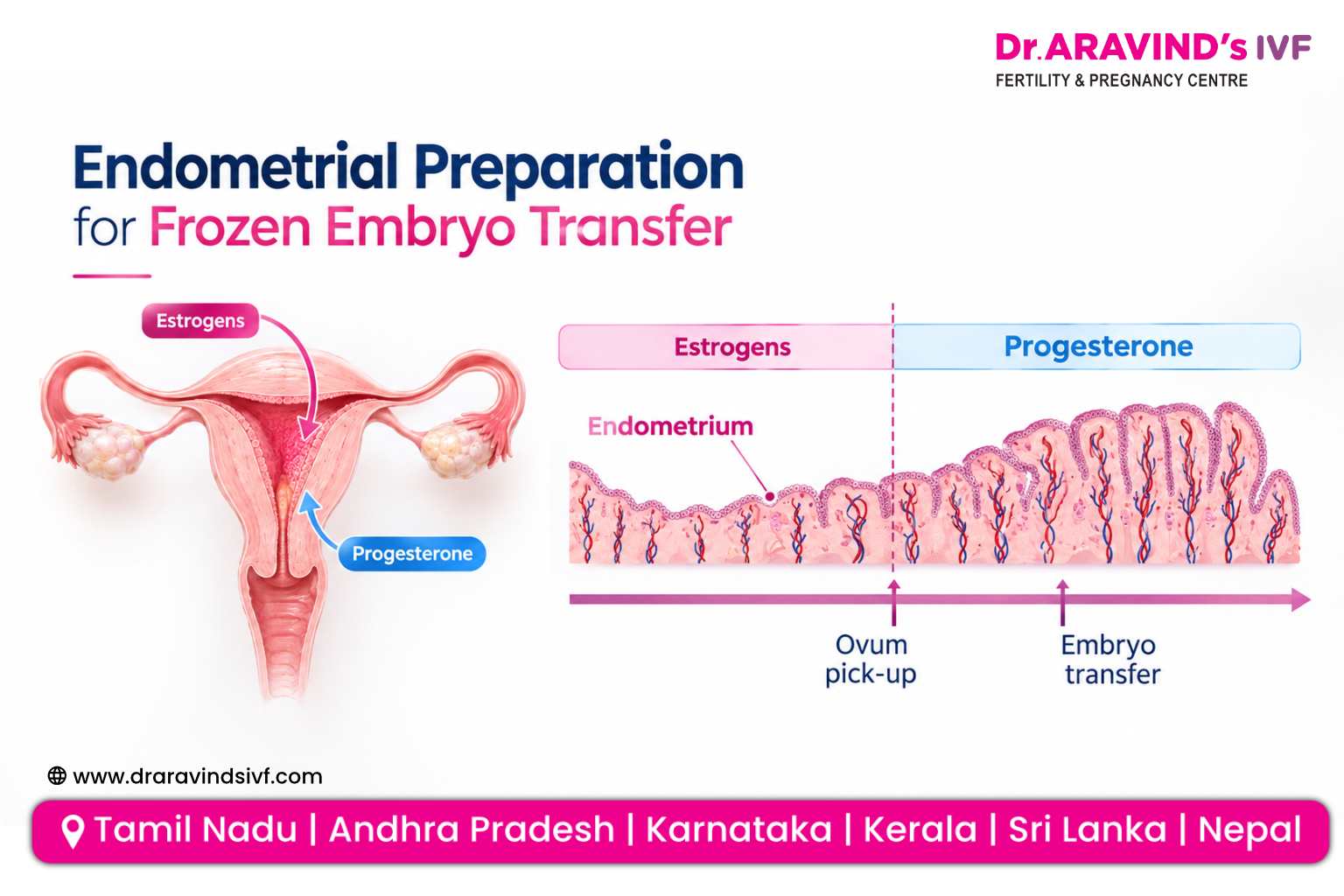
The endometrium is the inner lining of the womb, where an embryo attaches during implantation. In a frozen embryo transfer (FET), an embryo that was frozen during an earlier cycle is thawed and transferred in a later cycle. This allows the fertility team to prepare the uterine lining and coordinate its hormonal development with the embryo's stage.
The goal of endometrial preparation is to create a suitable environment for a well-timed embryo transfer—not simply to achieve the thickest possible lining. The lining's development, its appearance and the timing of progesterone exposure all help the team plan the transfer.
Your fertility team may consider several factors when preparing your endometrium:
The exact approach varies from person to person. Your fertility specialist may recommend a natural, modified natural or medicated FET cycle depending on your ovulation pattern, medical history and treatment needs.
A natural-cycle frozen embryo transfer (FET) may suit people who ovulate regularly. The fertility team monitors follicle development, endometrial thickness and hormone levels to identify the timing of ovulation. Monitoring may include ultrasound scans, urine LH tests and blood tests, depending on the clinic's protocol.
The transfer date is planned around ovulation and the developmental stage of the embryo. Because this approach follows your natural cycle, the timing depends on how your follicle develops and when ovulation occurs.
In a modified natural cycle, the clinic monitors your follicle and uterine lining, and an hCG trigger injection may be used to help time ovulation. Progesterone support may also be prescribed, depending on your treatment plan.
The timing of the trigger, progesterone and embryo transfer must follow your clinic's instructions. Never copy an injection time or medication schedule from an online plan, as the correct timing depends on your individual monitoring results.
In a medicated FET cycle, estrogen helps the endometrial lining develop. Progesterone is then introduced to prepare the lining for implantation. The transfer is scheduled according to the duration of progesterone exposure and the embryo's developmental stage.
| Step | What Happens |
|---|---|
| 1 | A baseline scan or cycle-start assessment checks whether it is appropriate to begin. |
| 2 | Estrogen tablets, patches or gel are prescribed to support lining development. |
| 3 | An ultrasound checks the lining's thickness and appearance. |
| 4 | Progesterone begins when the lining and treatment plan are ready. |
| 5 | The embryo is transferred after the prescribed period of progesterone exposure. |
| 6 | Hormone support continues according to the clinic's instructions, with a scheduled pregnancy test. |
Some people need medication to help a follicle grow or trigger ovulation. This approach may be considered when ovulation is irregular or needs support. The clinic monitors follicle development, hormones and the uterine lining to plan the transfer. The medicines and monitoring schedule depend on your individual needs.
Many fertility clinics aim for an endometrial thickness of around 7–8 mm or more before transfer, although the preferred threshold and approach can vary. Pregnancies can occur with thinner linings, and a thicker lining does not guarantee implantation.
Your doctor will also consider the lining's ultrasound appearance, hormone timing, the condition of the uterine cavity and embryo-related factors. To understand embryo appearance and grading, read our guide to embryo grading in IVF.
Increasing estrogen without a clear clinical reason is not always helpful. Your treatment plan should be based on your scan findings, hormone levels and medical history.
Questions to ask your doctor:
A transvaginal ultrasound and a review of your previous investigations are common parts of the assessment. Depending on your symptoms and medical history, your doctor may investigate fibroids that affect the uterine cavity, polyps, scar tissue, fluid or other findings. Conditions such as adenomyosis or endometriosis may also be considered when clinically relevant. Further assessment for infection or inflammation is generally guided by specific signs or concerns.
A hysteroscopy may be recommended when a problem inside the uterine cavity is suspected or when your clinical history supports further investigation. It is not automatically required for everyone after a failed transfer. An ERA test may be discussed in selected circumstances, but its usefulness should be assessed carefully rather than assumed to improve outcomes. Read more about hysteroscopy before IVF.
If your endometrial lining is thinner than expected, your fertility specialist will review possible contributing factors. These may include estrogen exposure, the timing of the scan, previous uterine procedures, scarring or other underlying conditions.
Depending on the findings, options may include adjusting medication under medical supervision, changing the preparation protocol, investigating a suspected cavity problem or postponing the transfer. The best option depends on the likely cause; no single treatment works for everyone.
Some products marketed online for thin endometrium have limited evidence of benefit. Before spending money on a supplement or add-on, ask your doctor about the evidence, expected benefit, possible risks and cost. Read our guide to thin endometrium treatment.
Estrogen supports the growth of the uterine lining. Progesterone then helps the lining enter the stage needed for embryo implantation. In a medicated FET cycle, the start time and duration of progesterone exposure are important when calculating the transfer date.
A day-5 blastocyst is commonly transferred after approximately five days of progesterone exposure, but exact scheduling and how days or hours are counted can vary by protocol. Follow the specific calendar provided by your clinic.
Write down the exact start time and report a missed or delayed dose to your clinic promptly. Do not double a dose or change your medication schedule unless the team advises you to.
No particular food can guarantee implantation. A balanced diet, adequate sleep and avoiding smoking are sensible steps for general health, but they cannot replace correct medication timing and clinical monitoring.
Your clinic may recommend delaying a transfer if the lining is not developing as expected, progesterone rises earlier than planned, significant bleeding occurs, fluid is seen in the uterine cavity, an ovarian cyst or unexpected hormone result needs assessment, or you become unwell. A medication or timing error may also require review.
A postponement does not necessarily mean that treatment has failed. In some situations, waiting allows the team to investigate a concern and plan a better-timed transfer. Your doctor will explain the reason and discuss the next steps with you.
People from Coimbatore, Tirupur, Erode, Salem, Pollachi, the Nilgiris, and other parts of Tamil Nadu may seek support when planning a frozen embryo transfer. At Dr. Aravind's IVF Fertility & Pregnancy Centre, discuss your preparation protocol, monitoring schedule and medication timing with the fertility team so you know what to expect at each stage.
Clinic review before publishing: Confirm the centre's address, opening hours, phone number, monitoring-visit arrangements and whether scans can be completed closer to home. Include only services that the clinic currently provides.
Frozen embryo transfer preparation may follow a natural, modified natural, ovulation-induction or medicated approach. In each case, the aim is to coordinate the uterine lining and hormonal timing with the developmental stage of the embryo. Lining thickness matters, but it is only one part of assessing readiness for transfer.
Discuss your cycle, lining results and medication schedule with the fertility team to understand which preparation approach may suit you.
Book an IVF consultation →Medical disclaimer: Frozen embryo transfer protocols vary according to individual circumstances and clinic practice. This article is for general education and does not replace medical advice. Follow the written medication and monitoring schedule provided by your fertility team.
About 7 to 8 mm or more is generally preferred, but no thickness is a guarantee. Pattern, timing and the health of the womb also matter.
Neither is best for everyone. Your doctor chooses based on your ovulation, cycle regularity, history and safety.
A medicated cycle usually takes a few weeks from the start of the cycle to transfer (see the FET timeline). A natural cycle follows your own follicle growth and ovulation. Ask for a calendar made for your embryo.
Most people can carry on with ordinary activity unless told otherwise. Ask before doing anything intense.
No. Implantation after IVF also depends on embryo quality, timing, womb health and biology


