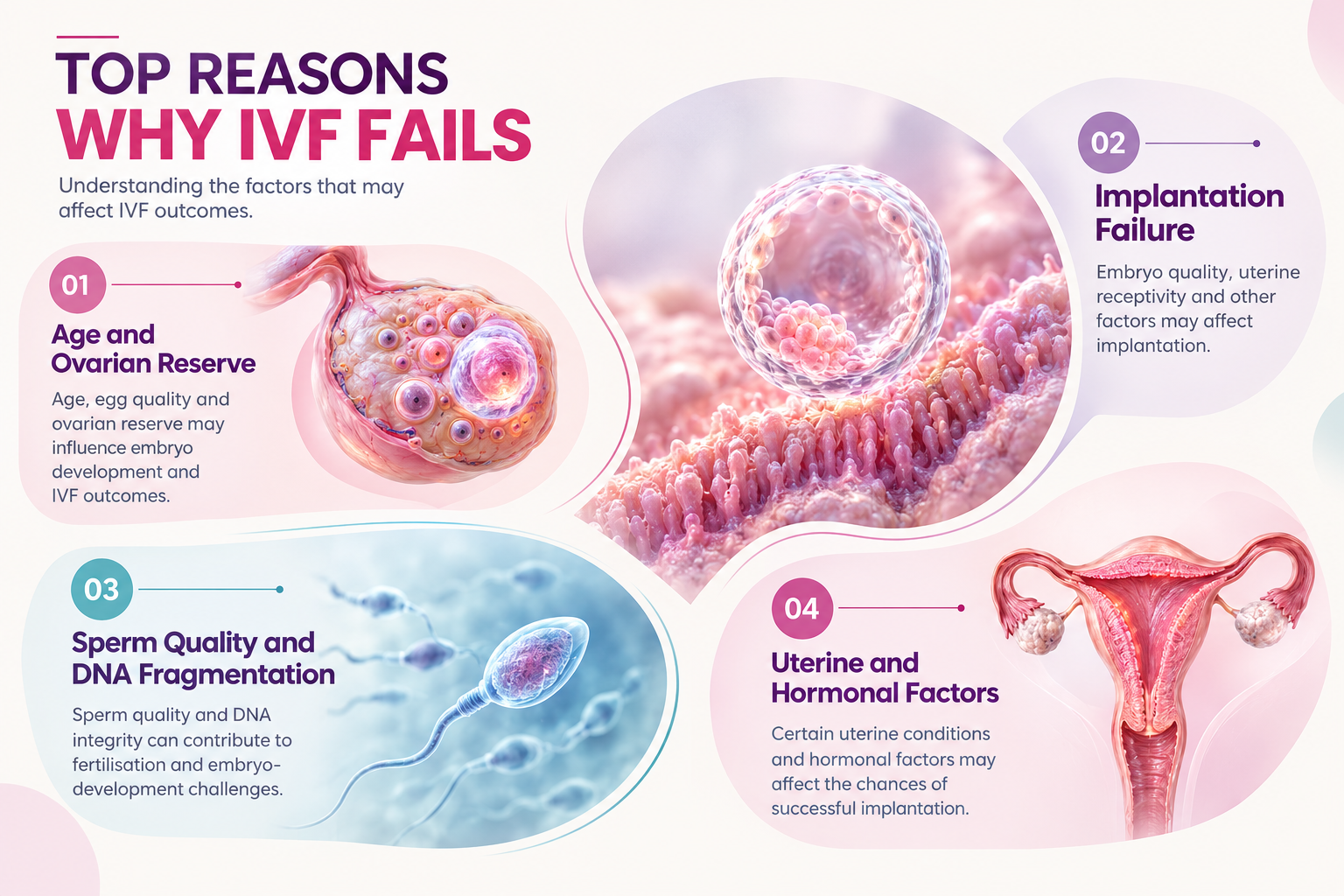
Most often, an IVF embryo fails to implant because of the embryo itself, typically a chromosomal difference that cannot be seen under a microscope. Other reasons include the womb lining or cavity, a mismatch in timing between lining and embryo, sperm-related factors, the transfer itself, and sometimes causes that are never found. One failed transfer is common and does not mean something is wrong with you. A calm, step-by-step review with your fertility specialist is safer than guessing or buying add-on tests.
Call your clinic urgently for severe or one-sided belly pain, heavy bleeding, fainting, fever, or trouble breathing after a transfer. These need prompt care, whatever your pregnancy test shows.
Key takeaways:
After an embryo transfer, the embryo needs to continue developing, interact with the womb lining, attach to it, and begin an early pregnancy. If the pregnancy blood test is negative, the embryo may not have implanted, or its development may have stopped before enough hCG was produced to be detected.
A single failed embryo transfer is common and does not necessarily mean that future transfers will fail. The chance of success depends on several factors, including the embryo, the patient's individual circumstances, the transfer procedure, the laboratory, and the biology of that particular cycle.
The term "recurrent implantation failure" (RIF) is used for a smaller group of patients who experience repeated unsuccessful embryo transfers. However, definitions vary, and no single number of failed transfers applies to everyone. The European Society of Human Reproduction and Embryology (ESHRE) recommends an individualised, probability-based approach rather than a single fixed threshold for all patients.
If you have experienced repeated unsuccessful transfers, your fertility specialist can review your treatment history and discuss which investigations or changes may be appropriate for your situation. Learn more about repeated IVF failure and possible treatment options.
| Cause | What it means |
|---|---|
| Chromosome differences | An embryo can look perfect and still carry the wrong number of chromosomes. This often happens by chance as eggs or embryos form, and becomes more likely with age. |
| Growth stage | Some embryos stall between fertilisation and day 5 or 6. Reaching the blastocyst stage is encouraging, but not a promise. |
| Look and grade | Grading helps select which embryo to transfer first, but it cannot determine genetic health. A lower-grade embryo can implant, while a top-grade embryo may not. |
| Limits of genetic testing | Preimplantation genetic testing does not explain every implantation failure. Mosaic results and biopsy limitations exist, and uterine factors still matter. |
An embryo with a chromosome difference may fail to implant, stop growing early or end in an early loss. This is biology, not something you caused by walking, working, eating or worrying.
Genetic testing should be considered based on age, embryo numbers, medical history, specific genetic indications, cost and appropriate counselling — not out of fear after a single failed transfer.
| Cause | What it means | Usual first step |
|---|---|---|
| Problems in the cavity | Polyps, fibroids that push into the cavity, scar tissue, an unusual womb shape or leftover tissue can interfere with implantation. | Transvaginal ultrasound, followed by further imaging if needed. |
| Thin or slow lining | A lining that stays thin, looks unusual or contains fluid may matter. No single thickness guarantees or rules out implantation. | Review previous procedures, possible infections and the treatment protocol. |
| Endometriosis or adenomyosis | These conditions can affect pelvic anatomy and the womb environment, and their impact varies between women. | Individual assessment based on symptoms and medical history. |
| Fluid or infection | Fluid in the cavity or an untreated infection may change the transfer plan. Chronic endometritis is investigated in selected patients. | Establish the diagnosis before starting antibiotics. |
In a frozen embryo transfer, the womb lining needs to be in sync with the developmental stage of the embryo. Your clinic may review ovulation timing, estrogen preparation, when progesterone was started, the route of administration and any relevant blood test results.
A missed progesterone dose or an unexpected rise in progesterone does not automatically mean the transfer has failed. However, contact your fertility clinic promptly so the team can assess the situation and advise you on what to do next. Learn more about progesterone before embryo transfer.
Even a good-quality embryo may not implant if the embryo's developmental stage and the lining's readiness are out of sync. This is one reason doctors assess transfer timing rather than relying on a single measurement of lining thickness.
Sperm contribute half of an embryo's genetic material. A routine semen analysis may look normal even when other sperm-related factors could influence fertilisation or embryo development. Depending on your medical history, your doctor may review:
Not everyone who experiences a failed embryo transfer needs a sperm DNA fragmentation test. It may be worth discussing in selected situations, such as repeated poor embryo development or recurrent unexplained treatment failures. Before agreeing to the test, ask your doctor: "If this result is abnormal, what would we do differently?" Understanding how the result could influence your treatment can help you decide whether testing is worthwhile.
For further information, read sperm testing and male infertility and the sperm DNA fragmentation test.
An embryo transfer may be technically difficult because of a narrow cervix, the position or angle of the uterus, discomfort or scar tissue. If your transfer was difficult, ask your doctor to review the procedure notes with you.
Depending on your anatomy and previous experience, options for a future transfer may include a practice transfer, ultrasound guidance during the procedure or a different catheter. Your doctor can explain whether any of these approaches would be helpful in your case.
Laboratory processes such as embryo culture, identification, freezing, warming and coordination with the transfer also matter. One unsuccessful transfer does not mean that a laboratory error occurred. However, you should be able to review your embryo report and ask your clinic how it monitors and checks laboratory quality.
Your doctor may review health conditions and lifestyle factors that could affect pregnancy or treatment planning, including:
Testing every immune marker or inherited clotting condition after one failed transfer is not recommended for everyone. Investigations should be guided by your history, clinical findings and whether the results could change your care.
Fertility treatment can be emotionally demanding, but ordinary worry, crying or having a difficult day does not mean you have caused an embryo transfer to fail. You deserve support, not blame.
Getting adequate sleep, eating balanced meals, engaging in gentle physical activity when appropriate and avoiding smoking can support your general health. However, these steps cannot correct an embryo's chromosomal differences or guarantee implantation.
A healthy-looking embryo is only one part of the picture. Implantation also depends on factors such as the readiness of the womb lining, the timing of the transfer, how smoothly the procedure went and the embryo's underlying biology and genetics.
That is why even a highly graded embryo may not implant, and why a clear explanation is not always found after an unsuccessful transfer. Embryo grading describes appearance at a particular time; it cannot guarantee implantation or a live birth.
The decision depends on your age, the number and quality of available embryos, whether genetic testing was performed, your previous transfer history, any pregnancy losses, your scan findings and your preferences.
After one unsuccessful transfer, a routine review may be sufficient. A more structured assessment may be appropriate after repeated unsuccessful transfers, particularly when the embryos had a reasonable chance of success, or when symptoms or abnormal findings suggest a specific problem.
Your fertility specialist can help determine which investigations are relevant rather than recommending every available test. Read more about how doctors investigate failed embryo implantation.
Implantation can fail because of embryo biology, uterine or womb-lining factors, sperm-related factors, transfer difficulties, timing, laboratory factors or causes that are never identified. A single unsuccessful IVF cycle does not automatically mean there is an underlying problem or that every available test is necessary. A step-by-step review with your fertility specialist is safer than self-diagnosis or unproven treatment add-ons.
Discuss your previous cycle, embryo report and possible next steps with your fertility team.
Book an IVF consultationMedical disclaimer: Implantation failure can have many possible explanations, and the cause may remain unknown in an individual case. This article is for educational purposes only. It does not diagnose your condition or recommend a specific IVF add-on. Discuss investigations and treatment decisions with your fertility specialist.
How an embryo looks cannot confirm its chromosomes. Implantation also depends on the lining, timing, transfer, lab and biology, and sometimes no single cause is found.
A lining that stays thin or looks unusual may be associated with lower implantation rates in some women, but there is no universal cut-off. The doctor should look for the cause and read thickness together with pattern and timing.
Yes. Sperm give the embryo half its genes, so male factors can affect fertilisation and growth. Whether extra sperm testing helps depends on your history.
No. One failed transfer is not enough to diagnose RIF. Definitions differ, and the expected chance of success should be considered.
Not automatically. Many immune tests and treatments lack strong evidence for routine use and can carry risks. Ask whether a treatment would change your care.


