After a failed embryo transfer, doctors usually begin by going back over your cycle: the pregnancy test, the embryo report, how the transfer went, your womb and lining, hormone timing, and the sperm results. Further tests are added only when your history or findings point to them. For one failed transfer, a careful review and a plan often matter more than a long list of tests. Be cautious about immune tests, ERA and other add-ons, because they do not suit everyone.
Key takeaways
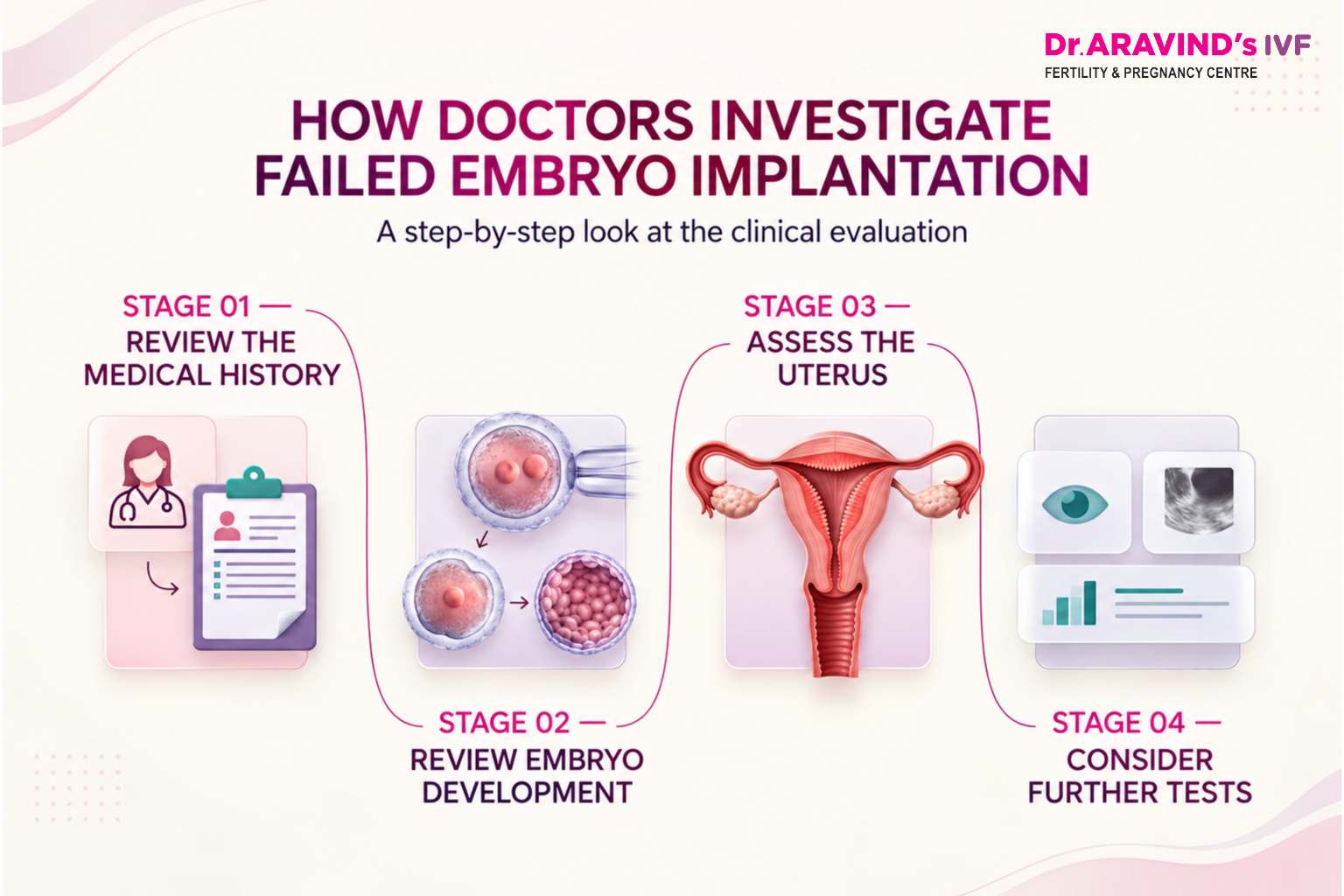
A negative pregnancy test after IVF can be difficult emotionally. Your first follow-up appointment should help you understand what happened without placing blame on you or any one part of your body. Your fertility specialist may review questions such as:
After a single unsuccessful transfer, a careful review of your previous cycle and a discussion about the next attempt may be all that is needed. Additional testing is not automatically better; your medical history should guide investigations and whether the results could change your treatment plan.
To understand the possible reasons for an unsuccessful transfer, read why IVF implantation fails.
| Step | What is looked at | Why |
|---|---|---|
| 1. Confirm the outcome | The beta-hCG result, its timing and any trigger-shot effect | To separate no implantation from a biochemical pregnancy, a loss, a pregnancy of unknown location or an ectopic pregnancy |
| 2. Embryo report | Eggs retrieved and mature, fertilisation, embryo count, day 3 growth, blastocyst, grade, survival after warming, genetic testing, embryos left | To see how the embryos developed |
| 3. Womb and cavity | Ultrasound and earlier imaging, with more if needed | To look for polyps, fibroids, scar tissue, fluid or adenomyosis |
| 4. Lining and timing | Thickness and pattern, estrogen, ovulation or progesterone start, progesterone level where useful | To check lining and embryo were in step |
| 5. The transfer | The transfer note: ease, ultrasound guidance, blood or mucus, catheter check | To see whether it was difficult |
| 6. Sperm information | Semen analysis, fertilisation method, development history | To decide whether more male-factor work-up helps |
| 7. Health and medicines | Thyroid, diabetes, blood pressure, endometriosis, medicines | To make sure conditions are controlled |
| 8. Chronic endometritis | Selected patients only | Never a reason for automatic antibiotics |
| 9. Genetic testing | Selected patients only | Not suitable or needed for everyone |
Your fertility team will first review your beta-hCG result, when the blood test was performed and whether a trigger injection could have influenced an early result. These situations can require different follow-up approaches:
Understanding which situation occurred helps your doctor decide what follow-up is needed and whether further investigations may be useful. Read more about what your first beta-hCG after IVF tells you.
Your embryologist and fertility specialist may review the full embryo development report, including:
If embryos repeatedly stop developing before reaching the blastocyst stage, your doctor may discuss factors such as egg age, sperm-related factors, patterns in embryo development and whether genetic counselling is appropriate. These findings do not, by themselves, prove that eggs or sperm were solely responsible.
For more information, read embryo grading in IVF.
Your doctor may study your latest scan and any earlier imaging. Looking further makes sense if you have symptoms, abnormal findings, past surgery or repeated failures.
| Tool | What it shows | When it is used |
|---|---|---|
| Transvaginal ultrasound | The womb, lining, ovaries, and possible fibroids, polyps, adenomyosis or fluid | Usually the first, simple check |
| Saline infusion sonography | Sterile fluid outlines the cavity during a scan and can show polyps or distortion | When a routine scan isn't clear enough |
| Hysteroscopy | A thin camera looks inside the cavity | When imaging suggests a polyp, scar, fibroid or other problem. Not needed for everyone after one failed transfer |
| MRI or specialised scans | Adenomyosis, complex fibroids or differences in womb shape | When these need clearer answers |
Your fertility team may review the thickness and pattern of your womb lining, estrogen preparation, ovulation timing, when progesterone was started, and progesterone blood levels when clinically useful. They may also check for fluid or bleeding around the time of transfer and review any history of a thin endometrium.
No single lining thickness predicts the outcome for every patient. Your doctor may recommend adjusting the treatment protocol or addressing a specific problem, but should explain the expected benefits, limitations and supporting evidence for any proposed change.
Learn more about endometrial preparation for frozen embryo transfer (FET) and progesterone before embryo transfer.
Your doctor may review the transfer notes to understand whether the catheter passed easily, whether ultrasound guidance was used, whether blood or mucus was present, and whether the catheter was checked after the procedure.
If the transfer was technically difficult, your doctor may consider options such as:
An easy transfer does not guarantee implantation, and a difficult transfer does not automatically mean it caused the failure. Any changes should be based on the findings from your procedure and your individual needs.
To understand the procedure in more detail, read about the embryo transfer catheter.
Your fertility specialist may review the semen analysis, the fertilisation method used, and sperm count, movement and shape. Depending on your embryo development history, additional male-factor investigations or genetic counselling may be considered.
Sperm DNA fragmentation testing, varicocele assessment, and similar investigations are most useful when the findings could influence treatment decisions. A normal semen analysis does not assess every aspect of sperm function, while an abnormal result does not mean successful implantation is impossible.
For more information, read sperm testing and male infertility.
Your doctor may review whether existing conditions, such as thyroid disease, diabetes, high blood pressure, endometriosis or adenomyosis, are appropriately managed. They may also check your current medicines and supplements to determine whether any changes are needed before another treatment cycle.
Broad testing panels can sometimes produce unclear or incidental findings that lead to unnecessary treatment. Investigations should therefore be guided by your symptoms, medical history and clinical assessment rather than ordering every available test routinely.
Chronic endometritis is inflammation of the womb lining. In selected patients, particularly those with repeated unsuccessful implantation or recurrent pregnancy loss, a specialist may consider testing using an endometrial sample and laboratory markers such as CD138, depending on local practice and the clinical situation.
This diagnosis does not mean antibiotics should automatically be started. If testing is recommended, ask your doctor about its limitations, how the result would be interpreted and what treatment would follow if the findings were positive.
Preimplantation genetic testing for aneuploidy (PGT-A) may be discussed in selected situations, depending on factors such as age, pregnancy-loss history, embryo development and genetic risk. It is not necessary or appropriate for every patient, and it cannot identify every possible cause of failed implantation.
Before deciding, ask your fertility specialist to explain:
The decision should be individualised, with a clear discussion of the potential benefits, limitations and alternatives before proceeding.
After a failed transfer, many people meet ads for immune testing, NK-cell tests, cytokine panels, intralipids, steroids, antibiotics, heparin, receptivity tests and large clotting panels. Many of these are not recommended for everyone, because the evidence is limited, results may not predict implantation, and some treatments carry risks or high costs.
Use these questions with every test your clinic suggests:
| Ask your specialist | Why it matters |
|---|---|
| Why is this test being considered for me? | To check there is a genuine clinical reason |
| What does a positive or negative result mean? | So you know what you will learn |
| Would the result change my treatment? | If not, the test may add nothing |
| What are the risks and costs? | So you can weigh them |
| Do professional guidelines support it? | To avoid unproven treatment |
A more detailed evaluation may be considered after repeated transfers of embryos with a reasonable expected chance of implantation, or when your medical history includes abnormal imaging findings, repeated pregnancy losses or significant symptoms. Your expected chance of success matters more than simply counting the number of unsuccessful attempts.
The investigation plan should be tailored to your circumstances. For example, an older patient who has had one transfer of an untested embryo may need a different review from someone who has undergone several transfers of genetically tested embryos. Your fertility specialist can help determine which factors deserve closer attention and which tests are likely to be useful.
For more information about possible next steps, read repeated IVF failure and treatment options.
After reviewing your previous IVF cycle, you should receive a clear plan that explains the findings, the available options and the reasons for each recommendation. Ideally, the plan should separate:
You should feel comfortable asking questions and understanding why a particular test or treatment has been recommended. A second opinion is reasonable if the advice remains unclear or if several costly add-ons are being suggested without a clear explanation of their potential benefits.
Doctors investigate an unsuccessful embryo transfer by reviewing the pregnancy test results, embryo development, womb cavity, uterine lining, hormone timing, transfer procedure, sperm-related factors and your medical history. The safest approach is staged and evidence-based, rather than automatically including every available commercial test or treatment add-on.
Discuss your previous transfer, available reports and appropriate next steps with your fertility specialist.
Book an IVF consultationMedical disclaimer: The appropriate evaluation depends on your medical history, previous treatment and clinical findings. This article does not recommend a fixed package of tests and should not be used to select investigations or treatment without guidance from a qualified fertility specialist.
Doctors usually begin by reviewing the cycle, embryo report, transfer, womb scans, lining, hormone timing, and sperm information. Further tests are chosen from what they find and your history.
Not automatically. It can help when symptoms, abnormal imaging, past surgery, or repeated failure give a reason. Ask what it is expected to find and how the result would change your treatment.
Not for everyone. Evidence and recommendations differ, so ask your doctor whether it suits your history.
Routine immune testing and immune treatments are not advised for everyone. Ask for the evidence, the risks, and how a result would change your plan.
Sperm give the embryo half its genes, so male factors can affect development. Whether more testing helps depends on the semen analysis, fertilisation results, and embryo history.


