The path to becoming a parent resembles a marathon race, but people who experience Recurrent Implantation Failure (RIF) must navigate their journey through life as an uphill marathon which takes place during night time. In Vitro Fertilization (IVF) serves as the primary standard for assisted reproductive technology, but actual results show that the procedure fails to achieve pregnancy during the initial three attempts.
The team at Dr. Aravind's IVF Center regards multiple unsuccessful attempts as a reason for conducting more thorough investigations. The failure of standard procedures to produce results shows that there exist hidden biological obstacles which need to be resolved. This guide provides complete insights for couples who have encountered difficulties, explaining the reasons behind IVF failure and describing specialized clinical solutions.
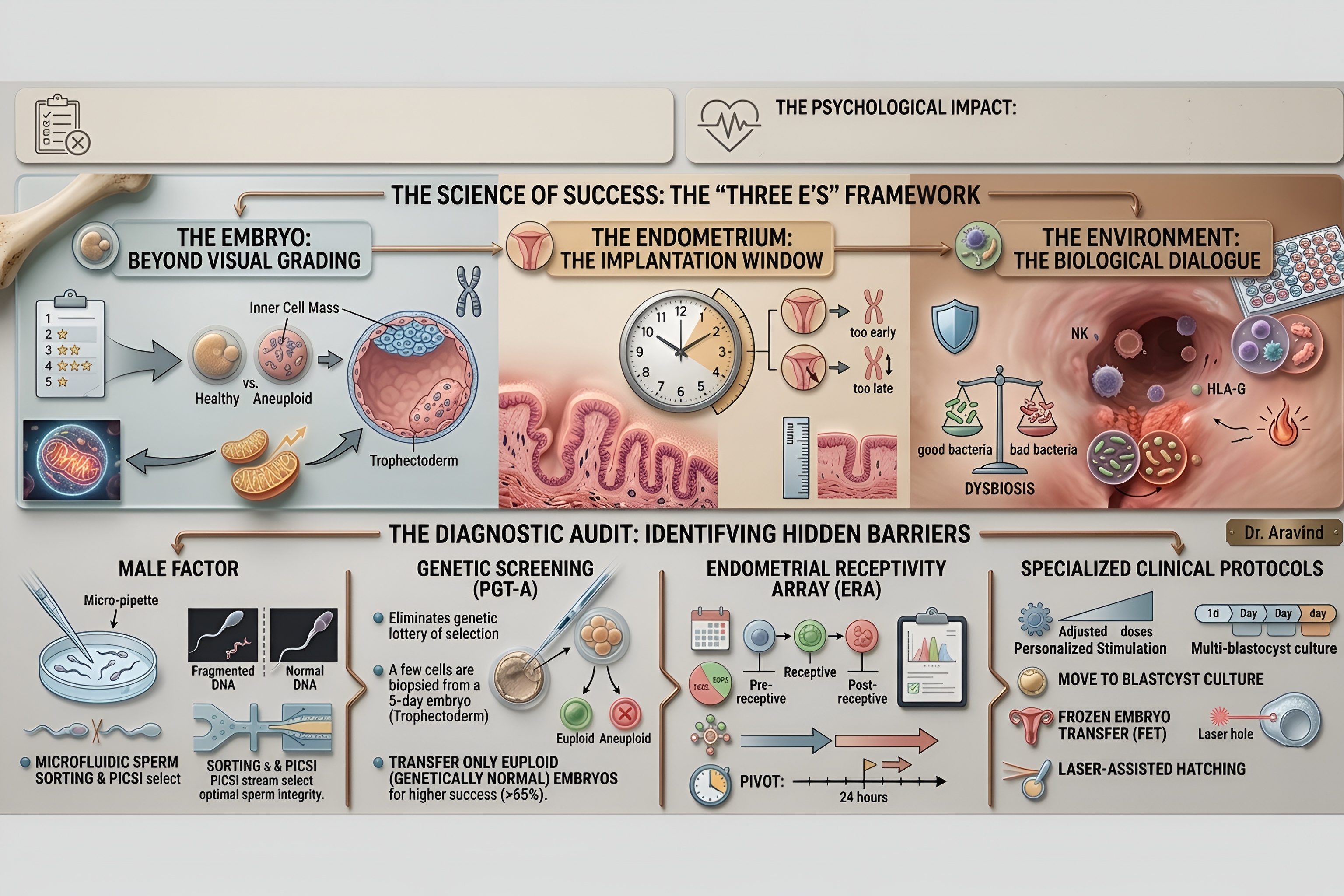
The solutions need to be solved after we first explain the existing problem. Recurrent Implantation Failure exists when a patient fails to achieve a clinical pregnancy after undergoing three IVF cycles which included high-quality embryo transfers.
The statistics indicate that most patients will achieve pregnancy after three cycles yet RIF will affect approximately 10% to 15% of couples. This knowledge allows us to change our thinking from asking "Why did I fail?" to determining which biological factor scientists have not yet recognized.
The "unexplained" nature of repeated failure creates a greater burden for us than the actual physical medical procedures. We achieve our intended results by combining emotional resilience with clinical precision to create a recovery period which enables both biological and psychological healing during the "Strategic Pause" that occurs between treatment cycles.
A successful pregnancy requires perfect timing in all biological processes. The success factors for our study exist as three main pillars which include The Embryo (The Seed) and The Endometrium (The Soil) and The Environment (The Climate).
The standard process of embryo evaluation in IVF laboratories relies on visual assessment of their developmental stage. The "Grade A" designation for an embryo does not prevent the embryo from having "Aneuploid" genetic status which results in incorrect chromosome counts.
The uterine lining allows embryo implantation to occur only during a specific time period which lasts between 12 and 48 hours. The Window of Implantation (WOI) serves as a designated time framework for this process.
The uterus functions as an active immune system rather than a dormant vessel. The body's immune response needs to decrease its activity level because the body must accept an embryo that contains 50 percent foreign paternal DNA.
The centers of our organization conduct a "Diagnostic Audit" test after every cycle that experiences a complete failure. This study requires multiple data sources to conduct an evaluation that exceeds typical blood examinations.
The standard semen test evaluates sperm through three measurements which include count and movement and shape assessment. The test does not assess the DNA preservation within the sperm head. High Sperm DNA Fragmentation (DFI) leads to low embryo quality which results in "arrested development" on Day 3. We use Microfluidic Sperm Sorting and PICSI (Physiological Intracytoplasmic Sperm Injection) methods to identify sperm that possesses optimal DNA integrity.
The development of a specific protocol occurs after we finish the audit process. The medical staff at Dr. Aravind's IVF center creates unique treatment plans for each of their patients.
Most clinics perform embryo transfers at Day 3 according to current medical standards. However, many embryos that look good on Day 3 fail to make it to Day 5. By waiting for the Blastocyst stage to reach development we enable the process of natural selection to happen. The strongest embryos reach this stage, which allows us to determine their viability better.
Research shows that estrogen levels which rise during an egg retrieval cycle create conditions that make the uterine lining "hostile" by disrupting its natural cycle. We use Freeze-All Strategy to freeze our embryos until the body achieves its normal hormonal state.
The Benefit: The chances of success increase when doctors transfer embryos into a "natural" uterus which has been hormonally prepared during the following month.
An embryo needs to break through its outer protective layer which scientists call the zona pellucida in order to achieve implantation. The thick shell prevents hatching from occurring in some cases when frozen embryos are tested or when women reach advanced maternal age. We use a high-precision laser to create a microscopic thinning in the shell, assisting the embryo in the hatching process.
This condition exists as a silent uterine lining inflammation which common bacteria strains cause to develop. The condition exists without visible signs yet it functions as "weeds" that develop in soil. Targeted antibiotics which testing showed effective through CD138 biopsy testing can help couples achieve pregnancy after multiple years of unsuccessful attempts.
The time that exists between operational periods holds equal importance to the actual operational period. The 4-to-6 week period serves as the time frame which we use to enhance your biological core.
The Gold Standard for Diagnostic Hysteroscopy before a repeat attempt exists as the diagnostic standard for medical professionals. The doctor uses this method to create a visual representation of the uterus through its complete interior structure. The procedure enables us to eliminate small polyps, repair T-shaped uterine defects and remove scar tissue from Asherman’s Syndrome which ultrasound failed to detect.
The diagnosis of "infertility" remains unconfirmed since repeated IVF failures create an overwhelming burden. The condition exists as "Unsolved Variables" which require explanation.
All IVF processes at Dr. Aravind's IVF facility reach success because we refuse to accept standard solutions. The combination of Advanced Genetic Screening and Precision Implantation Timing with Holistic Metabolic Preparation enables us to transform your three E's from obstacles into your most powerful resources.
We invite you to experience our unique form of care which combines data analysis with empathetic understanding and uses all failed attempts as learning opportunities to create successful outcomes.
You have not changed your dream but our team will modify our approach to reach it.
The definition of RIF states that it describes the condition wherein a woman fails to achieve pregnancy after three IVF cycles which used high-quality embryos for transfer.
The process of IVF can lead to repeated failures because of several factors which include chromosomal abnormalities and poor uterine receptivity and immune issues and sperm DNA damage.
The answer is yes because the success rates of advanced techniques PGT-A and ERA testing and personalized protocols show significant improvement.
The ERA test identifies the exact window of implantation to optimize embryo transfer timing.
The use of PGT-A enables the selection of genetically normal embryos which results in higher implantation rates and lower miscarriage rates.


