First published [14/10/2026]
Embryo development day by day follows a pattern. The egg is fertilised on day 0 and checked on day 1. It then divides into 2 to 4 cells on day 2, around 6 to 8 cells on day 3, compacts into a morula on day 4, and may form a blastocyst on day 5, 6 or occasionally 7. Not every embryo completes every step, and the timeline is a general guide rather than a promise.
Key takeaways
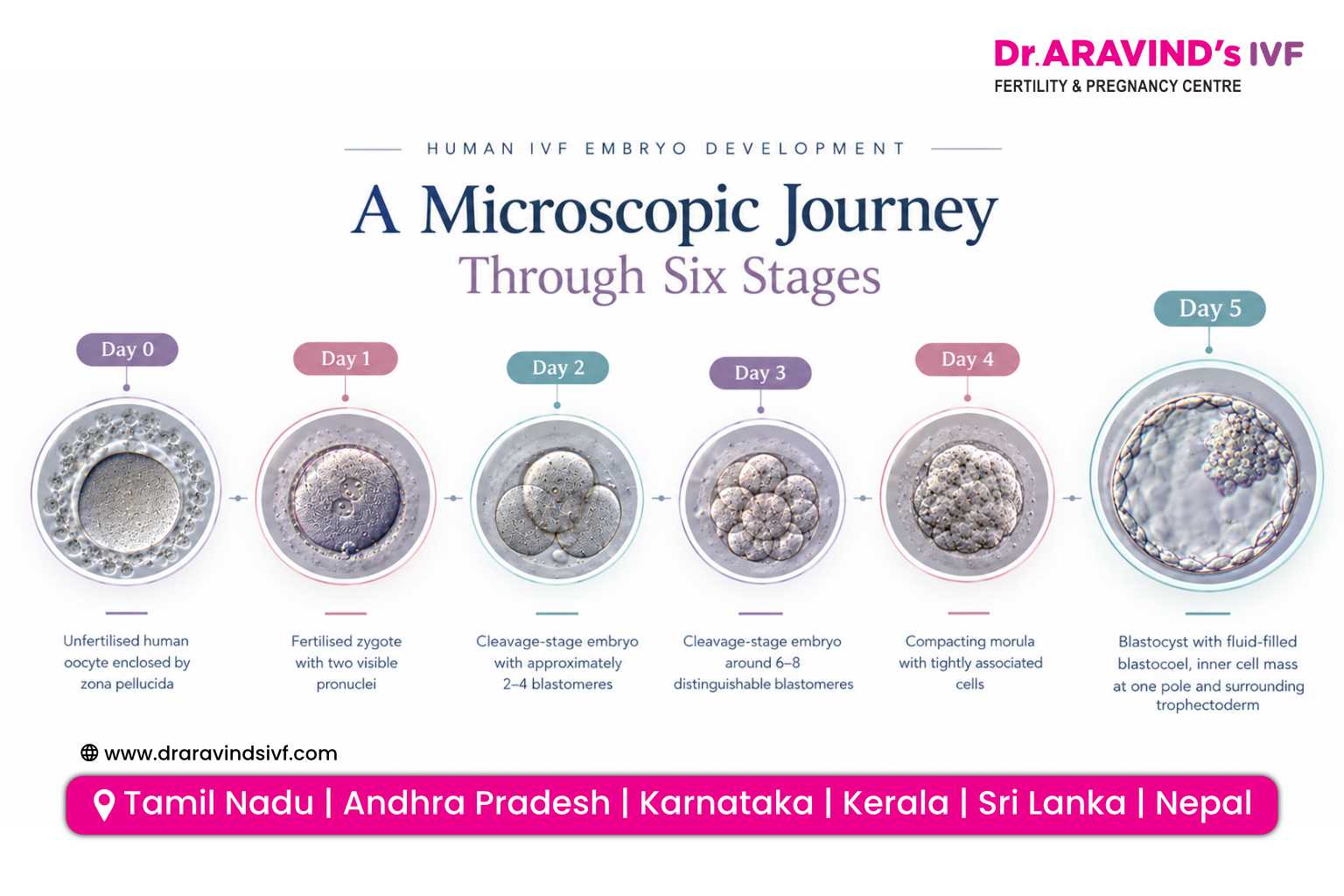
After egg retrieval and fertilisation, the embryo stays in the embryology laboratory while it divides. The embryologist watches its growth, its cell divisions and its overall appearance as it heads toward the blastocyst stage.
Not every fertilised egg gets as far as day 5 or 6. That drop is expected, and it is one reason the number of eggs collected is higher than the number of embryos available for transfer. See the fertilisation rate in IVF for how the numbers narrow.
On the day of retrieval, the team identifies the eggs and checks which are mature. Mature eggs are then fertilised either by placing prepared sperm with them or, in ICSI, by injecting one sperm into each suitable egg. The choice rests on the sperm results, earlier cycles, the number of mature eggs and your plan.
Until fertilisation has taken place, the embryologist does not call a retrieved egg an embryo.
The first big update is the fertilisation check. A normally fertilised egg usually shows two pronuclei, one from the egg and one from the sperm. At this point it is called a zygote. It is not yet a day 3 embryo or a blastocyst.
Some eggs show abnormal fertilisation, no fertilisation, or a result that needs another look. A day 1 report often lists:
The zygote starts to divide, and the new cells are called blastomeres. By day 2 there may be roughly two to four of them, although embryos do not all keep exactly the same clock.
The embryologist may note the cell number, how even the cells look and any fragments. That appearance is useful, but it cannot say which embryo will implant. Many labs limit handling at this stage, so how much you hear on day 2 depends on the clinic.
By day 3, an embryo often has about six to eight cells, though a range is possible. The lab may review:
Some clinics transfer or freeze embryos at this cleavage stage, while others keep them in culture toward day 5 or 6 when that suits the case. An embryo that looks promising on day 3 may still stop, and one that looks less ideal can sometimes continue, so day 3 appearance is not a measure of genetic health.
Around day 4, the cells squeeze together and the embryo may become a morula. Single cells are harder to tell apart as the structure changes. This is the bridge between the cleavage stage and the blastocyst, and the embryo's own genes are increasingly switched on.
Because the embryo is changing so fast, many labs avoid disturbing it, which is why there is often no routine call on day 4.
By day 5, some embryos have become blastocysts. A blastocyst has a fluid-filled cavity and two groups of cells:
A blastocyst may be graded by how far it has expanded and how the inner cell mass and trophectoderm look. A grade describes appearance, not the chance of implantation, normal chromosomes or live birth. For more, see what is a blastocyst and embryo grading in IVF.
Bring your day-by-day updates to a consultation and our team will explain each stage and your transfer options.
Book an IVF consultationSome healthy embryos take until day 6 to reach the blastocyst stage. They can be assessed, frozen or used for the next planned step according to the clinic's protocol. Day 6 does not make a blastocyst automatically inferior to day 5. The day is one part of the picture, alongside grade, expansion, your age and your transfer plan.
A smaller group continues to day 7, and policies differ on whether such embryos are frozen or tested, since not every laboratory cultures that long. A day 7 result can be hard to hear, but the key question is whether a suitable embryo is available, not the day it formed.
Embryos can stop for several reasons, including chromosomal differences, egg or sperm factors, problems at fertilisation or ordinary biological variation. Laboratory and patient factors may also be reviewed.
Often the exact reason cannot be proven from appearance alone. Be wary of anyone who promises that a single supplement, add-on or procedure will prevent this in every future cycle.
Embryo grading is a visual assessment. For cleavage-stage embryos, the lab may look at cell number, symmetry, and fragmentation. For blastocysts, it may describe expansion, the inner cell mass, and the trophectoderm.
Grading helps the team decide which embryo to prioritise, but it is not a genetic diagnosis. If genetic testing is suggested, your doctor should explain why, along with its limits, cost, and possible results.
A blastocyst can be transferred during the same IVF cycle or frozen for a later frozen embryo transfer. The decision depends on factors such as hormone levels, the womb lining, the risk of ovarian hyperstimulation syndrome (OHSS), genetic testing and your individual medical plan.
After IVF, an embryo moves from fertilisation and the zygote through cleavage and compaction to a blastocyst. Not every fertilised egg completes the journey, and a day 5, 6 or 7 result must be read alongside the embryo's grade and your own treatment plan.
For the earlier numbers, read about the fertilisation rate in IVF and IVF egg maturity, or why IVF eggs fail to fertilise.
Ready to talk about transfer options? Book a consultation at Dr. Aravind's IVF Fertility & Pregnancy Centre to go through your embryo reports.
Medical disclaimer: Embryo growth varies. This timeline is a general explanation and cannot predict the outcome for any one embryo or pregnancy.
Most that get there do so around day 5 or day 6 after fertilisation. A smaller group takes until day 7, and others stop growing before reaching this stage.
Not automatically. The day is read together with the grade, the expansion, the look of the inner cell mass and trophectoderm, your age and any genetic-testing plan.
It means two pronuclei were seen at the fertilisation check, one from the egg and one from the sperm, which is usually taken as a sign of normal fertilisation.
Some do continue to day 5, 6 or 7, and others stop. The lab watches and reports, but it cannot promise the next stage.
No. A grade describes how an embryo looks. It cannot confirm that the chromosomes are normal, and genetic testing has its own benefits and limits.


