The path to conception becomes easier for women with Polycystic Ovary Syndrome (PCOS) when they establish connections with other women who experience identical challenges. PCOS stands as one of the most prevalent hormonal disorders that affects women during their reproductive years and currently affects between 8 and 13 percent of women throughout the world. This article guides how to increase fertility with PCOS
Women who want to conceive a child or grow their family face an overwhelming experience when they receive a PCOS diagnosis, yet they need to understand that PCOS will not stop them from getting pregnant. Through the combination of medical advice and lifestyle modifications, along with their fertility treatments, most women with PCOS will successfully attain pregnancy and deliver healthy babies.
The medical team at Dr. Aravind's IVF Fertility & Pregnancy Centre, a best fertility clinic in Chennai, has dedicated their expertise to reproductive medicine for over 20 years with PCOS-related infertility. The guide explains all details that help women with PCOS to enhance their fertility through their understanding of hormonal issues and the available medical and lifestyle solutions.
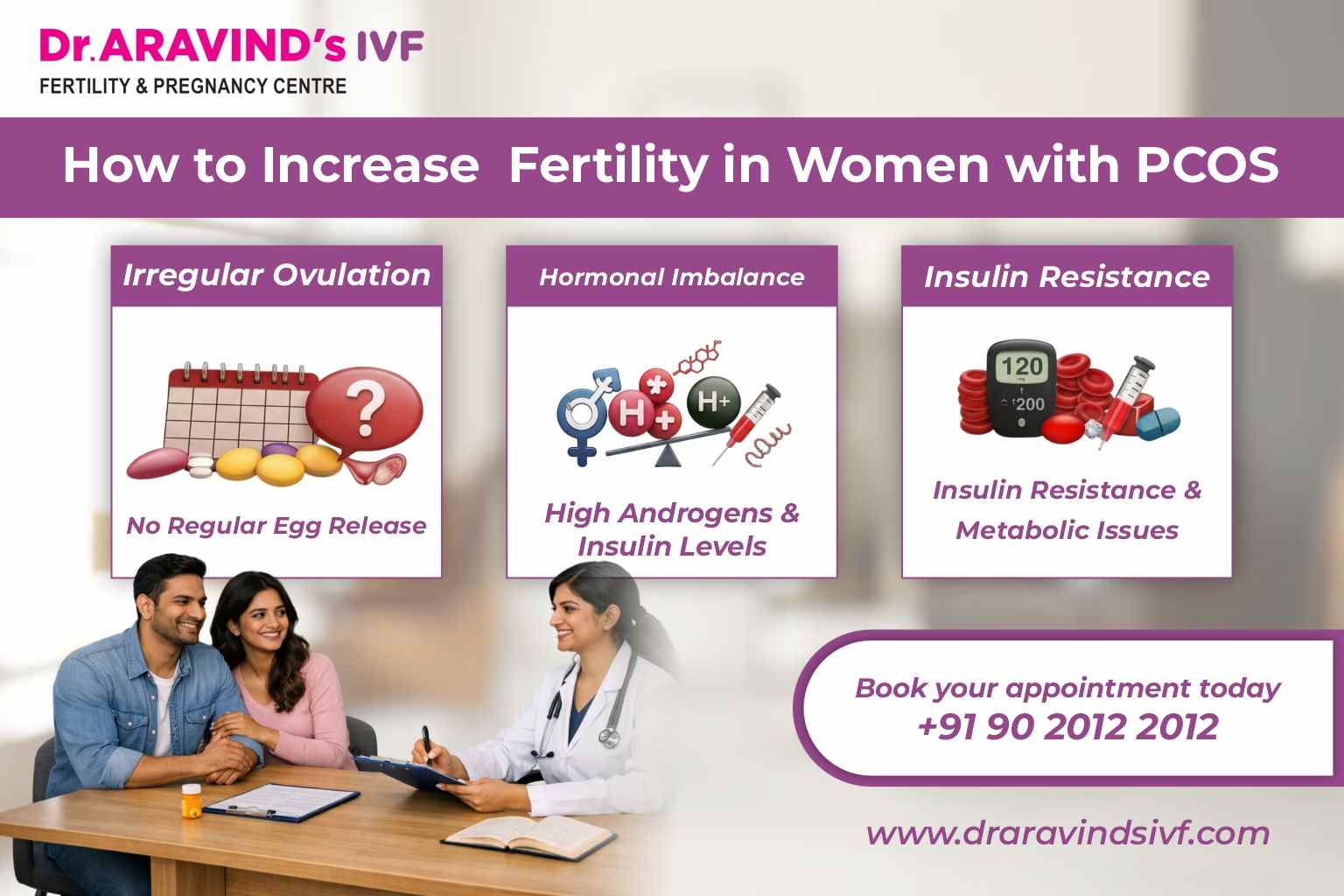
Before proceeding to solutions, PCOS-related fertility issues need explanation. PCOS describes a hormonal disorder that leads to elevated androgen production and results in irregular menstrual cycles and the development of multiple ovarian cysts. The body experiences disruptions because of hormonal changes, which stop it from executing its regular monthly ovulation cycle that requires a mature egg for conception.
PCOS creates three main obstacles that prevent people from achieving their reproductive goals:
The good news is that all three of these challenges are addressable. The current PCOS and pregnancy treatment methods enable fertility specialists to assist women in achieving pregnancy through personalized care, which produces successful outcomes.
The foundation of any fertility journey with PCOS is an accurate, detailed diagnosis. The condition of PCOS infertility presents different symptoms in various patients. Some women experience irregular cycles, yet they still manage to ovulate during particular times, while other women have stopped ovulating for extended periods. Some women demonstrate extreme insulin resistance, while others exhibit only minor increases in androgen levels. Your optimal treatment approach will depend on your unique hormonal patterns and medical background.
A comprehensive assessment at a fertility clinic will generally involve these components:
The first treatment for women with PCOS should begin with lifestyle changes before any medications or assisted reproduction methods become necessary. Research shows that people who make small dietary and exercise changes together with weight management will achieve better results for natural conception through restored ovulation.
For women with PCOS who are overweight, losing 5 to 10 percent body weight will lead to successful ovulation restoration in most patients, according to clinical research evidence. The presence of excess body fat creates a situation where insulin resistance increases, which leads to higher androgen production and interferes with the hormonal signals necessary for ovulation. Even slight weight reduction results in decreased insulin production, which enables the body to process its reproductive hormones better.
The existence of lean PCOS as a recognized phenotype proves that not all women with PCOS fall into the overweight category. The process requires dietary quality improvements not caloric intake restrictions, to achieve better insulin sensitivity and hormonal control in these instances.
Diet serves as a critical factor that enables people with PCOS to control their symptoms and achieve better results in their efforts to conceive. The low glycaemic index (GI) diet, which maintains stable blood sugar levels throughout the day, serves as a direct solution to the insulin resistance that requires PCOS infertility treatment in most cases.
The regular practice of physical exercise helps PCOS women to improve their insulin sensitivity, manage their body weight and reduce their androgen production. The most effective approach combines moderate-intensity aerobic exercise with resistance training. People need to complete 150 minutes of moderate exercise each week. Very high-intensity exercise without rest periods aggravates cortisol levels and hormone imbalance in certain PCOS patients who require proper exercise balance according to their needs.
Manage Stress
Chronic stress raises cortisol levels, which leads to increased hormonal imbalances in people who have PCOS. The practices of yoga, mindfulness meditation and adequate sleep, which require 7 to 9 hours of sleep each night, together with reduced workload needs, serve as both wellbeing recommendations and clinical guidelines for women with PCOS who want to become pregnant. The mind–body connection in reproductive health is real and significant.
The majority of women with PCOS achieve natural conception through lifestyle changes, which help them restore their ability to ovulate. Medical professionals should use medical treatment as their next option after three to six months of dedicated lifestyle changes when their patient experiences continuing irregular cycles or other medical conditions.
Metformin functions as an insulin-sensitizing drug that doctors frequently prescribe to treat PCOS symptoms. The drug improves insulin response in the body, which leads to reduced androgen production, menstrual cycle control and successful natural ovulation for many women. Doctors usually recommend Metformin as their initial medication choice when they need to treat women with severe insulin resistance who have not achieved results from lifestyle modifications. The treatment is often used together with ovulation-induction drugs because it enhances their treatment outcomes.
Letrozole (Femara) has become the primary treatment for inducing ovulation in patients with PCOS. The treatment operates by reducing oestrogen levels, which results in increased FSH secretion from the pituitary gland, leading to follicle maturation. The PPCOS II trial and various other clinical studies have shown that letrozole produces better results for ovulation and live birth rates than clomiphene citrate in women with PCOS. The medication needs to be taken between days 3 and 7 or 5 and 9 of the menstrual cycle while doctors check follicle development through ultrasound.
Clomiphene (Clomid) served as the primary treatment for inducing ovulation in women with PCOS for several decades. While it remains in use today, letrozole has largely superseded it as the preferred first-line agent because it delivers better treatment results for patients with PCOS. The oestrogen receptors in the brain function as Clomiphene's binding target because it activates FSH production through this mechanism. Some women respond well to clomiphene treatment, especially when they cannot use or take letrozole.
Clinicians use injectable gonadotrophins (FSH or LH injections) when women fail to achieve pregnancy after multiple cycles of using oral medications to induce ovulation. The more potent stimulants require ultrasound monitoring to prevent patients with PCOS from experiencing hyperstimulation, which represents a known risk and to prevent multiple pregnancies. The medical procedure requires close specialist observation during its entire process.
The medical condition requires assisted reproductive technology as the primary treatment method when patients have failed to conceive through ovulation induction and timed intercourse, and intrauterine insemination IUI after completing multiple treatment cycles, while showing additional medical issues, which include blocked tubes and critical male fertility problems and age-related conditions.
The procedure connects with low-dose ovulation induction to enhance timing and boost the number of mature eggs that doctors can use. IUI offers couples with PCOS who have normal sperm quality and functional tubes an effective treatment option that costs less than IVF and serves as a useful step between basic treatments and advanced assisted reproductive technology.
IVF serves as the most effective fertility treatment, which delivers high success rates to women who have PCOS. The IVF process begins with ovarian stimulation that produces multiple eggs, which laboratory technicians fertilize with sperm to create embryos, which they transfer into the uterus. Women with PCOS show strong responses to ovarian stimulation, which creates two different results. PCOS patients develop multiple follicles, which provide embryologists with sufficient embryos to create their process. PCOS patients face increased danger of developing Ovarian Hyperstimulation Syndrome (OHSS), which stands as a serious health risk.
To manage this risk, modern IVF protocols for PCOS patients often use:
The IVF success rates at Dr. Aravind's IVF clinic show our clinical expertise and dedication to patient safety, which we demonstrate through our 70,000+ IVF cycles that produced a 75% live birth success rate. The fertility specialists and embryologists at our centre create personalized stimulation programs for PCOS patients who need individual treatment.
ICSI represents a specialized IVF method that involves direct sperm injection into a mature egg. The procedure becomes necessary when a male partner shows decreased sperm production, movement and physical appearance of spermatozoa while his partner suffers from PCOS-related female infertility. Dr. Aravind's IVF centre provides ICSI as part of its complete fertility treatment services because ICSI delivers maximum success rates for fertilization.
The process of enhancing fertility for people with PCOS requires examination of factors beyond their ovarian function. A complete solution requires assessment of multiple health conditions, which together affect your capacity to become pregnant despite having restored normal ovulation.
Women with PCOS experience a higher frequency of thyroid disorders, which include both hypothyroidism and hyperthyroidism. The abnormal operation of thyroid glands prevents successful ovulation and implantation, and early pregnancy development. The evaluation of PCOS-related infertility requires a TSH test, which needs to be done alongside thyroid level testing that should be treated until TSH levels fall below 2.5 mIU/L for fertility treatment to start.
The results of research studies show that vitamin D deficiency affects most women with PCOS, which leads to higher insulin resistance, disrupted menstrual cycles and lower IVF success rates. The process of vitamin D supplementation should aim for serum levels between 50 and 80 ng/mL because this method provides an effective way to enhance fertility, which many people do not notice.
Women who want to become pregnant need to begin taking a daily folic acid supplement of 400 micrograms three months before they plan to conceive. Folic acid significantly reduces the risk of neural tube defects in early foetal development. The best nutritional foundation for women who plan to conceive exists in a complete prenatal vitamin that contains folic acid, iron, omega-3 DHA, iodine, and vitamin D.
The process of achieving pregnancy requires different time periods because it depends on your PCOS severity, your age, your partner's fertility and your treatment response.
Women with mild to moderate PCOS who make significant lifestyle changes and start proper medical treatment have a 6 to 12 month window for achieving pregnancy. The success rates of IVF for PCOS patients show positive results, but women with complex PCOS who have attempted for an extended period need IVF as their only solution. The IVF process for women with PCOS results in more egg production, which leads to increased embryo options for transfer and freezing.
The emotional dimension of this journey deserves acknowledgement, too. The process of trying to conceive with PCOS creates an unpredictable path because every month brings new disappointments and excessive anxiety, which leads to worse hormonal functioning. The complete medical services and emotional counselling, plus compassionate support at Dr. Aravind's IVF centre serves patients who require assistance throughout their entire fertility process.
Dr. Aravind’s IVF Fertility & Pregnancy Centre assists women with PCOS who seek guidance and need a customized approach to their journey toward parenthood. The best IVF centre for PCOS in South India, our facility, offers more than 20 years of combined expertise and advanced laboratory equipment, which we use to assist PCOS patients in achieving successful pregnancies.
Our centres provide expert fertility care to patients throughout Tamil Nadu, Karnataka, Kerala, Andhra Pradesh and Sri Lanka because of their multiple locations. People search for PCOS fertility specialists near me with clear and cost-effective treatment options, which include continuous support and personalized care from our medical team who treat each patient as a unique individual.
Yes, many women with PCOS can conceive naturally, especially with lifestyle changes like weight management, healthy diet, and regular exercise.
Treatment depends on individual cases but commonly includes lifestyle changes, ovulation induction medications like letrozole, and sometimes IVF.
PCOS disrupts hormonal balance, leading to irregular or absent ovulation, making it harder to conceive.
Yes, studies show letrozole often has higher ovulation and pregnancy success rates compared to clomiphene in women with PCOS.
Yes, losing even 5–10% of body weight can restore ovulation and improve chances of pregnancy in overweight women with PCOS.


