Not really. A high AMH (anti-Müllerian hormone) tells your doctor that many small follicles are available, so your ovaries may react strongly to IVF injections. It says nothing reliable about egg quality, and it doesn't promise a pregnancy. It often appears alongside PCOS and can raise the chance of OHSS, so the stimulation plan is usually adjusted with extra care.
Key points
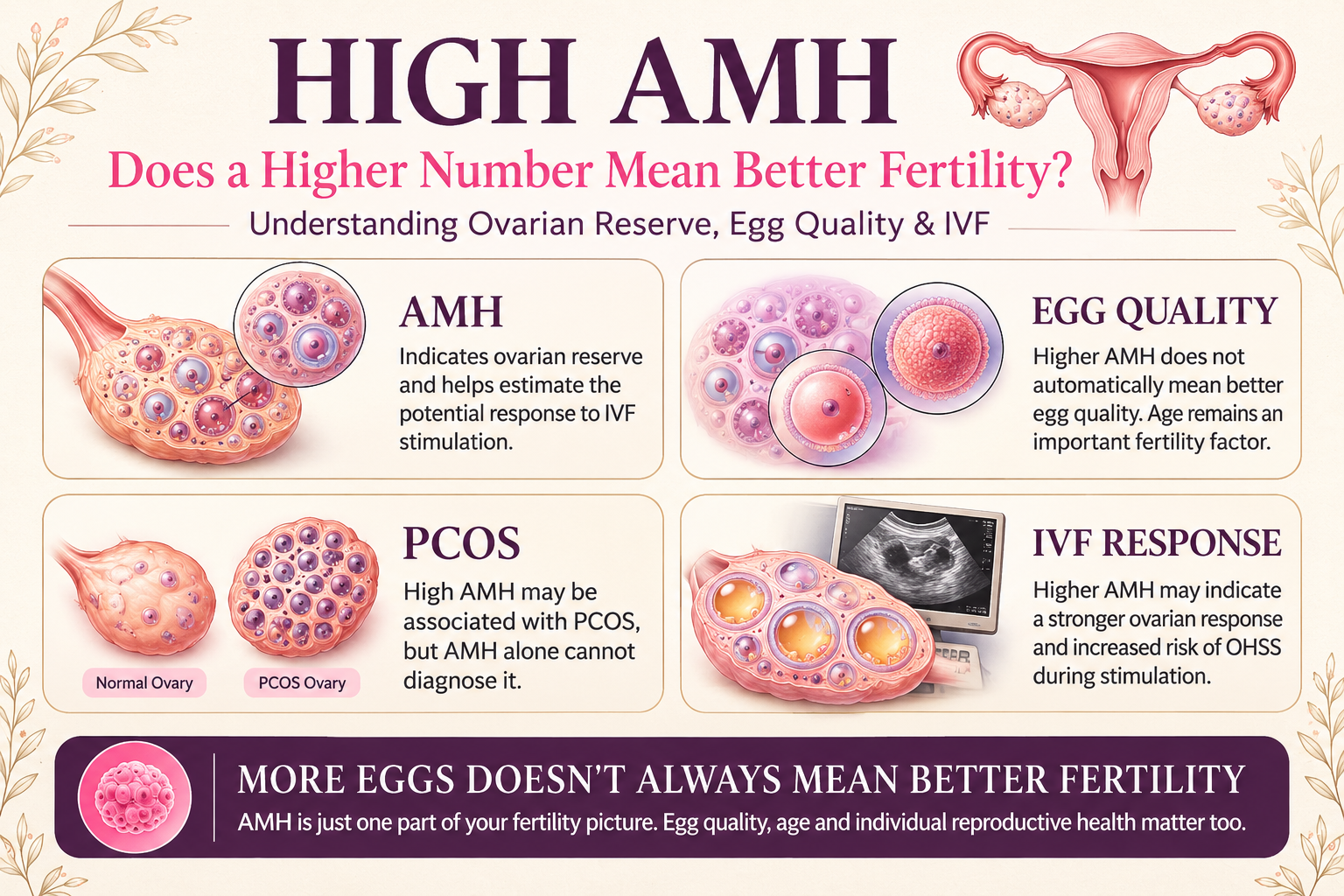
AMH is a hormone released by the tiny follicles growing inside your ovaries. A simple blood test picks it up, and the amount loosely tracks how many of those follicles stimulation could call into action. Fertility teams use it mostly to forecast how you'll respond to IVF injections and to pick a sensible starting dose.
What it can't do is assess egg quality, check embryo chromosomes, or tell you how easily you'd conceive without treatment.
No single number applies to everyone. Labs use different assays and report in either ng/mL or pmol/L, and AMH naturally falls as you get older. As a rough guide for teaching purposes only, clinics often group results like this:
| AMH (approximate, ng/mL) | Common description |
|---|---|
| Under about 1.0 | May be on the low side |
| About 1.0 to 3.5 | Frequently seen |
| Over about 3.5 to 4 | May be on the high side |
Always read your result against the range printed on your own lab report. The two units can't be swapped without converting (roughly 7.1 pmol/L for each 1 ng/mL). For the wider picture, see what is a good AMH level to get pregnant.
Not on its own. A high value hints at a big pool of follicles, but a big pool doesn't guarantee better eggs, regular ovulation or an easy route to pregnancy.
Fertility also rests on:
So treat a high AMH as a planning tool, not a fertility score.
A high AMH level may suggest that your ovaries could respond strongly to stimulation injections. This can mean more follicles develop during treatment, but it may also increase the risk of ovarian hyperstimulation syndrome (OHSS). Your fertility specialist may consider steps such as:
| Step | What it's for |
|---|---|
| Lower or tailored starting dose | Helps reduce the chance of an excessive ovarian response. |
| Antagonist protocol | Provides greater flexibility and control over trigger timing. |
| More frequent scans and blood tests | Helps identify rapid follicle growth and monitor the response early. |
| A trigger that lowers OHSS risk | Can help reduce OHSS risk in patients who are more likely to develop it. |
| Freeze-all in selected cases | Allows hormone levels and the body to settle before a later embryo transfer. |
The goal: A safe, steady ovarian response, not the biggest possible egg count. Your specialist will personalise the protocol and OHSS-prevention plan based on your AMH, AFC, age and response during stimulation. Learn more about IVF stimulation protocols.
It can be. Polycystic ovaries carry lots of small follicles, each producing AMH, so the total often runs high. Even so, AMH can't diagnose PCOS by itself. Doctors consider your cycle pattern and ovulation, signs or blood results pointing to raised androgens, and how the ovaries look on scan.
Some people have a high AMH without PCOS, and some with PCOS have a result that isn't especially high.
A high AMH, together with a high antral follicle count, makes an over-response to stimulation more likely, and with it OHSS. Age, PCOS, the dose, how many follicles grow, estradiol levels and the type of trigger all play a part too.
A high AMH doesn't mean OHSS will happen. It means your team should plan ahead. They may tailor the dose, use an antagonist cycle, pick a GnRH-agonist trigger where it suits, add cabergoline when indicated or freeze embryos for a later transfer. See OHSS prevention during IVF.
No. AMH speaks to how many follicles may respond, not whether an egg will fertilise, grow into a blastocyst or carry the right chromosomes. Age remains a major factor, so two women with the same AMH can have quite different embryo outlooks. See egg quality and age.
It may mean more eggs are collected, but a larger number doesn't guarantee more usable embryos or a baby. The result depends on how many eggs are mature, how well they fertilise, how the embryos develop and what their genetics look like, plus the womb, the sperm and the transfer itself. AMH is best at predicting response, not at predicting success.
Often, yes. A high AMH doesn't block conception. If PCOS is behind it and ovulation is irregular or absent, it's the ovulation problem that can slow things down, and treatment can help with that. Other causes, such as blocked tubes, endometriosis, sperm factors or age, can still be present.
Not directly. What matters most is how many embryos are transferred, although a strong response can leave you with more embryos to choose from. Transferring one embryo at a time can lower the chance of twins when it suits your situation. See single embryo transfer.
Compare it with your lab's units and range, your age, your AFC, your cycle pattern, and your scan. Your doctor may consider PCOS or other explanations, but a single number shouldn't lead to a diagnosis. See antral follicle count and AFC vs AMH.
The plan can change as your ovaries respond. AMH is a starting point, not a fixed prescription.
[Doctor to write 3 to 4 honest sentences: for example, how the team sets starting doses, how often it scans, which trigger options it considers and when it discusses freezing embryos. No success figures or unprovable claims. Delete this note.]
A high AMH mostly tells you how strongly your ovaries may respond to IVF medicines. It can go with PCOS and a higher OHSS risk, so stimulation is tailored to keep you safe. It does not mean better fertility, better egg quality or a guaranteed pregnancy.
Get personalised guidance on your AMH levels, ovarian response and IVF treatment options.
Book an IVF consultationDr. Aravind's IVF Fertility & Pregnancy Centre
AMH results must be read using your laboratory's units and reference range. A high AMH is not a diagnosis by itself and does not guarantee fertility, egg quality or pregnancy. This article is for education only.
No. It may mean a stronger IVF response, but it doesn't guarantee good egg quality, natural fertility, or pregnancy.
No. It can appear with PCOS, but diagnosing PCOS takes the wider picture of cycles, ovulation, androgen findings, and ovarian appearance.
Yes. High AMH doesn't prevent pregnancy. If PCOS causes irregular ovulation, treatment may be needed to support it.
It may predict more follicles or eggs with stimulation, but it doesn't promise mature eggs, good embryos or a live birth.
Your specialist decides, using AMH, AFC, age, earlier response, and the plan. Don't change medicines without medical advice.
Not directly. The number of embryos transferred matters most, and single-embryo transfer can lower the risk when appropriate.


