Neither is reliably "better". AFC (antral follicle count) is an ultrasound count of small follicles. AMH (anti-Müllerian hormone) is a blood test linked to those same small follicles. Both predict a low or a strong response to IVF stimulation about equally well in many women, and doctors often use both. Neither measures egg quality or guarantees a pregnancy, and age matters more than either number.
Key points
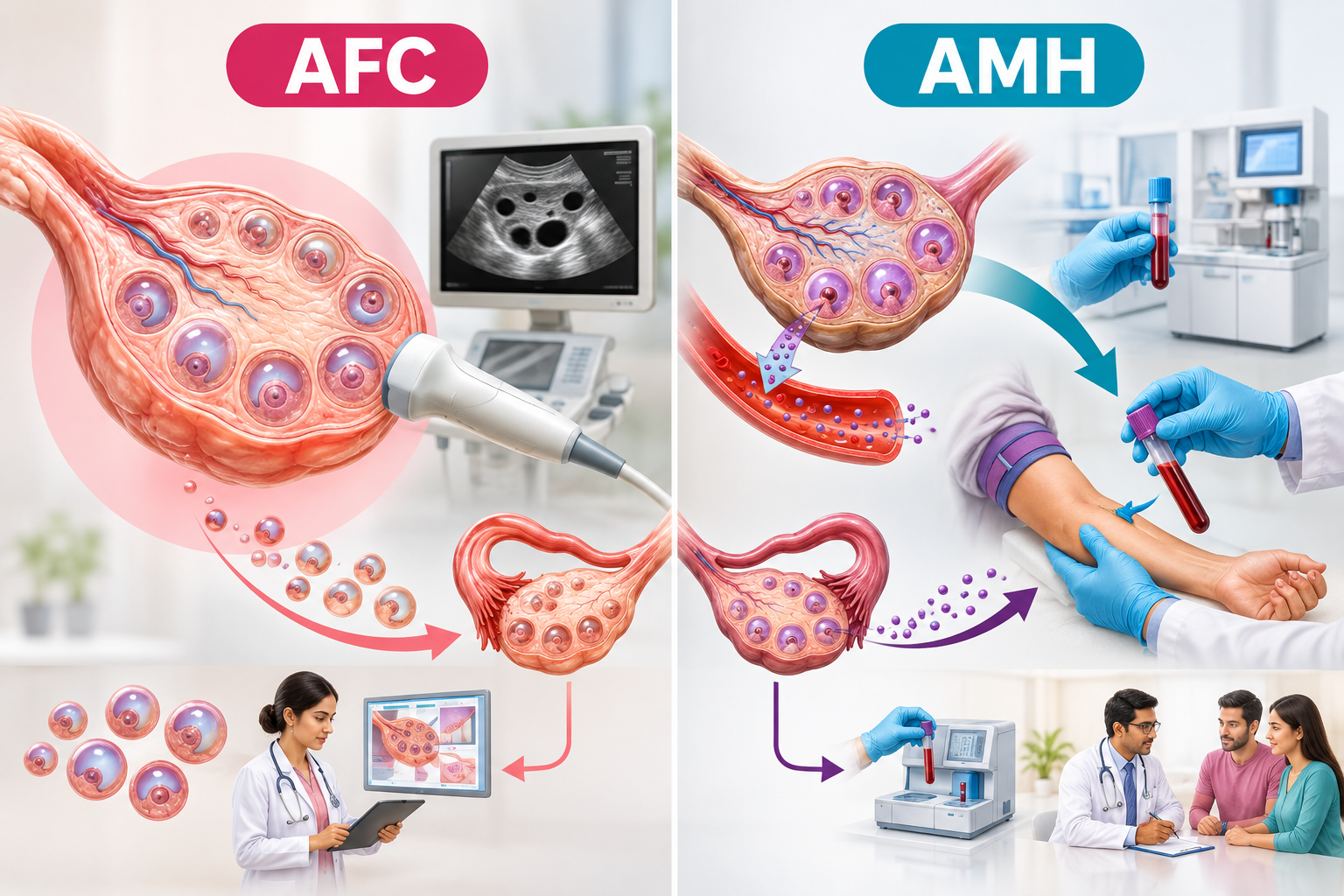
| AFC | AMH | |
|---|---|---|
| Type of test | Transvaginal ultrasound | Blood test |
| What it measures | Small follicles visible on the scan | A hormone produced by small growing follicles |
| Timing | Usually early in the menstrual cycle | More flexible, although clinical context still matters |
| Main use | Estimates ovarian response and shows ovarian anatomy | Estimates ovarian response and the ovarian reserve pattern |
| Main limitations | Operator skill, ultrasound machine, cysts and follicle visibility | Differences between lab assays, certain medicines and medical conditions |
| Predicts egg quality? | No | No |
| Guarantees pregnancy? | No | No |
AFC (Antral Follicle Count) is the total number of small follicles seen in both ovaries during an ultrasound scan. For a detailed explanation, see what is an antral follicle count.
AMH (Anti-Müllerian Hormone) is produced by cells in small developing follicles. Its level broadly reflects the number of these follicles. Labs report AMH in ng/mL or pmol/L, and the assays and reference ranges can vary between laboratories.
As a rough educational guide, many clinics may describe AMH levels in the following way:
| AMH (approximate) | How it is often described |
|---|---|
| Below about 1.0 ng/mL | Possibly low |
| About 1.0 to 3.5 ng/mL | A commonly seen range |
| Above about 3.5 to 4 ng/mL | Possibly high |
Important: These values are not diagnostic cut-offs. AMH interpretation depends on factors such as age, the laboratory method and your clinical history. Always compare your result with the reference range printed on your own report. You can also read about low AMH and pregnancy.
Research generally finds that both do a good job of flagging a low or a high response, and their accuracy is similar in many women. One may be more useful in a particular situation. AFC lets the doctor see the ovaries, cysts and how follicles are spread. AMH depends less on the person scanning and can often be measured outside the early-cycle scan. Neither gives an exact egg count.
The scan also shows things a blood test can't: ovarian position, cysts and womb findings. See baseline scan before IVF.
AMH can be affected by hormonal contraception and some medical treatments, so tell your doctor what you take.
When they disagree, review the full history. Don't choose whichever result sounds more comforting.
It may reflect assay variation, timing, recent hormones, medical history or a true difference between hormone level and visible follicles. Your doctor may repeat the test or look at it in context. Treatment shouldn't change on one number, especially if it conflicts with your age, earlier cycles and scan.
This can happen with test variation, cycle timing, cysts, technical limits or an underlying condition. A fertility specialist may review your ovaries, medicines, symptoms and earlier response. A high AMH doesn't guarantee many eggs or good egg quality.
Not directly. They mainly predict how the ovaries may respond to stimulation. Pregnancy and live birth also depend on:
A low result does not mean IVF can't work, and a high result doesn't guarantee it will.
Age remains one of the strongest influences on egg quality and embryo chromosome risk. AFC and AMH help with quantity and medicine planning, but they don't cancel the effect of age. Two women with the same AFC or AMH can have different chances because their ages and other factors differ. See egg quality and age.
A specialist may weigh:
The result can guide the medicine dose and monitoring. It doesn't set a fixed outcome. See IVF stimulation protocols and how many follicles are needed for IVF egg retrieval.
[Doctor to write 3 to 4 honest sentences: for example, whether the team uses both tests, which lab and assay it uses, and how results and age are combined when planning doses. No success figures or unprovable claims. Delete this note.]
AFC and AMH complement each other. AFC shows visible small follicles on ultrasound, while AMH is a blood marker linked to developing follicles. Both help predict likely IVF response, but neither predicts egg quality, embryo genetics or a guaranteed pregnancy. When they disagree, your specialist should read them with age, medical history, ovarian anatomy and earlier IVF response.
Get personalised guidance on your AFC, AMH results and fertility treatment planning at Dr. Aravind's IVF Fertility & Pregnancy Centre.
Book an IVF consultationDr. Aravind's IVF Fertility & Pregnancy Centre
AFC and AMH are estimates of ovarian reserve and response. They do not independently diagnose infertility or predict a guaranteed pregnancy or live birth. This article is for education only.
Not universally. Both are useful predictors of ovarian response, and accuracy depends on the patient, the test quality and the setting.
It depends. Many clinics use both, or one alongside age, history and earlier response.
No. Neither measures egg quality or embryo chromosomes.
Can I have IVF with low AMH and low AFC? Yes, depending on the full assessment. Expected egg numbers may be lower, but a low result doesn't mean treatment is impossible.
No. A high AFC can be seen with polycystic-looking ovaries, but PCOS is diagnosed using a broader assessment.
Not everyone does. Your doctor may choose one or both depending on your plan and whether the results agree.


