First published [16/10/2026]
For most people, transferring one embryo is the safer choice. It sharply cuts the chance of twins or triplets, and multiple pregnancies carry a greater risk of early birth and pregnancy complications. Two embryos can raise the chance of pregnancy in a single attempt for some patients, but a spare frozen embryo used in a later transfer often makes up much of that difference. The right plan for you depends on your age, your embryos and your health.
Key takeaways
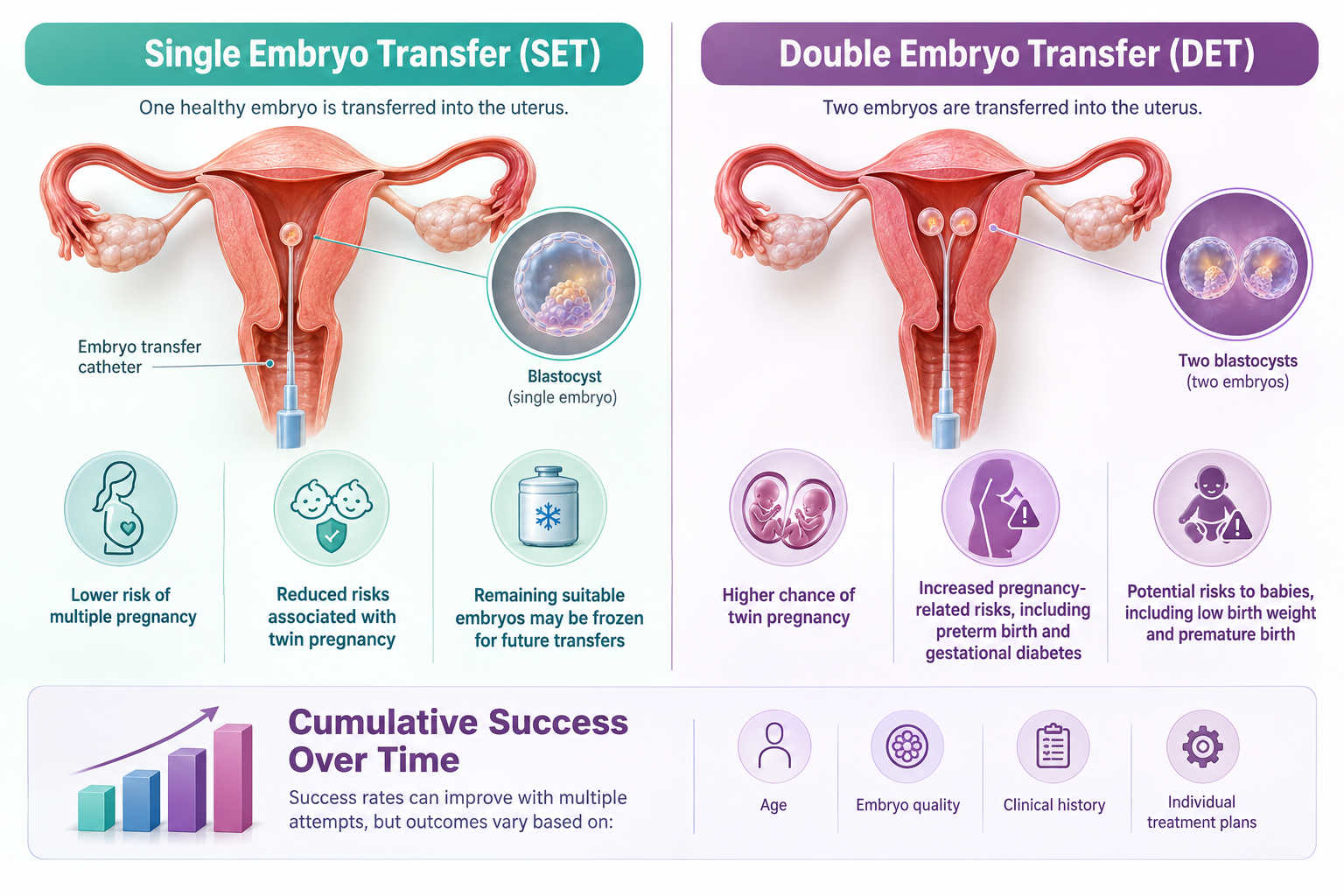
Single embryo transfer (SET) means transferring just one embryo into the uterus during a fresh or frozen embryo transfer cycle. Depending on your treatment plan, the embryo may be a day 3 embryo or a blastocyst that has developed to day 5, 6 or 7.
Your fertility team recommends an embryo by considering several factors, including:
Choosing a single embryo transfer does not mean giving up on pregnancy. It is a way to aim for one healthy pregnancy while reducing the risk of a multiple pregnancy. Your specialist can explain how SET fits your individual treatment plan.
Double embryo transfer (DET) means transferring two embryos into the uterus during the same procedure. It may be considered in selected circumstances after your fertility specialist discusses the potential benefits, risks, and alternatives with you.
Transferring two embryos does not guarantee two pregnancies. One embryo may implant, both may implant, or neither may implant. In some cases, a single embryo can also split and develop into identical twins.
A twin pregnancy carries a higher risk of complications, including premature birth and low birth weight, and may require additional monitoring during pregnancy. The decision should therefore be based on your clinical circumstances and the safest appropriate approach—not simply a wish for twins or the assumption that transferring two embryos will automatically double the chance of pregnancy.
Ask your fertility specialist to explain the expected outcomes and risks of transferring one versus two embryos in your specific situation before making a decision.
Single embryo transfer is generally safer because it lowers the chance of twins and triplets. A pregnancy with one baby usually carries fewer risks for both the mother and the child.
A twin pregnancy places greater demands on the mother's body and requires careful antenatal monitoring. Compared with a singleton pregnancy, it carries a higher risk of complications, including:
Many twin pregnancies have positive outcomes, but they are not risk-free. Babies born prematurely may have difficulty breathing, feeding and maintaining their body temperature. This is one reason fertility specialists consider the risks of multiple pregnancy when recommending how many embryos to transfer.
Learn more about twin pregnancy after IVF and read the World Health Organization's information on preterm birth.
A single embryo transfer may have a lower chance of pregnancy per transfer than transferring two embryos in some circumstances. However, the comparison changes when you consider the possibility of using a suitable frozen embryo in a later transfer.
For example, if you have two suitable embryos, your clinic may recommend transferring one and freezing the other for future use. If the first transfer does not result in a pregnancy, the frozen embryo may offer another opportunity. The overall chance of a live birth across successive transfers depends on factors such as embryo quality, age, medical history and whether embryos remain available.
Ask your fertility specialist about your estimated chance of live birth, the likelihood of a multiple pregnancy and the potential benefits and limitations of each approach. A positive pregnancy test is important, but it is not the only outcome to consider.
Unsure which transfer approach may suit you? Bring your embryo report to a consultation at Dr. Aravind's IVF Fertility & Pregnancy Centre to discuss your options, expected outcomes and individual risks.
Book an IVF consultation →Yes. Occasionally, a single embryo divides and develops into identical twins. This is uncommon, so transferring one embryo reduces the risk of a twin pregnancy but does not eliminate it completely.
Transferring one embryo also reduces the additional risk that can occur when two separately transferred embryos both implant. Your fertility specialist can explain the difference between identical and non-identical twins and how embryo transfer choices affect the likelihood of multiple pregnancy.
Double embryo transfer may be discussed in selected situations after a careful assessment of your medical history, treatment results and the potential risks of a multiple pregnancy. Your fertility specialist may consider:
If transferring two embryos is being considered, ask your doctor to explain the chance of twins, the potential complications and the alternatives, including single embryo transfer followed by a frozen transfer if needed. Transferring two embryos cannot guarantee a baby or a successful pregnancy.
Embryo grade and developmental stage help embryologists assess which embryo may be suitable for transfer. A good-quality blastocyst may have a favourable chance of implantation, depending on other clinical factors. However, lower-grade embryos can also result in pregnancy.
Your fertility specialist will consider your complete embryo report and treatment history when discussing whether to transfer one embryo or two. A morphological grade describes an embryo's appearance; it does not confirm its chromosomal health or guarantee a successful outcome.
If genetic testing has been performed, ask your specialist to explain what the test can and cannot tell you. Read more in our guides to embryo grading in IVF and blastocyst transfer success rates.
Elective single embryo transfer (eSET) means choosing to transfer one embryo when more than one suitable embryo is available. Other suitable embryos may be frozen for possible use in future treatment cycles.
Potential benefits include:
Not every patient has spare embryos available for freezing, and not every embryo survives the freezing and thawing process. Your clinic can explain whether eSET is suitable for your circumstances. Learn more about frozen embryo transfer.
Transferring two embryos in one procedure may reduce the number of transfer procedures needed in some cases, but it increases the possibility of a twin pregnancy if both embryos implant. It is not equivalent to transferring one embryo at a time across separate treatment cycles.
Before deciding, ask your fertility specialist to discuss your estimated chance of live birth, the number of embryos available, freezing and thawing options, potential costs and the risks associated with multiple pregnancy. The goal is to choose a treatment approach that balances the chance of success with the safest outcome for you and your future baby.
For many IVF patients, single embryo transfer (SET) is the preferred approach because it reduces the risk of twins and higher-order multiple pregnancies. Double embryo transfer may be considered in selected circumstances, but the decision should follow a careful discussion of your age, embryo quality and stage, treatment history, general health, applicable clinical guidance and informed preferences.
To understand the factors involved in choosing the number of embryos for transfer, read our guide on how many embryos should be transferred during IVF. You can also learn more about embryo implantation after IVF.
Want to understand which embryo transfer approach may be right for you? Book a consultation at Dr. Aravind's IVF Fertility & Pregnancy Centre to review your embryo report, discuss your options and understand the potential risks and benefits.
Book an IVF consultation →Medical disclaimer: The most appropriate embryo transfer strategy depends on your individual circumstances. Your fertility specialist should explain the expected outcomes, potential risks and available alternatives before you make a decision.
Usually, yes. One embryo lowers the chance of twins and so reduces many risks of a multiple pregnancy. It cannot remove the small chance that one embryo splits into identical twins.
No. Neither embryo may implant, one may, or both may. Occasionally a single embryo also splits.
In one attempt, two embryos can raise the chance of pregnancy for some patients. They also raise the chance of twins, so the fair comparison looks at results over several transfers.
You can raise it, but twins carry higher risks for you and the babies. The final plan has to follow medical advice, informed consent, professional guidance and the rules that apply to your clinic.
One blastocyst can lead to a healthy pregnancy. Your own chance depends on its quality, your age and your womb, and your specialist can explain it.


