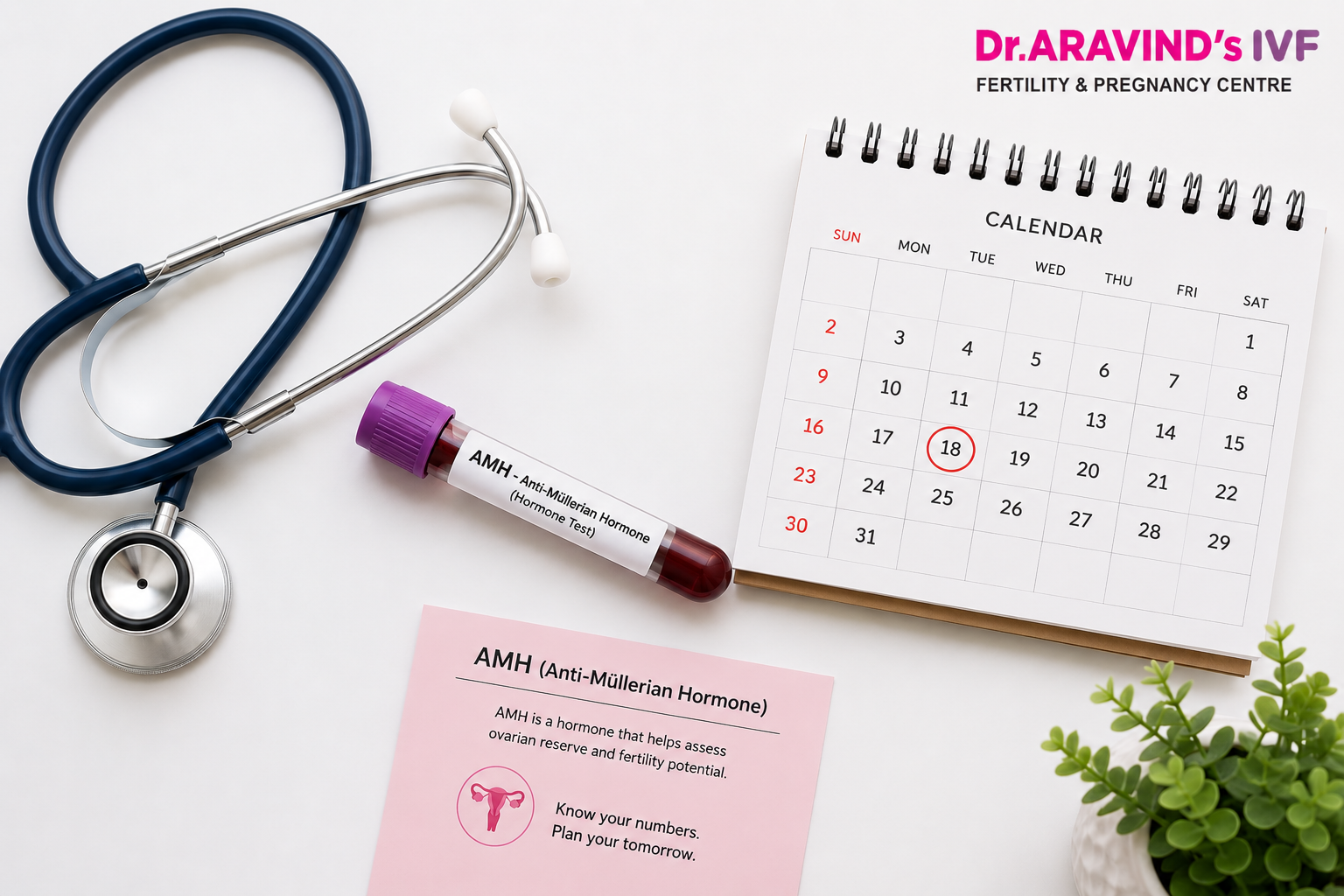
Anti-Müllerian Hormone (AMH) is a hormone produced by small follicles in the ovaries. It gives doctors an estimate of how many eggs you have remaining — your ovarian reserve.
The higher your follicle count, the more AMH your ovaries produce. As the ovarian reserve naturally declines with age, AMH levels fall with it.
What makes AMH particularly useful as a fertility test is its stability. Most reproductive hormones fluctuate throughout the menstrual cycle, which means the timing of the test matters. AMH stays relatively consistent regardless of where you are in your cycle, making it a more reliable snapshot of ovarian reserve.
One important limitation: AMH reflects egg quantity, not egg quality. A woman with a high AMH can still have poor-quality eggs, and a woman with low AMH can still have healthy ones. If egg quality is your concern, read our guide on improving egg quality before IVF.
A good AMH level for natural conception and fertility treatment is generally between 1.0 and 4.0 ng/mL.
Women in this range are typically considered to have an adequate ovarian reserve. For IVF treatment, this range also tends to predict a reasonably good response to stimulation medication.
That said, AMH is not a pass or fail test. Plenty of women conceive naturally with levels below 1.0 ng/mL, and some women with levels above 4.0 ng/mL face their own fertility challenges. The number needs to be interpreted in context — alongside your age, your partner's semen analysis, your hormone levels, and your ultrasound findings.
| AMH Level | Range | What It May Indicate |
|---|---|---|
| Very Low | Below 0.5 ng/mL | Significantly reduced ovarian reserve |
| Low | 0.5 – 1.0 ng/mL | Lower egg count than expected for age |
| Normal | 1.0 – 4.0 ng/mL | Healthy ovarian reserve |
| High | Above 4.0 ng/mL | May suggest PCOS or high follicle count |
These ranges are general guidelines. Laboratory reference ranges can vary slightly, so always review your result with your fertility specialist rather than interpreting it alone.
AMH declines naturally as women get older. This is expected and normal — it simply reflects the natural reduction in ovarian reserve that happens over time.
| Age Group | Average AMH Range |
|---|---|
| 20–29 years | 3.0 – 5.0 ng/mL |
| 30–34 years | 2.0 – 4.0 ng/mL |
| 35–39 years | 1.0 – 3.0 ng/mL |
| 40+ years | 0.5 – 1.5 ng/mL |
A 38-year-old with an AMH of 1.2 ng/mL is in a very different clinical position than a 28-year-old with the same result. Age provides the essential context that raw numbers alone cannot.
Yes — and this is one of the most important things to understand about AMH results.
Low AMH causes understandable anxiety. Many women assume a low result means they cannot conceive. In reality, low AMH means you have fewer eggs remaining than average for your age. It says nothing definitive about the quality of those eggs, whether you are ovulating, or your overall ability to achieve pregnancy.
Women with low AMH can and do conceive naturally, particularly if:
What low AMH does indicate is that the fertility window may be shorter than average. Waiting is riskier than it might be for someone with higher reserve. If your AMH is low, seeing a fertility specialist sooner rather than later gives you more options — not fewer.
For an in-depth look at how low ovarian reserve affects treatment planning, see our guide on IVF treatment at Dr. Aravind's IVF Centre
Not necessarily. Very high AMH levels are most commonly associated with Polycystic Ovary Syndrome (PCOS).
Women with PCOS have a larger number of small follicles than usual, which drives AMH levels up. A high AMH can mean more eggs are available, but PCOS also often disrupts ovulation — which means getting pregnant naturally may still be difficult despite the high follicle count.
Common signs that high AMH may be linked to PCOS include:
If your AMH is high and you have any of these symptoms, a proper evaluation for PCOS is an important next step. Read more about fertility and PCOS
and how it affects your chances of conception.
The AMH fertility test is a simple blood draw. It can be done on any day of the menstrual cycle, which makes it one of the most convenient fertility investigations available.
No fasting is required. The result is usually available within a few days.
The test is commonly recommended for women who:
AMH is rarely interpreted in isolation. Your specialist will typically review it alongside an antral follicle count (AFC) on ultrasound, day 2–3 FSH and oestradiol levels, and a full hormonal profile — all part of a complete female fertility evaluation.
AMH plays a central role in planning IVF treatment. It helps fertility specialists:
Women with lower AMH may produce fewer eggs during IVF stimulation, but fewer eggs does not mean zero chance of success. With individualised protocols and careful monitoring, many women with low AMH achieve successful IVF pregnancies.
Women with very high AMH need careful medication management to avoid OHSS, a condition where the ovaries over-respond to stimulation. This is something fertility specialists plan around from the outset.
At Dr. Aravind's IVF Fertility & Pregnancy Centre, AMH results are always interpreted alongside age, ultrasound findings, and the full hormonal profile — because no single number tells the whole story.
For more on how IVF works and what to expect at each stage, see our IVF treatment guide
There is no clinically proven method to significantly increase AMH levels. The ovarian reserve declines naturally with age and cannot be fully reversed.
However, certain lifestyle factors may affect how quickly that decline happens. Things worth considering:
For women with declining ovarian reserve who want to preserve their options, egg freezing is worth discussing with a specialist. Freezing eggs while they are still viable means preserving future choices, regardless of what AMH levels look like later.
If any of the following apply, a fertility consultation is worth booking sooner rather than later:
AMH is a genuinely useful fertility test. It gives a real window into ovarian reserve and helps guide decisions about timing, treatment, and fertility preservation. But it is not a verdict on whether you can get pregnant.
A normal AMH does not guarantee pregnancy. A low AMH does not rule it out. The number only becomes meaningful when a specialist interprets it alongside everything else — your age, your partner's results, your hormones, and your reproductive history.
If you've received your AMH result and aren't sure what it means for you, the clearest next step is a fertility consultation. At Dr. Aravind's IVF Fertility & Pregnancy Centre, every patient receives a personalised evaluation rather than a number on a page.
Yes. Low AMH reflects a reduced egg count, not an inability to conceive. Many women with low AMH ovulate normally and go on to conceive naturally. If your AMH is low, consulting a fertility specialist earlier than you might otherwise can help you understand your options.
No. AMH measures egg quantity — how many follicles are present. Egg quality is influenced primarily by age and is assessed through other means, including embryo development during IVF. A woman can have low AMH and still have good-quality eggs.
Yes. AMH declines naturally with age. It can also be affected by ovarian surgery, chemotherapy, certain hormonal conditions, and possibly lifestyle factors like smoking. AMH does not typically increase significantly on its own once it has declined.
Unlike FSH, which is best tested on day 2 or 3 of the menstrual cycle, AMH can be tested on any day of the cycle. This makes it one of the most flexible fertility investigations available.


