Embryos stop growing before day 5 most often because of chromosomal differences, but egg factors, sperm factors, abnormal fertilisation, the demanding day 3 to day 5 transition, laboratory conditions, and plain biological variation can all play a part. Often the exact cause cannot be proven from one cycle. It is not caused by something you ate, how you exercised, or how stressed you felt.
Key takeaways
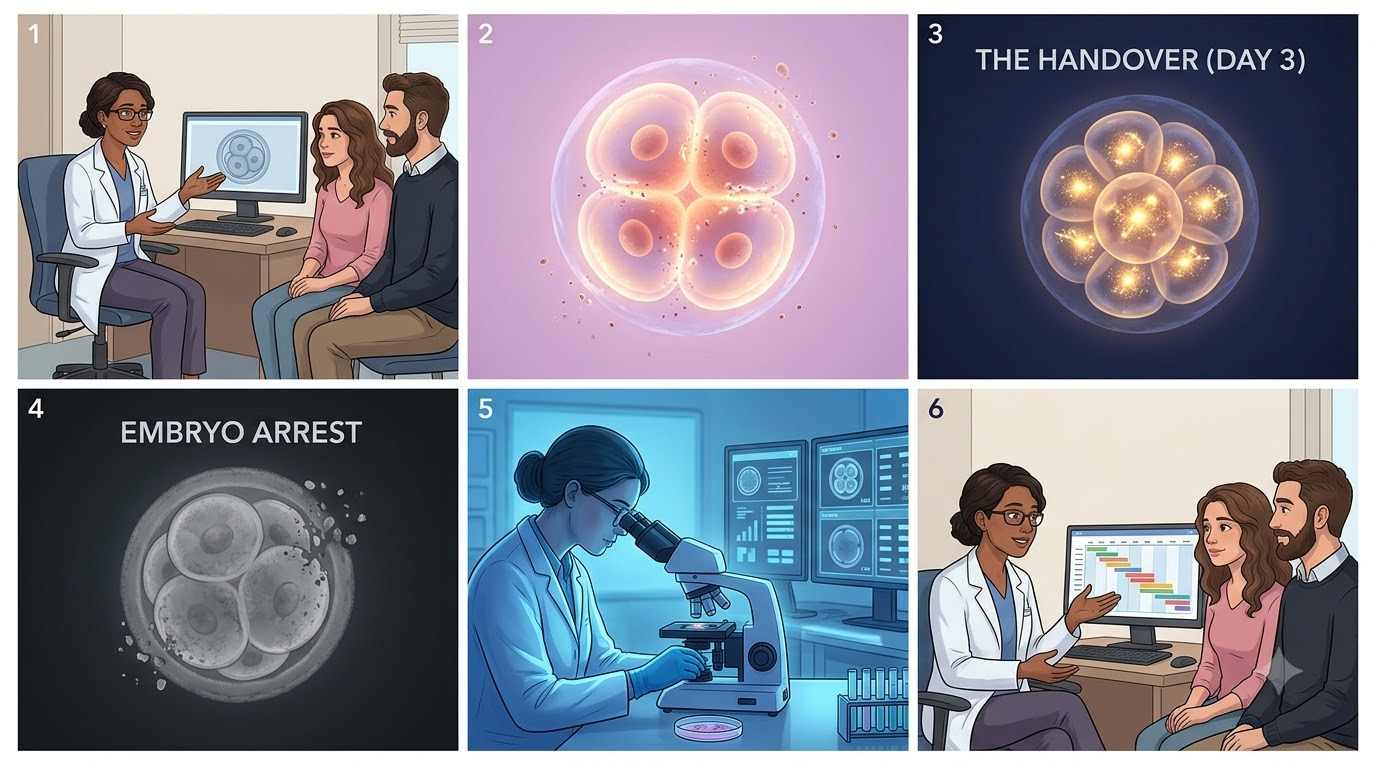
When an embryo stops dividing or fails to develop into a blastocyst, embryologists may describe it as embryo arrest. This can happen at different stages between fertilisation and day 5, 6 or 7 of embryo development.
Think of embryo development as a series of stages: egg maturity, fertilisation, early cell division, day 3 development, compaction and blastocyst formation. Not every fertilised egg progresses through every stage. Some embryos stop developing before they reach the blastocyst stage, even when fertilisation initially occurs.
Having fewer blastocysts on day 5 than the number of fertilised eggs does not automatically mean your IVF cycle has failed. Embryos develop at different rates, and some may reach the blastocyst stage on day 6 or day 7. Your embryology team can explain how your embryos progressed and what the results mean for your next steps.
For a clearer picture of each stage, read our guide to embryo development day by day.
One possible reason for embryo arrest is a chromosomal difference, such as an extra or missing chromosome. These differences can arise when eggs or sperm develop or during the embryo's early cell divisions. Some embryos with significant chromosomal abnormalities stop developing naturally.
An embryo's appearance cannot reveal every chromosomal difference. Preimplantation genetic testing (PGT) may be discussed in selected situations, but it has limitations and is not necessary for every IVF cycle.
The egg plays an important role in fertilisation, early cell division and blastocyst development. Egg quality can change with age, although age alone cannot predict how an individual embryo will develop.
Ovarian reserve, endometriosis, previous ovarian surgery and the response to ovarian stimulation may also be considered when reviewing an IVF cycle. Tests such as AMH help estimate ovarian reserve, but they cannot directly measure egg quality or predict the developmental potential of every embryo.
Learn more about IVF egg maturity and why some retrieved eggs may not develop as expected.
Sperm contributes half of the embryo's genetic material. When embryo development is poor, the fertility team may review sperm concentration, movement, shape and other relevant male fertility factors.
A normal semen analysis does not assess every aspect of sperm function, while an abnormal result does not prove that sperm caused embryo arrest. Further evaluation, including sperm DNA fragmentation testing, may be considered when clinically appropriate and when the results could influence treatment decisions.
An egg that is immature or fertilises abnormally may not develop normally. The embryology team may review how many eggs were mature, how many showed normal fertilisation with two pronuclei (2PN), whether abnormal fertilisation occurred and whether conventional IVF or ICSI was used.
Fertilisation failure is different from embryo arrest after several days of development. Reviewing the exact stage at which development stopped can help the team understand what happened during your cycle.
Read more about why IVF eggs fail to fertilise and the fertilisation rate in IVF.
Early embryo development involves complex processes, including energy production, gene activation and coordinated cell division. Mitochondria help supply the energy cells need, while the embryo must activate its own genes and organise its cells as it develops.
These processes cannot be fully assessed through a routine scan or a simple blood test. Be cautious about treatments marketed as guaranteed ways to improve or repair embryo development. Ask your fertility specialist what evidence supports a proposed treatment, what remains uncertain and whether it is appropriate for your circumstances.
Sometimes, embryos stop developing even when routine investigations are reassuring and the laboratory follows established procedures. Human reproduction is not perfectly efficient, and a single IVF cycle may not reveal a clear reason for embryo arrest.
This uncertainty can be emotionally difficult. However, embryo arrest does not mean you caused it through your diet, exercise, stress or everyday activities. Your fertility team can help you understand the findings without placing blame on either partner.
Embryos develop in carefully controlled laboratory conditions. If an unexpectedly high number of embryos stop growing, the laboratory team may review culture conditions, equipment and incubator records, embryo handling procedures and quality-control data.
A review should consider the development pattern across the whole group of embryos, the details of the treatment cycle and the laboratory's usual outcomes. Embryo arrest alone does not establish that a laboratory problem occurred.
Bring your complete embryology report to a consultation. Your fertility team can review egg maturity, fertilisation, embryo development and relevant treatment factors with you, step by step.
Book an IVF consultation →During the earliest stages, an embryo relies heavily on materials stored in the egg. As development continues, the embryo increasingly activates its own genes and coordinates more complex processes, including compaction and blastocyst formation.
This is one reason an embryo may look promising on day 3 but fail to reach the blastocyst stage by day 5. The day 3 appearance provides useful information, but it cannot reliably predict everything that will happen over the following days. Some embryos may continue developing and reach the blastocyst stage on day 6 or day 7.
Your embryologist can explain the stage at which development slowed or stopped and whether the pattern offers any useful clues for future treatment.
Not necessarily. Embryo development depends on several interacting factors, including the egg, sperm and the embryo's own biology. If no blastocysts form, your fertility team may review egg maturity, age-related factors, sperm findings, fertilisation results, ovarian stimulation, laboratory conditions and previous IVF cycles.
One unsuccessful cycle cannot prove that every future embryo will stop developing. It also cannot establish that one partner was responsible. A careful review of the complete cycle is more useful than drawing conclusions from the final blastocyst count alone.
Your fertility specialist and embryology team may review the following details from your treatment cycle:
Depending on the findings, the team may recommend no major change, an adjustment to the treatment protocol, further male fertility evaluation, a different fertilisation approach where indicated or another treatment strategy. The right decision depends on your individual circumstances.
If none of your embryos reaches the blastocyst stage, ask your fertility specialist to review the cycle before committing to multiple additional tests or treatments. The next step depends on factors such as your age, the number of eggs retrieved, egg maturity, sperm findings, fertilisation results and any previous IVF cycles.
Depending on your situation, options for discussion may include:
There is no single approach that suits everyone. If you have experienced repeated disappointing cycles, read more about repeated IVF failure and discuss your options with your specialist.
A day 3 embryo transfer takes place before the embryo's ability to reach the blastocyst stage can be observed in the laboratory. It does not prevent an underlying developmental problem; it simply means that the embryo is transferred earlier.
Your fertility team can explain the potential benefits and limitations of day 3 versus day 5 transfer based on the number of embryos available, your treatment history, the embryo development pattern and the laboratory's experience. The decision should be individualised, with a clear discussion of the possibility that an embryo may not continue developing after transfer.
Embryos can stop developing before day 5 for several reasons, including chromosomal differences, egg or sperm factors, abnormal fertilisation, difficulties during early development, laboratory factors or natural biological variation. If no blastocysts form, the next step is a careful review of your embryology report and treatment cycle—not self-blame or rushing into multiple add-on treatments.
To understand how embryos are assessed when development continues.
Need help understanding why your embryos stopped developing? Book a consultation at Dr. Aravind's IVF Fertility & Pregnancy Centre and bring your complete laboratory report for an individualised review.
Book an IVF consultation →Medical disclaimer: Embryo arrest can have several possible causes, and an online article cannot determine why it occurred in an individual IVF cycle. Your fertility specialist and embryology team should interpret your complete laboratory report and discuss appropriate next steps.
To some extent, yes. Not every fertilised embryo reaches blastocyst, and doctors see this as a normal part of early development. How often it happens depends on age, egg and sperm factors, the lab and the number of embryos.
Around day 3 the embryo has to start using its own genes. Chromosome differences, the sperm's contribution, egg biology and other reasons may be involved, but a lab report rarely points to just one.
There is no evidence for blaming everyday stress. An embryo's growth is a complex biological process, and your mood, diet or exercise did not cause it to stop.
No supplement can promise that your embryos will reach day 5. Speak to your doctor before starting one, as some are not needed and some may not suit you.
ICSI can help with certain fertilisation problems, for example when sperm cannot enter the egg. It cannot prevent every cause of arrest that happens after fertilisation.


