Yes. Low AMH (anti-Müllerian hormone) mainly suggests that fewer eggs may be collected in an IVF cycle. It doesn't directly measure egg quality or embryo chromosomes, so good-quality embryos are still possible, especially when the eggs that are available are healthy. Age, egg maturity, sperm, embryo development, and the womb all matter alongside AMH, and results vary from person to person.
Key points
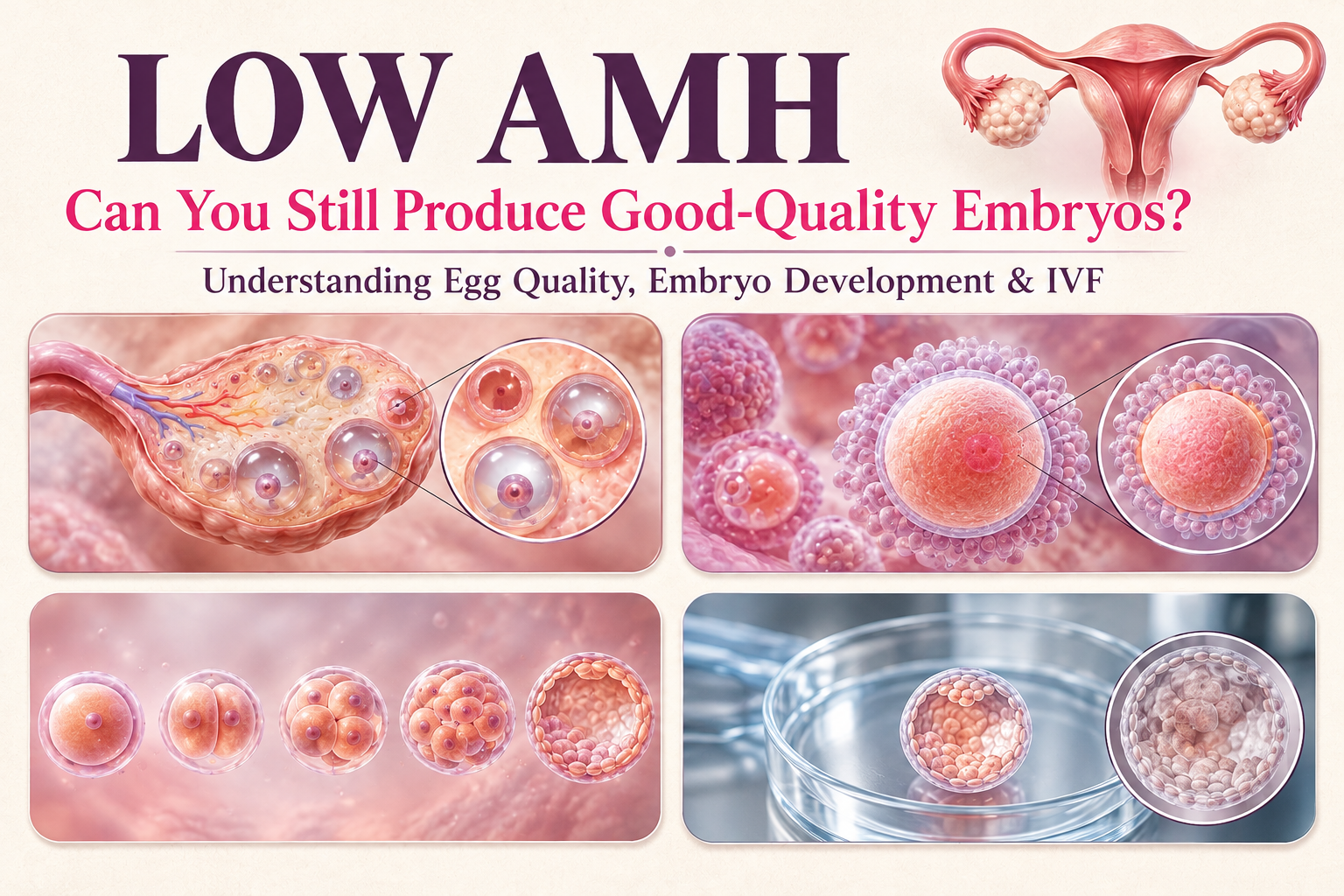
Low AMH generally means fewer measurable developing follicles, or reduced ovarian reserve. It may go with a lower response to stimulation and fewer eggs collected.
It doesn't necessarily mean:
Doctors read AMH with your age, AFC, cycle history, earlier IVF response and the full assessment. For ranges, see what is a good AMH level to get pregnant.
AMH is better at estimating how many eggs may respond than how good each egg is. Egg quality is strongly influenced by age, though not by age alone.
If a mature egg fertilises normally and develops well, a low AMH doesn't stop it from becoming a good-quality embryo. Some women with a low response still create a usable blastocyst from a small number of eggs. Every cycle is different, and no single test can guarantee embryo development.
| Quantity | Quality | |
|---|---|---|
| What it means | How many eggs are available or collected during IVF | The developmental potential of each egg, including its ability to fertilise and support embryo development |
| What AMH tells you | Provides a useful estimate of ovarian response and likely egg yield | Very little directly about egg quality |
| What matters more | AMH, AFC and response to stimulation medicines | Age, egg maturity, sperm factors, laboratory conditions and chromosome status |
| With low AMH | Fewer eggs may be retrieved | Does not automatically mean poor egg quality |
Remember: Fewer eggs may mean fewer opportunities in one IVF cycle. That is a question of quantity, not proof that each egg has poor developmental potential.
Your team may weigh:
AMH helps plan stimulation. It doesn't replace embryology information. See embryo grading in IVF and blastocyst development.
Not reliably. It may predict fewer eggs, but studies and clinical experience don't support using AMH alone to label every egg as poor quality. A patient with low AMH may end up with fewer embryos simply because fewer eggs were available.
Yes. Egg chromosome risk generally rises with age. A younger patient with low AMH may have fewer eggs but a reasonable chance that some are developmentally competent. An older patient with the same AMH may face both lower quantity and age-related quality challenges. That is why the timeline should be discussed early and individually. See egg quality and age.
If your AMH is low, your fertility specialist will consider your age, antral follicle count (AFC), medical history and previous treatment response before recommending an IVF plan. You may discuss the following:
| Planning topic | What it involves |
|---|---|
| Starting dose and protocol | Choosing a stimulation plan suited to your expected response, rather than automatically using the highest dose. |
| Expected egg yield | Setting realistic expectations while recognising that egg numbers can vary between cycles. |
| Mild, conventional or other stimulation | Considering which stimulation approach best suits your ovarian reserve and treatment history. |
| More than one retrieval | Discussing whether another retrieval cycle could improve the overall opportunity to obtain embryos. |
| Embryo banking | Collecting eggs and freezing suitable embryos across multiple cycles when clinically appropriate. |
| Sperm optimisation and ICSI | Considering sperm preparation or ICSI when indicated by sperm-related factors. |
| Time sensitivity | Considering how age and ovarian reserve may influence the timing of treatment. |
| Alternatives such as donor eggs | Discussing other options when appropriate, with clear counselling about their implications. |
Important: A higher medicine dose does not always overcome low ovarian reserve. The aim is to recruit the follicles available as safely and efficiently as possible. Your treatment plan should be based on your individual response. Learn more about IVF stimulation protocols.
Usually, waiting for AMH to rise is not a dependable strategy. AMH can fluctuate, but supplements or lifestyle changes haven't been proven to restore ovarian reserve or guarantee better embryos. Healthy habits support general wellbeing, but age and ovarian reserve should shape the plan. Ask your specialist whether earlier IVF, fertility preservation, repeat retrieval or another option fits your situation.
A low result can be influenced by test variation, hormonal contraception, recent ovarian surgery, chemotherapy, endometriosis, some medical conditions or natural age-related decline. Your doctor may review the context or repeat the test. A repeat shouldn't become a reason to delay care when treatment is time-sensitive.
No. AMH isn't a general test of whether you can conceive naturally. That also depends on ovulation, tubes, sperm, age, timing and the womb. Low AMH may reduce the time available or suggest lower reserve, but it doesn't decide any single month's chance. See low AMH and pregnancy.
One egg can sometimes fertilise and become an embryo. A live birth from a single egg is not guaranteed, but a low number doesn't make treatment pointless. Your team may discuss whether to proceed with retrieval, whether to try another cycle, how sperm factors affect fertilisation and whether banking embryos is appropriate.
Yes. Low AMH doesn't prevent blastocyst development. The chance depends on how many eggs are mature, fertilisation, embryo development, age, sperm and the lab. Some cycles produce no blastocyst while another produces one or more, so your doctor should review your whole treatment history rather than judge future potential from AMH alone. See fertilisation rate in IVF.
Low AMH can mean fewer eggs, but not automatically poor eggs or poor embryos. Age, egg maturity, sperm, embryo development and the womb all shape the outcome, and good-quality embryos are possible. If AMH is low, the best move is usually early, realistic planning with your specialist rather than waiting for the number to change.
Discuss your AMH results, ovarian reserve and suitable IVF options with a fertility specialist.
Book an IVF consultationDr. Aravind's IVF Fertility & Pregnancy Centre
Low AMH requires individual fertility assessment. It may predict a lower response to stimulation, but it doesn't prove that eggs or embryos will be poor quality. This article is for education only.
Yes. Low AMH mainly predicts a possible lower egg yield. It doesn't directly measure egg quality or guarantee that embryos will be poor.
IVF can succeed with low AMH, although fewer eggs may be collected and more than one cycle may be discussed. Success depends on age, embryos, sperm, the womb, and other factors.
There's no single value that makes IVF impossible for everyone. Your result has to be read with AFC, age, ovarian function, and your goals.
Small changes can reflect biological or lab variation. There's no proven method to restore a depleted ovarian reserve or guarantee better embryo quality.
Not by itself. AMH isn't a precise menopause countdown and shouldn't be used alone to predict when periods will stop.
Not automatically. Donor eggs may be discussed when the chance of embryos from your own eggs is very low or after repeated unsuccessful treatment. The decision is personal and needs counselling.


