The IVF success rate in India is high for young women and low for older women. Under age 35, the live birth rate is 50 - 60% per cycle. Over age 42, it drops below 10% with a woman's own eggs. The clinical pregnancy rate is often a bit higher, since not every early pregnancy ends in a birth. The national average across all ages is about 35 - 40% per cycle. The real picture only makes sense once you look at the IVF success rate by age. Clinics also do not all report numbers in the same way. Some count per cycle, some count per transfer, and some add up results over many cycles. This is why two clinics can give different numbers for the same age group.
Before you compare numbers, you need to know what is being measured, because clinics do not all report the same thing. This is why one site says 40%, and another says 65% for the same age group.
| Metric | What It Means |
|---|---|
| Clinical pregnancy rate | The percent of cycles that lead to a confirmed pregnancy on scan. This is often the highest number, since not every pregnancy leads to a birth. |
| Live birth rate | The percentage of cycles that result in a live birth. This is the most useful number for your own plan. |
| Added-up rate | Your chance of success adds up over 2–3 cycles. This is almost always higher than a single-cycle number. |
Always check which of these three you are looking at. A "65% rate" over three cycles is not the same as a 65% rate in one single cycle.
Age is the biggest factor in IVF success. It affects your egg count, your egg health, and the number of embryos with flaws.
| Age Group | Live Birth Rate (Per Cycle) | Rate Over 3 Cycles |
|---|---|---|
| Under 30 | 50–60% | 78–88% |
| 30–34 | 45–55% | 70–82% |
| 35–37 | 32–42% | 58–70% |
| 38–40 | 22–32% | 42–58% |
| 41–42 | 12–18% | 25–40% |
| Above 42 (own eggs) | 5–10% | 15–25% |
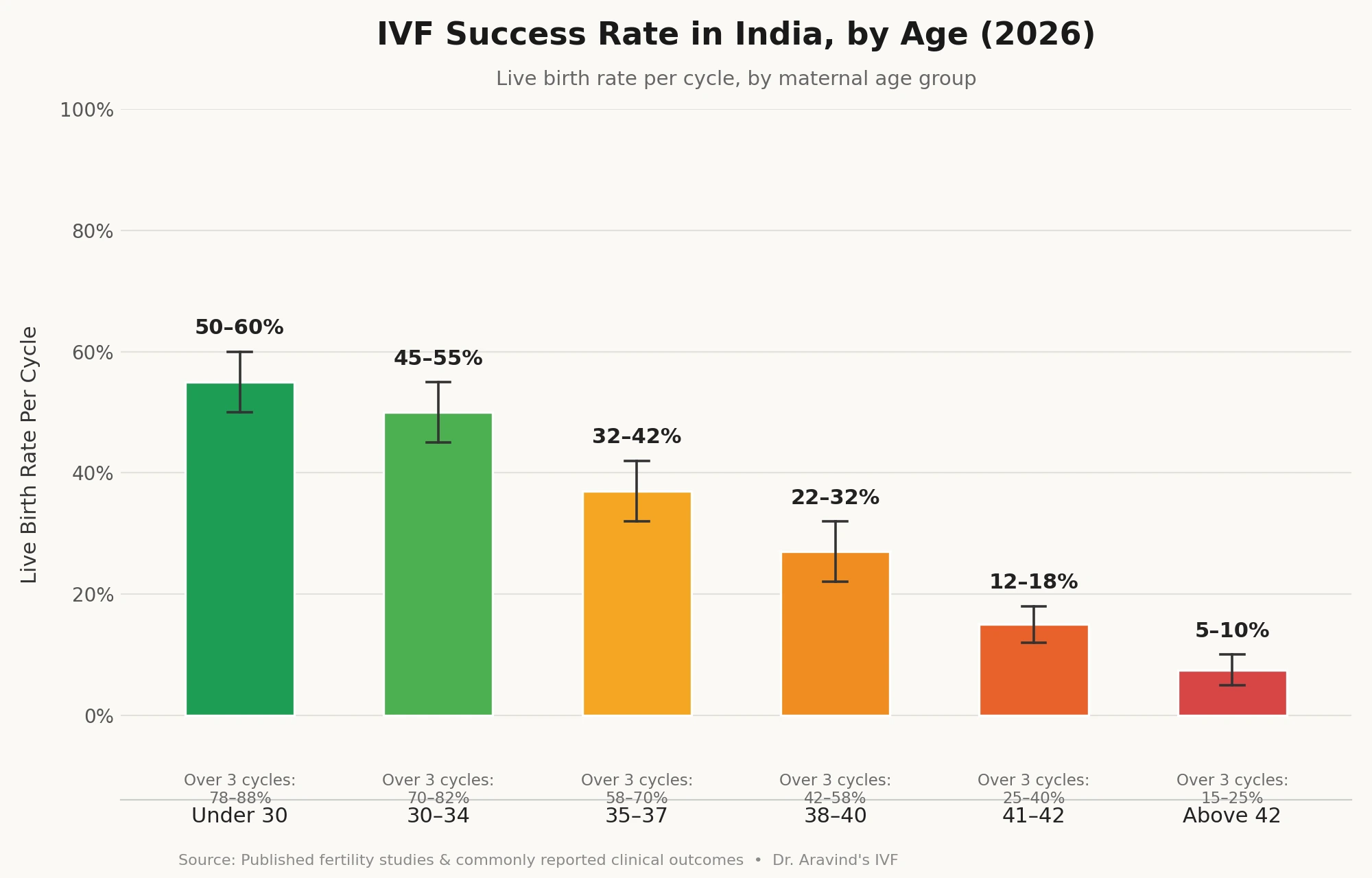
Women under 35 have the best chance with IVF, mostly because young eggs have fewer flaws and respond well to fertility drugs. Most clinics move just one strong embryo at a time, which keeps success high and lowers the risk of twins.
Success rates drop to 32 - 42% in this age group, since about 40 - 50% of eggs may have flaws by now. Doctors often suggest a gene test on the embryo, called PGT-A. It helps find the healthy ones before transfer.
Egg count drops more in this age group. Live birth rates fall to 22 - 32% per cycle. Egg supply tests matter more now, and doctors also fine-tune drug doses with more care.
Up to 70 - 80% of embryos may have flaws at this age, which drops one-cycle success to 12 - 18%. Success added up over three cycles can reach 25 - 40%. This is why doctors often plan for more than one try from the start.
Live birth rates with a woman's own eggs often fall below 10% past age 42. But the uterus can often still carry a baby well into the mid-40s. The real issue is egg quality, not the health of the uterus.
Donor egg success depends on the donor's age, not the mother's age. Live birth rates stay high, often 60 -70% per cycle, no matter how old the mother is. India's ART Act, 2021, sets strict rules for egg donors. They must fit a set age range, the donor's name stays private, and every donor goes through health checks.
Say you are in your early 40s and have tried two or three cycles with your own eggs. If they did not work, this may be the right time to talk about donor eggs.
Why Success Rates Differ Between Clinics
This is the part most articles skip. It is also the main reason success rates feel so confusing to compare.
A clinic that says 40% may be just as honest as one that says 65%. They simply count things in different ways. Some count every patient who started the drugs, even if the cycle was later called off. This is known as "per cycle started." Others count only patients who made it to embryo transfer. This leaves out anyone whose cycle did not produce a usable embryo. A few clinics add up the success across many cycles. That number will always look higher than a single-cycle rate.
None of these ways is wrong. But you cannot compare them side by side. When you check a clinic's success rate, do not just look at how high the number is - ask what is being counted.
Age matters most, but several other things can shift your odds within any age group:
| Your Situation | What To Do |
|---|---|
| Trying on your own, under 35 | See a doctor after 12 months |
| Trying on your own, 35–40 | See a doctor after 6 months |
| Trying on your own, above 40 | See a doctor right away |
| IUI failed 2–3 times | Move on to IVF tests |
| Told you have PCOS, endometriosis, or blocked tubes | See a doctor before waiting a full year |
| Had two or more miscarriages | Get tested before your next try |
Age-based numbers are just a starting point. Your real odds depend on your egg count, your partner's sperm health, and your uterus health. A fertility doctor can give you a number based on your own case after basic tests, often within about a week. Dr. Aravind's IVF has centres across Tamil Nadu, Kerala, Karnataka, and Andhra Pradesh for in-person checkups.
Medically reviewed by Dr. Aravind Chander, MS (Obstetrics & Gynaecology). He trained in reproductive medicine and ART in Singapore and founded Dr. Aravind's IVF Fertility & Pregnancy Centre.
Ready to know your own success odds? → Book a consultation with Dr. Aravind's IVF
Disclaimer: The success rates mentioned are based on published studies and commonly reported clinical outcomes. Individual results vary depending on age, ovarian reserve, sperm quality, embryo quality, uterine health, and the treatment plan recommended by your fertility specialist.

The national average is about 35 - 40% per cycle. This changes a lot based on age, clinic method, and how "success" is counted.
Women under 35 often see live birth rates of 50 - 60% per cycle. This is the best of any age group, thanks to better egg health and a larger egg count.
Yes. Live birth rates with a woman's own eggs often fall below 20% after 40 and below 10% after 42. This is mostly because more eggs carry flaws at this age.
Donor egg IVF often reaches 60 - 70% live birth rates, no matter the mother's age. Success here depends on the donor's younger age, not the mother's own age.
They often count different things, such as cycles started, embryo transfers, or results added up over many cycles. Check which one is used before you compare clinics.
Many patients succeed within 2 - 3 cycles. Rates added up over three cycles run much higher than a single-cycle rate. For women under 30, this climbs to 78 - 88%, compared with just 50 - 60% in one cycle alone.


