The previous method of IVF treatment used to provide couples with one opportunity to create an embryo from each egg extraction. The development of embryo cryopreservation technologies has completely transformed this situation. Frozen Embryo Transfer or FET enables families to keep their embryos, which they created during one stimulation period, for future use throughout the upcoming months and years, which provides each embryo with its highest chance to develop into a successful pregnancy.
The FET procedure has become a standard treatment method at Dr. Aravind's IVF Fertility and Pregnancy Centre, widely recognised for offering FET treatment in Chennai, which operates multiple locations throughout Coimbatore, Madurai, Trichy, Tanjore, Erode, Salem and Tiruppur. Patients still need assistance because they arrive with their unanswered questions and common misconceptions about frozen embryo transfer risks and outcomes. This article presents all the information that Dr Aravind gathered from clinical experience in a direct and complete manner.
The process of Frozen Embryo Transfer involves the thawing of embryos, which were created through In Vitro Fertilization (IVF) and preserved by vitrification (flash-freezing) to be implanted in the uterus during a later scheduled menstrual cycle. This blastocyst frozen transfer approach ensures embryos are transferred at an optimal developmental stage. The FET method differs from fresh embryo transfer because it requires two separate procedures for egg retrieval and embryo transfer.
The FET procedure at Dr. Aravind's centre follows a standard sequence which includes multiple steps:
The FET process begins with preparation and ends with transfer, which takes two to four weeks to complete based on the selected protocol, making FET vs fresh embryo transfer an important consideration for couples exploring IVF options.
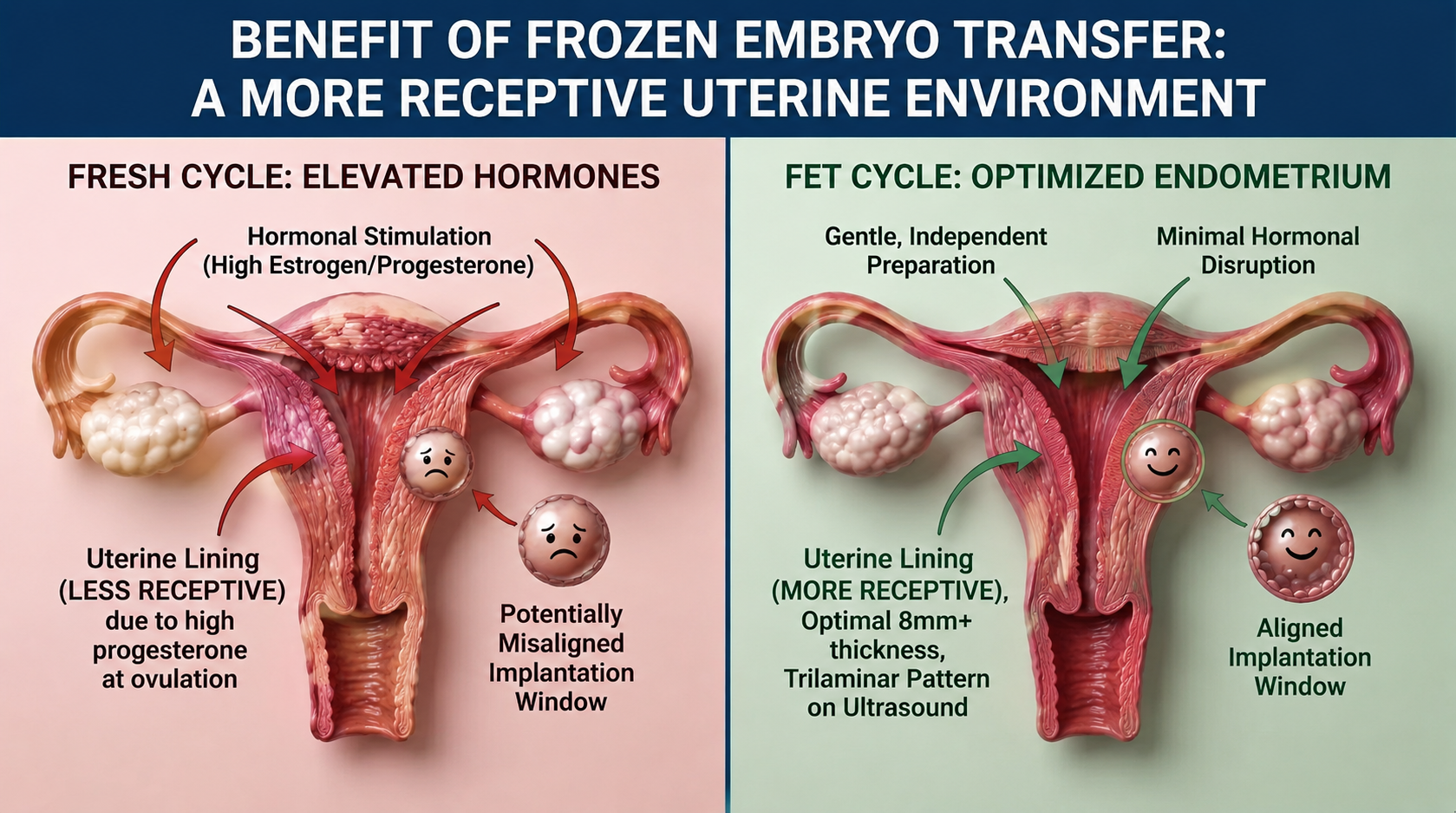
The assessment of uterine condition at transfer time shows that FET offers greater benefits than fresh embryo transfer. The IVF process starts with doctors performing ovarian stimulation through high hormone doses during a fresh IVF cycle. This is a major reason why the frozen embryo transfer success rate India continues to improve across leading fertility centres. The elevated progesterone levels at ovulation trigger time cause hormonal changes that result in minor but critical alterations to the uterine lining that make it temporarily unsuitable for its current embryo development stage.
Ovarian stimulation effects do not affect the uterus during an FET cycle. The endometrium is prepared through independent and gentle methods, which enable it to reach an optimal thickness of 8mm or above while displaying the classic trilaminar pattern on ultrasound, which shows peak receptivity. Dr. Aravind consistently emphasizes: 'A well-prepared uterus is as important as a high-quality embryo. Our FET success rates remain high because FET gives us complete authority over how we prepare the uterus for FET.'
Ovarian Hyperstimulation Syndrome represents a dangerous risk for IVF procedures because it causes the ovaries to swell and develop discomfort after patients receive hormones. The severe OHSS condition leads to major health problems, which include excessive fluid accumulation and difficulties with breathing, blood clotting disorders and requires medical treatment in a hospital.
The 'freeze all and transfer later' method, which involves freezing all suitable embryos while skipping any direct embryo transfer during the current treatment cycle, provides a major decrease in OHSS risk. The woman waits until her ovaries have recovered their normal state before she receives her first embryo transfer because this process prevents hCG from increasing, which would worsen her already existing hyperstimulated condition. Dr. Aravind recommends the freeze-all approach, which he follows with FET treatment as a standard procedure for his patients who experience PCOS with high antral follicle counts or previous episodes of OHSS.
Fertility treatment requires continuous engagement from patients because their personal life activities remain active during this time period. The FET cycle enables patients to choose their embryo transfer time according to their individual situation, which includes work obligations, family needs and upcoming travel and medical needs. Vitrified embryos maintain their full quality for multiple years because their storage method prevents any significant decline in their condition. The flexible schedule enables couples to reduce their mental stress and achieve their complete physical and emotional readiness before they start their next steps.
The process of Preimplantation Genetic Testing (PGT), which includes PGT-A for chromosomal aneuploidy screening and PGT-M for monogenic disorders, requires the biopsy of embryos, which are then frozen until the testing results become available. The only option for genetic testing during treatment exists through FET. Procedures like PGT FET treatment India require embryos to be frozen before transfer, making FET essential for genetic screening. The team at Dr. Aravind's centre has developed deep expertise in the specialized fields of PGS (Preimplantation Genetic Screening) and PGD (Preimplantation Genetic Diagnosis). The success rates for embryo transfer increase when doctors choose an embryo with normal chromosomes because this method decreases the likelihood of miscarriage.
The first stimulation cycle produces multiple exceptional embryos, and the vitrification of extra embryos permits transfer attempts to proceed without needing fresh treatments. Patients can attempt multiple transfers without repeating ovarian stimulation, reducing overall treatment burden and cost considerations, such as IVF frozen embryo transfer cost Tamil Nadu. The FET method enables couples to protect their health while saving money because they require two or three implantation attempts before achieving success.
Frozen embryos were believed to have lower success rates than fresh embryos, according to historical medical research. Modern vitrification technology has completely solved that problem. The studies that appeared in major reproductive medicine journals, together with Dr. Aravind's practice clinical data, demonstrate that FET success rates match fresh transfer cycles while showing superior results for various patient groups. The IVF Centre at Dr. Aravind's facility achieves an overall success rate of 75% through its IVF procedures, which benefit from FET as a major contributing factor.
Dr. Aravind's philosophy requires complete organization of information, which needs to be disclosed to the public. The medical field involves risks through all procedures because patients who understand their treatment options can choose what best suits their health needs. The following document presents an unbiased assessment that accurately describes the danger medical procedures pose during FET treatment.
Modern vitrification technology enables laboratories to achieve survival rates between 90 and 98 percent through their expert techniques. The freezing process becomes more likely to cause damage to embryos that have borderline quality because they were frozen as a safety measure instead of their strong developmental capabilities. The embryology team at Dr. Aravind's centre follows established protocols for vitrification and warming, while they only freeze embryos that meet their strict quality standards.
FET requires endometrial lining to achieve both proper thickness and correct pattern distribution. Women who have had previous uterine operations and have developed adhesions or structural deformities face challenges when trying to reach proper lining thickness. The transfer process will be delayed when the lining fails to show a proper response to hormone preparation. The embryo requires this mechanism to work as a safety system, which enables transfer to happen only when optimal conditions exist.
Some research exists that shows FET births result in LGA birth rates that exceed those of fresh transfer deliveries. The system functions through changes that develop in hormonal patterns, which control the uterine environment during the FET process. Dr. Aravind's team conducts ultrasound monitoring for all FET pregnancies while they follow established clinical protocols to address the identified problem.
The presence of extra embryos creates operational benefits for medical procedures but leads to emotional difficulties for patients. The FET process brings back feelings of hope and anxiety to patients. The existence of additional frozen embryos brings both comfort and pain when a cycle ends without achieving pregnancy. The counselling team at Dr. Aravind's clinic offers emotional assistance to patients throughout their entire journey because they believe that fertility treatment involves both medical and psychological elements.
Storage fees continue to accumulate for embryos that need to be stored beyond their initial time frame. The couple must choose between several options regarding their frozen embryos after completing their family, which includes options for storage, donation to other families, donation for research purposes, or disposing of the embryos. Couples need to conduct open discussions with their clinical team during the initial treatment stages to prepare for upcoming treatment possibilities.
Any embryo transfer procedure includes a small chance of developing ectopic pregnancy, which occurs when an embryo implants outside the uterus, as well as early pregnancy loss and procedure-related pain, which occurs during the process. The transfer procedure takes place at an urgent care facility, but Dr. Aravind provides patients with detailed instructions about their follow-up schedule, which includes blood tests and early pregnancy scans to verify correct intrauterine implantation.
Dr. Aravind and his team assess each couple individually, but FET works best for these two groups, which include:
A consultation with Dr. Aravind's team will determine FET as the correct treatment option for you through their analysis of your medical background, hormone levels and reproductive objectives.
The start of every FET procedure at Dr. Aravind's clinic requires an initial consultation. The team conducts a comprehensive evaluation, which includes your previous IVF records, embryo quality assessments, uterine examination results through 3D ultrasound or hysteroscopy if necessary and your hormonal baseline measurements. The medical staff use the available data to choose one of three treatment methods:
The natural FET protocol assists women who follow consistent ovulation patterns through ultrasound monitoring and LH surge detection to track their natural ovulation process. The protocol establishes a transfer schedule that begins progesterone supplementation after the woman confirms her ovulation. The protocol requires no more than essential medications, which most patients find easy to handle.
Estrogen tablets or patches create the endometrial lining, which progesterone prepares the uterus to receive. This protocol enables precise timing management, especially beneficial for women who experience irregular cycles or do not ovulate, or who desire a defined timetable.
The procedure tracks natural ovulation but uses a trigger injection to achieve precise ovulation control. The medical team implements progesterone support after the woman has ovulated. The method works best for women who require management of their ovulation schedule.
You must come to the clinic on transfer day with a bladder that holds enough urine because this aids in the ultrasound examination. These approaches fall under the FET protocol natural vs medicated, depending on individual needs. The procedure lasts about 15 to 20 minutes, which most people find painless and does not need anaesthesia. You need to rest for at least 15 minutes after the procedure before you can go home. You can start your standard activities again, but you should avoid intense workouts for a few days.
Dr. Aravind provides his patients with practical recommendations that extend beyond the technical aspects of his medical procedures.
The founders of Dr. Aravind's IVF Fertility & Pregnancy Centre established their organization based on one principle, which states that all couples must receive superior fertility treatment together with compassionate services. The centre provides fertility treatment through its more than 30 years of expertise and its specialized team of fertility doctors and embryologists who use advanced laboratory facilities to serve thousands of families throughout South India.
The centre demonstrates technical excellence, but its unique differentiating element comes from the underlying philosophy that governs its operations. The staff provides comprehensive consultations that they conduct at a deliberate pace. The medical staff develops treatment plans that they create specifically for each patient instead of following a standard procedure. The team provides you with support through difficult times while maintaining their commitment to stay by your side, with expertise in embryo vitrification Chennai and high success rates. The multiple centres located throughout Chennai and the cities of Coimbatore, Madurai, Trichy, Tanjore, Erode, Salem and Tiruppur make it possible for you to find expert medical assistance at a nearby location.
Frozen Embryo Transfer functions as a crucial breakthrough that improves current methods used in reproductive medicine. Modern vitrification ensures outcomes equal to or better than fresh transfers, making FET a preferred option at the best IVF centre for FET Chennai. The procedure enables patients to control their treatment while achieving optimal implantation conditions, experiencing reduced health risks and gaining access to multiple treatment attempts through single retrievals.
Medical procedures require assessment of their benefits and drawbacks, yet FET becomes a secure and effective treatment option that parents choose when medical experts operate with their prepared patients. While evaluating frozen embryo transfer risks and benefits, patients can confidently choose FET under expert guidance. The team at Dr. Aravind's IVF Fertility & Pregnancy Centre provides support for every aspect of your journey to parenthood because they understand its personal nature.
No, FET is a minimally invasive and usually painless procedure that does not require anesthesia.
Risks include embryo thaw failure, cycle cancellation due to poor lining, slight increase in large babies, and rare complications like ectopic pregnancy.
FET is ideal for women at risk of OHSS, couples undergoing genetic testing, or those who want flexible timing for embryo transfer.
An FET cycle typically takes about 2 to 4 weeks, depending on the preparation protocol used.
Yes, if multiple embryos are frozen, couples can attempt multiple transfers without repeating the full IVF cycle.


