In the last few decades, frozen embryo transfer (FET) has matured into one of the most popular and efficacious treatments offered in an IVF program. Instead of transferring embryos right after fertilization, embryos are being frozen and cryopreserved for later usage in another cycle. This way, the body can recuperate, hormone levels can stabilize, and the uterus can attain optimal conditions for embryo implantation.FETs often lead to better results because the management of the treatment is relaxed for couples.
Understanding how FET cycles work and when to make use of them, as well as knowing the successful variables, can decrease anxiety in couples, making them more comfortable in the process of fertility. The following is a comprehensive introduction to the FET process as applicable to timelines, procedures, success rates, and the best transfer day.
A Frozen Embryo Transfer Cycle is not a fresh embryo transfer procedure but rather thawing of a previously frozen embryo and transferring it to the well-prepared uterus after a natural cycle. The entire cycle and the preparation are therefore not increased by ovarian stimulation and egg retrieval but can fully devote all attention to establishing the ideal intrauterine environment.
Frozen embryo transfer can be either natural or hormone-supported. In a natural cycle transfer is timed to coincide with the ovulation of the patient, whereas in the hormone-assisted cycle estrogen and progesterone are given to prepare the lining of the uterus for the embryo. Under both methods embryo transfer could be successfully undertaken depending on the case of the patients, their cycle pattern, hormone levels, and clinical history.
The couples commonly ask about when FET can be timed in relation to the menstrual cycle. Preparation is usually initiated just after menses are over, so that hormone levels and endometrial development can be monitored by the physician.For the patients, whether the FET is done after the period depends on whether it is a natural or stimulated cycle. In stimulated (medicated) cycles, estrogen is started usually on days 2-5 of the cycle, and transfer is done usually between 17 and 21 days thereafter. On natural cycles, the exact day of transfer is determined by ovulation.
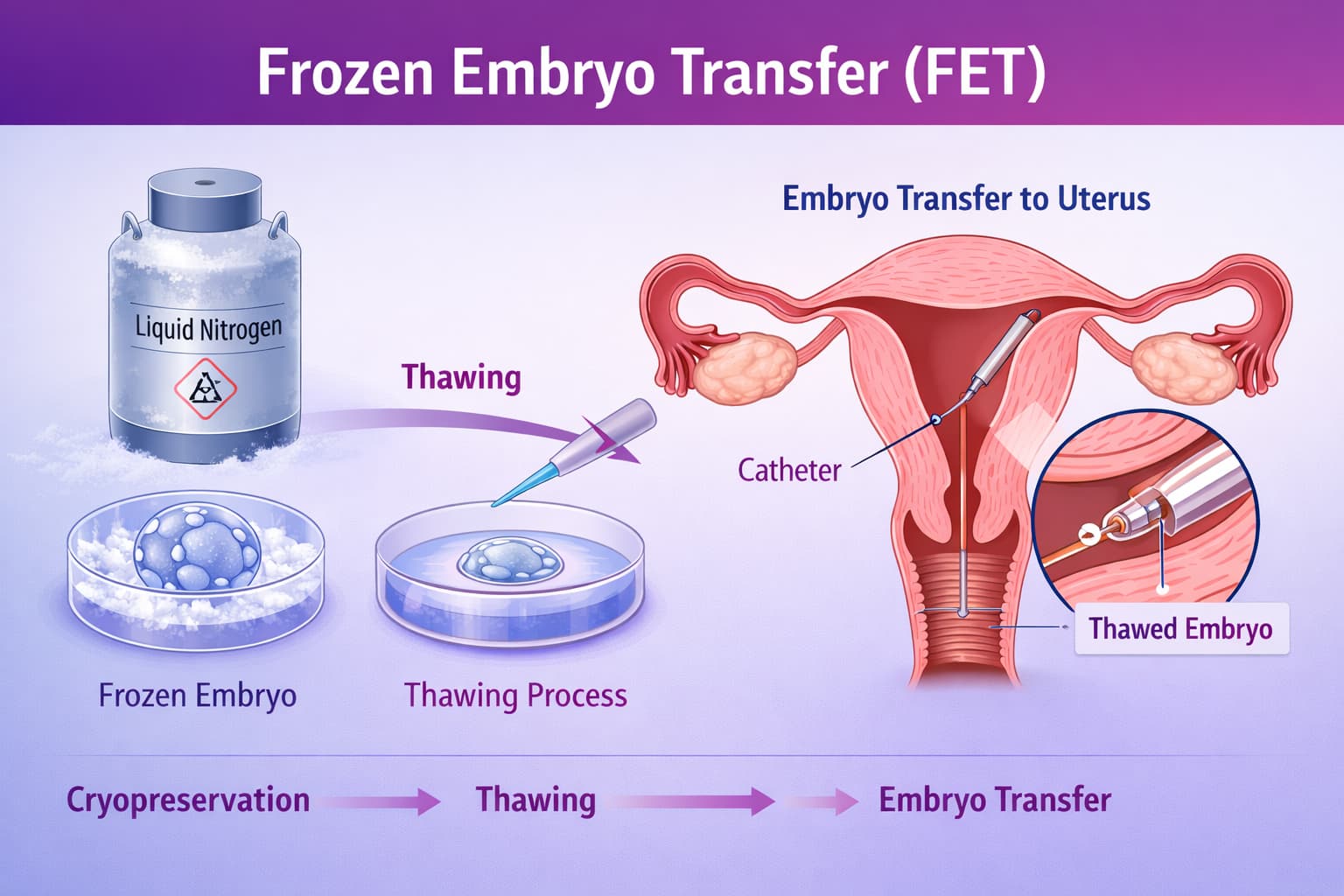
The day of embryo transfer is important for the success of implantation. In order for pregnancy to take place, the uterus must be in a perfectly synchronized state with respect to the developmental stage of the embryo.The doctors determine on what day of cycle is frozen embryo transfer done by coordinating the age of the embryo (day 3 or day 5) with the exposure of progesterone in the uterus. For instance, a day-5 blastocyst is transferred following an exposure of 5 days of progesterone support. This timing ensures that the embryo is in contact with the uterus during the implantation window. The FET process is simple and painless, without any need for anesthesia. Its actual preparation, however, is very, very important. The Frozen Embryo Transfer Procedure begins with hormonal preparation and ultrasound monitoring for adequate uterine lining thickness. When the uterus is ready, the embryo is thawed in the lab and introduced into the uterus via a fine catheter, without disturbing daily activity, takes just a few minutes of time.
An aware timeline allows patients to plan ahead emotionally and physically for the treatment cycle. FET cycles are in general less stressful than fresh IVF cycles. The Frozen Embryo Transfer Timeline usually starts from day 2 or 3 of the menstural cycle with estrogen medication. After about 10 to 12 days, the uterine lining is checked. Progesterone is then started, and it is decided a few days later when to do the embryo transfer depending on embryo age. A pregnancy test is done 10 to 14 days after transfer.
For many couples, the question is how long they should wait between egg retrieval and frozen embryo transfer (FET) procedure. The waiting time is to allow the body to return to its natural hormonal imbalance. The IVF Frozen Embryo Transfer Timeline could be as little as one month or many months following egg retrieval. Some individuals can proceed with FET in the very next cycle; however, others may postpone FET for medical reasons, genetic testing, or personal preferences. This is one of the greatest advantages of FET.
In contrast to fresh transfers, the timing of egg retrieval is not a determinant of FET. This division allows for gaining an even more favorable outcome while decreasing risks such as hyperstimulation of the ovaries. As to how many days after egg retrieval is a frozen embryo transfer, this varies. Normally an FET is done at least one complete menstrual cycle after egg retrieval to allow for recovery of ovaries and uterus. At times this decision could go longer towards better health conditions or to prepare the uterus.
FET demands a well-aligned orchestration of hormonal preparations, laboratory expertise, and timing. Lining preparation, embryo thawing, transfer, and luteal support with progesterone are all parts of the Frozen Embryo Transfer Process. After transfer, patients are told to continue medications and avoid unnecessary stress while waiting for the pregnancy test. This time, the so-called two-week wait, while emotionally challenging, is important for implantation.
Among the most crucial factors influencing successful implantation is the uterine lining in its healthy state. For an ideal frozen embryo transfer lining, thickness has to range between about 8-12 mm with a trilaminar (three-layered) appearance. In case of thinner lining, their doctors may alter medications, prolong estrogen therapy, or propose added receptivity treatments before the transfer.
It helps in understanding the steps of the treatment, which helps reduce the fear and the unknown. Stepwise experience of frozen embryo transfer involves planning cycles, hormonal medications, ultrasound monitoring, thawing embryos, transfer day, and post-transfer care. Patients are often surprised about how fast and comfortable the transfer is compared to egg retrieval. It helps in understanding the steps of the treatment, which helps reduce the fear and the unknown.
Stepwise experience of frozen embryo transfer involves planning cycles, hormonal medications, ultrasound monitoring, thawing embryos, transfer day, and post-transfer care. Patients are often surprised about how fast and comfortable the transfer is compared to egg retrieval.
Every effort at transferring something creates a new window for a pregnancy to occur, thus cumulatively increasing the chances of conceiving over time. Frozen embryo transfer success rates generally range from 40 to 60%, depending on age and whether the embryos are of good quality. However, with attempts, those chances increase because the uterine environment may improve its receptivity. In addition, treatment protocols can be tailored based on previous cycles. Couples who had unsuccessfully first try on getting pregnant will often try again.
The cumulative success rates of in vitro fertilization with 2 frozen embryos are greater than 60-75 per cent when good embryos are available. Doctors examine the preceding cycle closely and can make some changes that would greatly enhance results on subsequent attempts.
The intrauterine embryo transfer stage is but one of the many factors enhancing the chances of implantation. By virtue of being more developed, success rates for a frozen embryo transfer on the 5th day are higher than for transfer on the 3rd day. In any case, day 5 allows for better synchrony between embryo and uterine lining and thus enhances chances of implantation.
The most important part of your journey to becoming a parent may depend on your choice of fertility center-and that's where Dr. Aravind's IVF differs. With experience in reproductive medicine spanning decades, the center combines advanced IVF technologies with a personalized compassionate approach. Each treatment plan is customized, not templated, ensuring each couple is offered solutions to their medical and emotional needs.
What really makes Dr. Aravind's IVF ethical and transparent is its emphasis on having high success rates with regard to IVF, IUI, and advanced fertility procedures. Backed by a sound embryology team, modern labs, and patient-first care, Dr. Aravind's IVF wouldn't just treat- but offer authentic hope, trust, and support to every single step of that journey.