Actually, blastocyst means a five- to six-day-old embryo which has developed enough to implant into the uterus. With the embryo already differentiated into two main structures, the inner cell mass of the baby, and an outer layer that will become the placenta, one can imagine what happens during this period. Transferring blastocysts increases the chances of pregnancy through IVF since they are more matured and ready to implant and nestle in the womb.
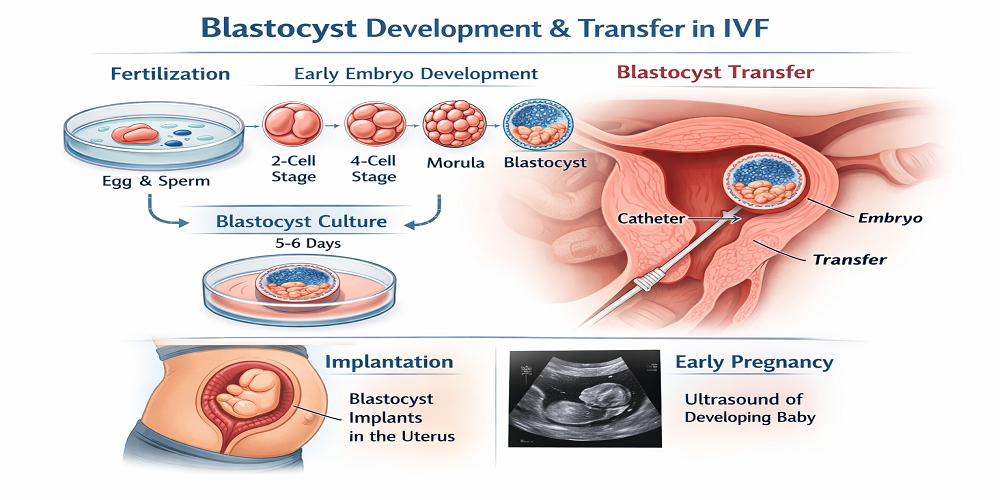
Blastocyst is an embryo, which develops around 5 to 6 days after fertilization and gets ready to implant within the uterus. A blastocyst consists of two main parts: the inner cell mass that will become a baby and an area that develops into the placenta. Blastocyst meaning is actually quite beneficial to couples since it lays a foundation for knowing why this is important in the context of IVF treatments. Transferring a blastocyst gives the embryo a better chance to implant successfully, because it is more developed and strong. Choosing to go with blastocyst transfer is likely to increase the chances of pregnancy and ensure a healthy start to your parenthood journey.
The blastocyst stage marks a significant point in the early development of the embryo. Typically, this stage arrives about day five or six after fertilization. An embryo has grown structurally from essentially one or two cells to a structured form with a fluid-filled cavity. It begins differentiating to two major forms: one will develop to become a baby, while another will form to become a placenta. If the embryo reaches the blastocyst stage, it is an indicator of good development potential and helps reduce the choice of embryos that will be transferred. In addition, this matches the natural timing of when implantation occurs in the uterus, thus improving the chances of success in pregnancy.
Embryo is the early stage after fertilization usually between days 1 to 3 and where it is just a small cluster of dividing cells. Continued development will lead to the formation of a blastocyst usually on day 5 or day 6. With regard to embryo vs blastocysts, the most significant difference is in terms of maturity and structural composition. Blastocysts have a chamber filled with a fluid and specific cells that will eventually become babies and placental components. This makes a blastocyst stronger in development, has better potential for implantation, and allows more accurate selection during IVF treatment as compared to an early embryo.
Transferring a 5-day blastocyst into the uterus is mainly performed in the practice of IVF as the moment coincides with the natural timing of implantation. Following transfer, the blastocyst will initiate its attachment to the lining of the uterus about 1-2 days after transfer. Following this, the process of implantation will proceed slowly over the next few days, as the embryo "settles" and links with the endometrium. During this time, the hormonal changes are initiated in a woman signaling the start of pregnancy. This period can often evoke an emotional response, but it is an inevitable and promising part of the IVF journey.
Offering labs in embryology fully equipped with state-of-the-art technology plus extremely careful observation of embryos during their growth, alongside a few of the most careful and competent fertility specialists, this center gives treatment according to individual requirements. One of the top fertility centers, Dr. Aravind IVF Centre in Krishnagiri, providing world-class medical excellence. It sets up a very strong emotional bond with the people receiving treatment and their trust in the doctor's skill and judgment, with clear communication in terms of all treatment options. Each step brings the couple that much closer to feeling confident, comfortable, and giving themselves the best chance of success.