Fibroids can change size during IVF or pregnancy, but growth is not guaranteed and cannot be predicted from the IVF protocol alone. Fibroids respond to hormones, and stimulation and pregnancy both change hormone levels, so some fibroids may grow while many stay the same. Small differences between two scans can be measurement variation. What matters most is usually where the fibroid is and whether it distorts the womb cavity, blocks access to an ovary, or causes symptoms, not how big it is.
Key points
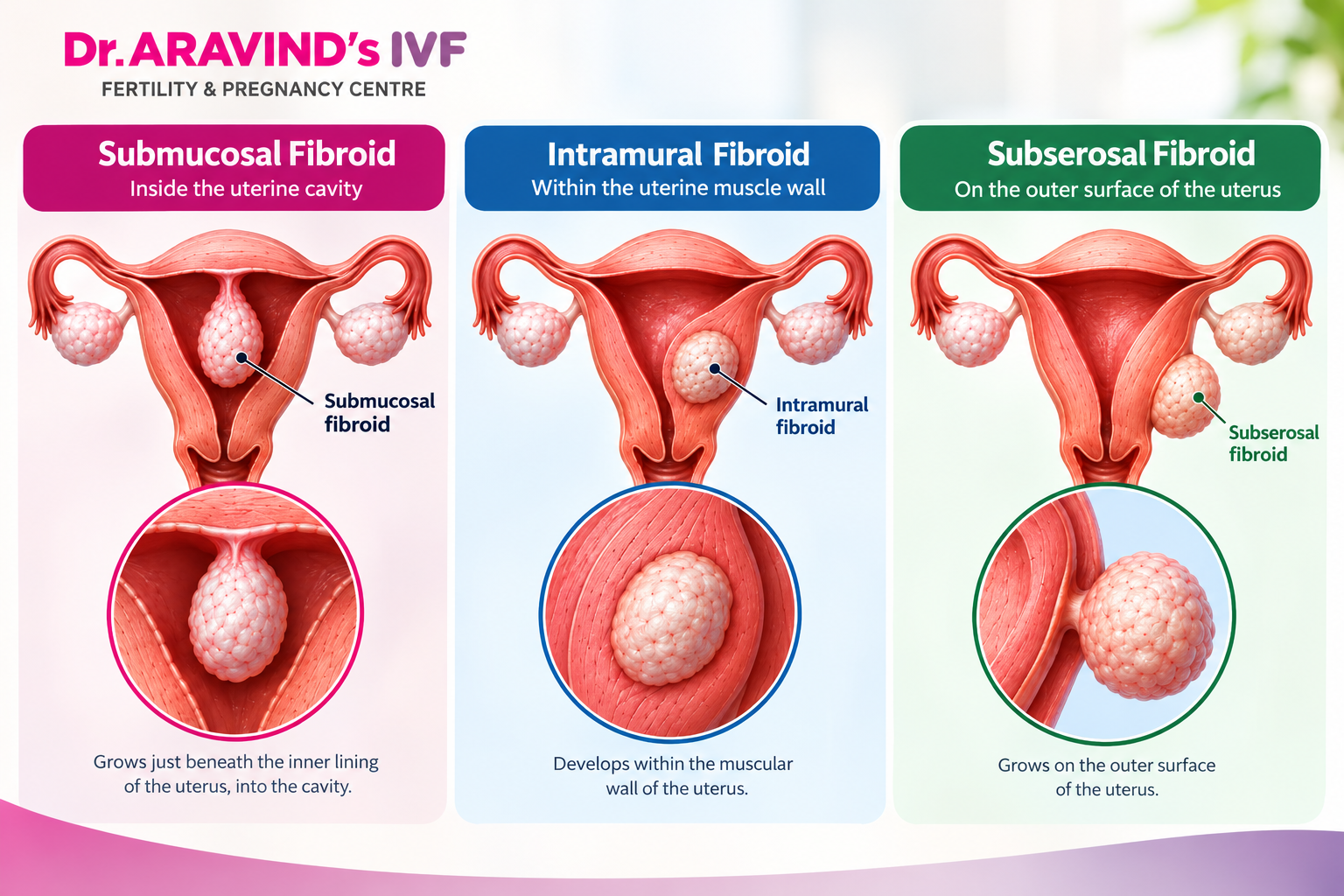
Fibroids (also called leiomyomas or myomas) are common, non-cancerous growths from the muscle of the womb. You can have one or several. They are often found by accident on a routine scan, a fertility work-up, an IVF baseline scan or a pregnancy scan. Many cause no symptoms and do not stop pregnancy.
| Type | Where it grows | Why it matters for IVF |
|---|---|---|
| Submucosal | Toward or into the womb cavity. | Can change the lining surface, cause heavy bleeding and interfere with implantation. These fibroids are more likely to need treatment before embryo transfer. |
| Intramural | Inside the muscle wall. | Some do not touch the cavity. Larger or well-positioned ones may distort it. Their effect on IVF outcomes is still debated. |
| Subserosal | On the outer surface of the womb. | Usually has little effect on implantation unless it is very large, causes symptoms or obstructs access to the ovary. |
| Cervical or lower womb | Near the cervix. | May make it harder to pass the embryo transfer catheter into the womb. |
| Near an ovary | Beside or in front of an ovary. | May make egg collection more difficult. |
Remember: Size alone does not determine whether a fibroid affects fertility. A 3 cm fibroid pressing into the womb cavity can matter more than a 6 cm fibroid on the outside of the womb. If your scan report uses FIGO type numbers, ask your doctor to explain what your specific classification means.
Fibroids respond to estrogen and progesterone, and stimulation raises hormone levels for a while. Some fibroids may react, but the response varies a lot, and the evidence does not support assuming every fibroid will grow.
Your team may record the fibroid before stimulation and scan it again during the cycle when there is a reason to. Do not stop your injections because of a small change in a measurement.
Measurements can differ because of the angle of the probe, the person scanning, how clearly the edges show, or the way two scans were taken. Doctors compare scans carefully, and prefer the same method and, where possible, the same operator. A small difference is often not a real change.
Baseline transvaginal ultrasound. This can record the number of fibroids, their position and FIGO type, their size in three dimensions, whether the cavity looks distorted, the lining, how easily the ovaries can be reached, and any other findings. See baseline scan before IVF.
Follow-up scans. These may be repeated during stimulation or before transfer, depending on symptoms, fibroid position and size, and clinic protocol.
Saline scan or hysteroscopy. If the cavity isn't clear, these can show whether a fibroid pushes into it. Hysteroscopy can also remove some cavity-based fibroids. See hysteroscopy before IVF and diagnostic hystero-laparoscopy.
MRI. Useful when fibroids are multiple, large, unusual or deep, or when it is unclear whether a finding is a fibroid or adenomyosis. Not needed for every small, clearly identified fibroid.
Most fibroids are benign, but fast change, unusual scan features or worrying symptoms need proper assessment, not an assumption.
Not automatically. Doctors weigh:
| Situation | What often happens |
|---|---|
| Small fibroid, cavity not distorted | It may be monitored while proceeding with IVF. |
| Cavity-distorting fibroid | The plan may change, often with treatment considered before embryo transfer. |
| Fibroid blocks access to follicles | Treatment may be discussed before ovarian stimulation. |
| Heavy bleeding or anaemia | These may need treatment first or alongside fertility care. |
| Older age or low ovarian reserve | Time pressure may favour creating and freezing embryos first. |
Whether to operate is covered in fibroid removal before IVF.
A fibroid that fills the pelvis or shifts an ovary can make that ovary harder to reach. Egg collection is done through the vagina under ultrasound, so anatomy matters. Your doctor can check access on the scan and discuss whether anything needs treating first. A fibroid does not automatically prevent egg collection.
A fibroid in the cavity may change the lining surface, and one at the cervix may narrow the path for the catheter. The team can review the cavity images and plan the transfer. A hard transfer doesn't guarantee failure, and an easy one doesn't guarantee success. See the embryo transfer procedure.
Fibroid size can change in pregnancy, especially in the first trimester, though patterns vary. Fibroids may sometimes cause pain from degeneration, pressure or bleeding, but many pregnancies go smoothly. The obstetric team may keep an eye on fibroid position, its relation to the placenta, baby's growth, symptoms and delivery planning. Don't take painkillers in pregnancy without checking with your obstetric team.
Uterine artery embolisation and other non-surgical procedures need careful fertility counselling because their effect on future pregnancy varies. Details on surgery are in fibroid removal before IVF.
[Reviewer/doctor to write 3 to 4 honest sentences: for example, which scans the team uses at baseline, how decisions are made with the gynaecological surgeon, and what patients are told. Do not include success figures or claims that cannot be proven. Delete this note.]
Fibroids can change during IVF or pregnancy, but they don't always grow, and a small scan difference does not automatically mean treatment. Position, cavity distortion, symptoms, access to the ovaries, and your timeline usually matter more than size. We tailor monitoring and treatment to you.
Get personalised guidance on fibroid position, treatment options and the next steps in your fertility journey.
Book for ConsultationDr. Aravind's IVF Fertility & Pregnancy Centre
Fibroid management during IVF depends on size, position, symptoms, cavity distortion, ovarian access and your fertility timeline. This article is for education and does not replace an ultrasound-based medical plan.
No. Some fibroids may change size with hormone shifts, but growth is not inevitable, and scans have to be compared over time.
Size alone doesn't decide it. A 3 cm fibroid that pushes into the cavity may matter more than a larger one on the outside of the womb.
Many women do, successfully. It depends on position, the cavity, size, symptoms, ovarian access and other fertility factors.
They may be, at baseline and during treatment when it is clinically relevant. The schedule depends on the fibroid and your plan.
One that distorts the cavity may interfere. The effect of fibroids that don't distort the cavity is less certain, especially when they are small.
It depends on position, size, number and the pregnancy itself, so a specialist should interpret it rather than quote one risk figure.


