Medically reviewed by [Dr. Dr. Aravind Chander - Best IVF Specialist, MBBS, MS (OG), A.R.T ( Singapore ), F.MAS, D.MAS (Germany), M.MAS, F.R.M] | Published [01/10/2026]
Who is eligible for IVF? People or couples who have difficulty conceiving may be considered for IVF when the cause or duration of infertility suggests it is the most suitable treatment. Common reasons include blocked fallopian tubes, ovulation problems, reduced ovarian reserve, endometriosis, significant male-factor infertility, unexplained infertility, and previous treatment failures. IVF may also be used with donor eggs or sperm, embryo testing for an inherited condition, or fertility preservation for a medical reason.
However, there is no single IVF eligibility test. A fertility specialist reviews both partners: the cause and duration of infertility, age, ovarian reserve, sperm health, the condition of the uterus, general health, previous treatment, and the safety of pregnancy. In India, treatment must also follow the ART (Regulation) Act, 2021.
Being diagnosed with infertility does not always mean IVF is needed straight away. Some couples first benefit from timed intercourse, ovulation induction, IUI, surgery or treatment of an underlying condition.
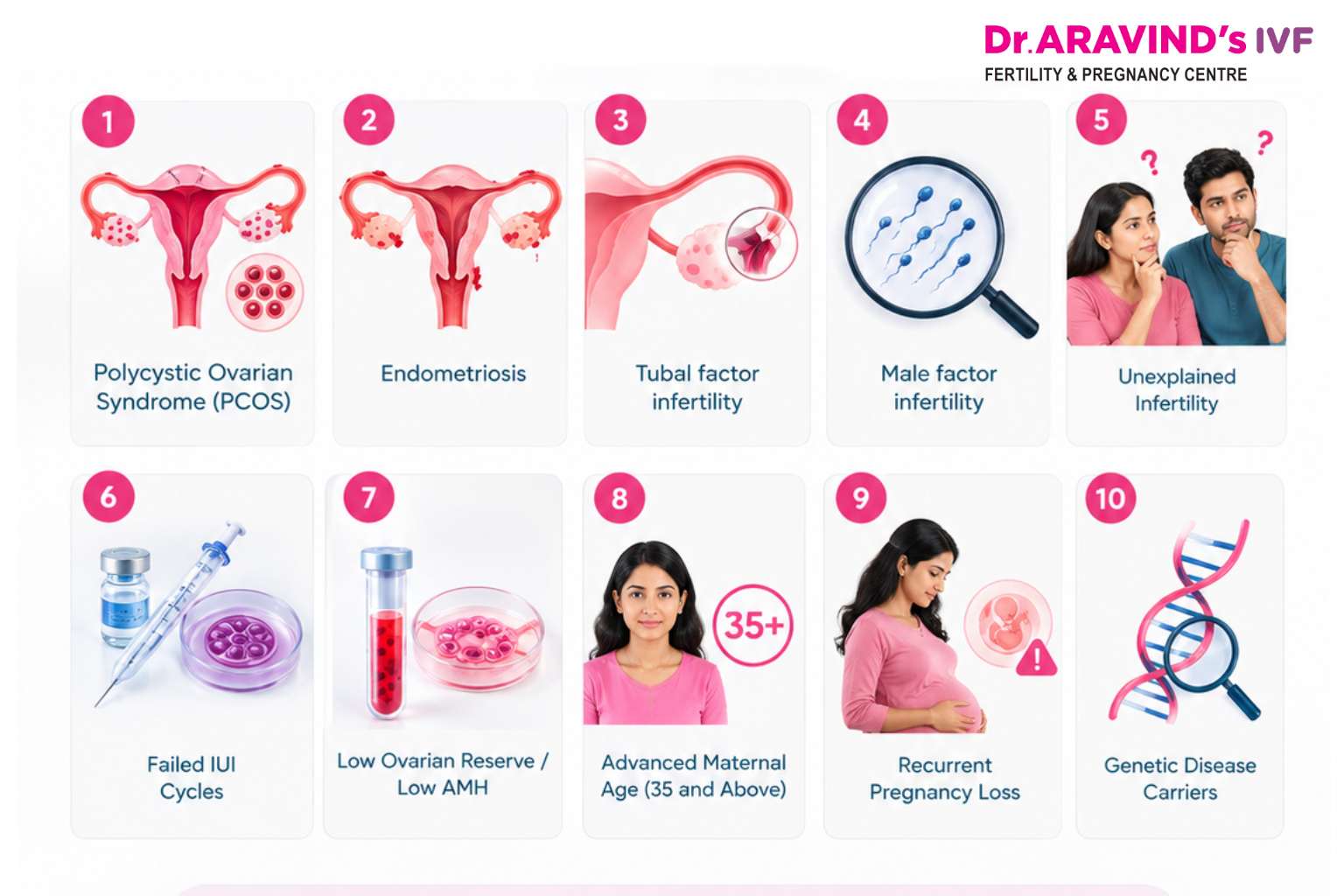
IVF eligibility means a medical team has assessed whether IVF is a reasonable, safe, and legally permitted option for your situation. It tells you IVF is a sensible option for you. It doesn't tell you how things will turn out, and no two treatment plans are exactly alike. Our IVF treatment team usually works through four questions:
Is IVF medically appropriate for the cause of infertility?
Can the ovaries, sperm, and uterus be assessed and treated safely?
Are there medical conditions that should be treated before pregnancy?
Does the proposed treatment follow applicable regulations and clinic policies?
This table shows when IVF is commonly discussed and what a doctor may try first. It is a general guide, not a diagnosis.
| Situation | Why IVF may be considered | Options a doctor may discuss first |
|---|---|---|
| Blocked or damaged fallopian tubes | Egg and sperm may not be able to meet naturally | Tubal surgery in selected cases |
| Ovulation disorders (PCOS, thyroid, high prolactin) | Simpler treatments have not worked, or other factors are present | Cycle tracking, ovulation medicines, treating the underlying condition |
| Male-factor infertility | Severely reduced sperm count or motility, failed fertilisation, or surgically retrieved sperm may need ICSI | Lifestyle changes, medicines, varicocele surgery, IUI |
| Endometriosis | Pelvic anatomy and egg quality may be affected | Medical treatment, surgery, IUI, depending on severity |
| Unexplained infertility | No cause found; age and duration guide timing | Timed intercourse, IUI |
| Previous IUI or treatment failure | Repeating the same approach may offer a low chance of success | Review of diagnosis and protocol |
| Reduced ovarian reserve or older age | Time-sensitive; response to stimulation matters | Earlier assessment; donor eggs may be discussed where appropriate |
| Genetic risk or fertility preservation | Embryo testing or freezing of eggs, sperm or embryos is needed | Genetic counselling and specialist review |
The fallopian tubes are where sperm and egg commonly meet. If both tubes are blocked or badly damaged, natural conception may be difficult or impossible. Tubal damage can be linked to previous pelvic infection, endometriosis, abdominal surgery, hydrosalpinx and other conditions.
Depending on the findings, the specialist may discuss tubal surgery or IVF. An HSG, ultrasound, laparoscopy or other test may be used when clinically appropriate. A tubal blockage does not mean every person needs the same procedure.
Some people do not release an egg regularly. PCOS, thyroid conditions, high prolactin and low ovarian reserve can all affect ovulation. Treatment may begin with cycle tracking or ovulation medicines. IVF may be considered when simpler treatments do not work, when other fertility factors are present, or when the doctor believes IVF is the more suitable path.
Male infertility can involve low sperm concentration, reduced motility, abnormal morphology, azoospermia, varicocele, ejaculation problems or sperm DNA concerns. Both partners should be evaluated because male factors contribute to a substantial proportion of infertility cases (see the AUA/ASRM male infertility guideline).
Depending on the report, treatment may include lifestyle changes, medicines, surgery, IUI, sperm retrieval or ICSI. IVF with ICSI may be discussed when sperm count or motility is severely reduced, fertilisation has previously failed or surgically retrieved sperm is used. Read more about male infertility and semen analysis.
Endometriosis may affect the ovaries, tubes, pelvic anatomy and the environment around the reproductive organs. Some patients have surgery or medical treatment first, while others are advised to consider IVF based on age, ovarian reserve, symptoms, tubal status and previous attempts to conceive.
Sometimes standard tests do not identify a clear reason for delayed conception. Depending on age, how long the couple has been trying, previous treatment and test results, a doctor may recommend continued timed attempts, IUI or IVF. "Unexplained" does not mean imaginary. It means the cause has not been identified by the tests performed so far.
IVF may be considered after unsuccessful cycles of ovulation induction or IUI, particularly when age, duration of infertility or test results suggest that continuing the same approach may have a low chance of success. The number of attempts before moving to IVF is not the same for everyone. A specialist should explain the expected benefit, cost, risks and alternatives.
AMH and antral follicle count give information about ovarian reserve, while age is strongly linked to egg quality and reproductive potential. A low AMH result does not by itself mean IVF is impossible, and a normal AMH does not guarantee pregnancy. See our guide to low AMH and pregnancy.
When ovarian reserve is reduced or a person is older, the doctor may discuss treatment timing, the likely response to stimulation, the possibility of fewer eggs or embryos, and alternatives such as donor eggs where appropriate.
IVF may be part of a plan when a couple needs preimplantation genetic testing for a specific medical indication, or when eggs, sperm or embryos must be preserved before treatment that may affect fertility. These options have specific indications, limitations and legal considerations and should be discussed with the appropriate specialist.
Age matters because it affects egg quantity and quality, miscarriage risk and the chance of a healthy live birth. But no single age number decides eligibility for every patient. See IVF success rate by age for how age relates to outcomes.
In India, the ART (Regulation) Act, 2021 sets legal age bands: ART services may be provided to a woman aged 21 to 50 years and a man aged 21 to 55 years (Section 21(g)). Clinics providing IVF must be registered under the Act. The Act covers married couples and, subject to its conditions, certain single women. How it applies to an individual case, including unmarried or single patients, should be confirmed with a registered fertility centre.
Within the legal limits, the doctor may also consider:
A consultation should give you an individualised discussion rather than a promise based only on age.
Not sure whether IVF is the right next step?
Bring your reports and treatment history to a fertility consultation so the team can explain your options, expected timeline and likely costs.
You do not need to wait until you "qualify" for IVF. As a general guide, consider a fertility consultation if:
These are general guides. A specialist may advise earlier or later based on your history.
The exact list varies, but a pre-IVF assessment may include the tests below. Learn more about female fertility tests and hysteroscopy before IVF.
| Test | For | What it helps assess |
|---|---|---|
| Medical and reproductive history | Both | Duration of infertility, previous treatment, surgeries, long-term illness |
| Menstrual-cycle review | Female | Ovulation pattern |
| AMH, FSH, LH, estradiol | Female | Ovarian reserve and hormone balance, when indicated |
| Thyroid and prolactin tests | Female | Conditions that can affect ovulation, when indicated |
| Pelvic ultrasound and antral follicle count | Female | Uterus, ovaries and ovarian reserve |
| HSG, hysteroscopy or laparoscopy | Female | Tubal blockage or uterine cavity problems, when needed |
| Semen analysis | Male | Sperm count, motility and morphology |
| Infectious-disease and routine pre-treatment screening | Both | Safety before treatment |
| Review of medicines, surgeries and illnesses | Both | Safety and timing of treatment |
Not every test is necessary for every person. The goal is to gather information that changes treatment decisions, not to order tests without a clinical reason.
A doctor may recommend treating or stabilising another problem before IVF. Examples include an untreated infection, a significant uterine problem, an ovarian cyst that needs evaluation, uncontrolled thyroid or metabolic disease, severe anaemia, a medical condition that makes pregnancy unsafe, or a need to review medicines.
Sometimes the best decision is to delay a cycle, change the protocol or consider another treatment. This is a safety decision, not a failure of treatment.
Possibly, depending on the complete evaluation. Low AMH may be associated with fewer eggs retrieved, but it does not alone determine whether pregnancy can occur. With azoospermia, the cause matters. Some patients have retrievable sperm, while others may need donor sperm or a different treatment plan.
These situations require specialist assessment. Internet calculators cannot determine an individual's eligibility.
The following should not be used alone to decide whether IVF will work:
Fertility is a couple-level and patient-specific medical question.
IVF eligibility is decided through a complete evaluation, not by age, AMH, sperm count or one diagnosis alone. People with tubal disease, ovulation disorders, male-factor infertility, endometriosis, unexplained infertility, previous treatment failures or fertility-preservation needs may be considered for IVF, within the limits of Indian law and clinic policy.
If you decide to go ahead, our IVF preparation checklist and IVF process timeline explain what to do before and during your cycle.
Bring both partners' reports and treatment history to a consultation at Dr. Aravind's IVF Fertility & Pregnancy Centre to discuss the options relevant to your situation.
Medical disclaimer: This article is for general education and does not decide whether IVF is suitable for you. Eligibility, treatment timing and legal requirements must be assessed by a qualified fertility specialist.
Under the ART (Regulation) Act, 2021, ART services may be provided to a woman aged 21 to 50 years and a man aged 21 to 55 years. Within those limits, the doctor also considers ovarian reserve, uterine health and general health, so age alone does not predict whether IVF is suitable.
You can discuss IVF at any stage, but the doctor will consider whether another treatment is safer, more appropriate or more cost-effective for your diagnosis and age.
No. Infertility is one reason IVF may be considered, but the team must evaluate both partners and confirm that treatment is medically appropriate and legally permitted.
Eligibility depends on the ART (Regulation) Act, 2021, its rules, clinic policy and the clinical situation. The Act covers married couples and, subject to its conditions, certain single women. Ask a registered fertility centre for current, specific guidance rather than relying on general online statements.
It may be considered in selected cases, particularly when a specific genetic or fertility factor is identified. Recurrent pregnancy loss needs a dedicated evaluation; IVF is not automatically the answer.


