Many women search for blocked fallopian tubes symptoms after months of trying to conceive with no clear reason why. That search often ends with more questions than answers.
Here is the honest starting point. Blocked fallopian tubes often cause no symptoms at all. For many women, the first clue is simply difficulty getting pregnant, not pain or any obvious warning sign.
This guide explains what you might notice, what doctors look for, why tubes can become blocked, and what your options are if this is your diagnosis.
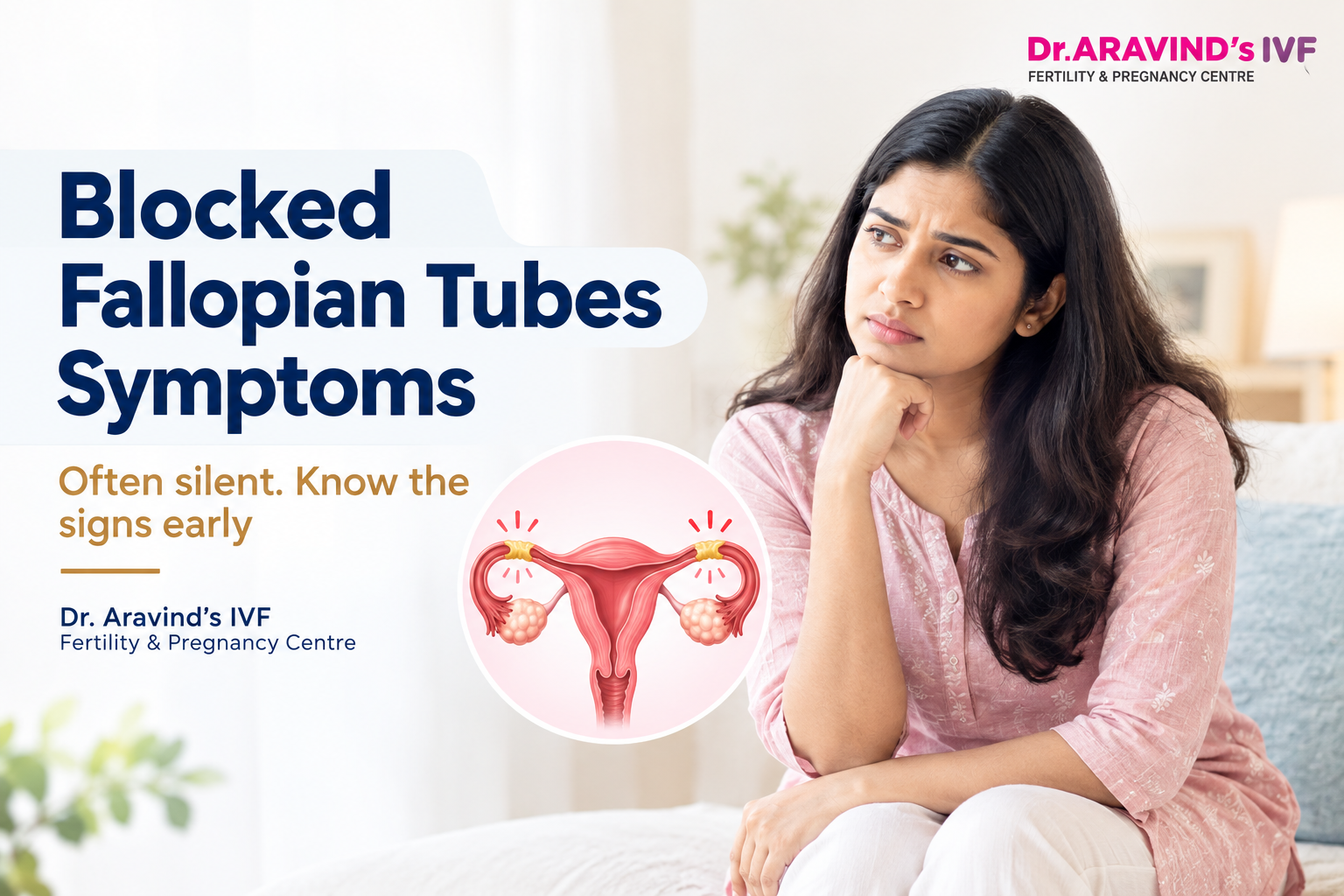
Most women with a blocked fallopian tube feel completely normal. The fallopian tubes are deep inside the pelvis, and blockage itself often does not cause noticeable symptoms.
When symptoms do appear, they tend to be subtle rather than dramatic:
These symptoms are not specific to blocked tubes. They may occur because of an underlying condition such as PID, endometriosis, or another pelvic problem, rather than the blockage itself. A proper test is what actually confirms a blocked tube.
Also Read: Fallopian Tube Blockage After PID: Causes and Fertility Impact
There is a useful difference between symptoms and signs. Symptoms are what you feel. Signs are what a doctor finds during testing.
Common signs of blocked fallopian tubes include:
These signs are what actually confirm the diagnosis, not how you feel day to day. This is why testing matters even when nothing feels wrong.
Where the blockage sits changes both the outlook and the treatment path.
Knowing the type of fallopian tube damage helps your specialist decide whether surgery is worth attempting or whether IVF is the more reliable route.
Most blockages come down to scarring from infection, inflammation, or surgery. Common causes include:
Also Read: Fallopian Tube Blockage After PID: Causes and Fertility Impact
In many cases, there is no single clear cause, and the blockage develops slowly over time without any obvious trigger. You can read more about tubal factor infertility from the American Society for Reproductive Medicine.
One cause deserves special attention for women in India specifically. Genital tuberculosis can affect the female reproductive tract and may cause tubal damage. It can also be difficult to recognize because some women have few or no obvious symptoms.
Many women have no chest symptoms and no known history of TB at all. In some cases, difficulty conceiving is the first and only sign.
If you have unexplained or severe tubal damage, your fertility specialist may consider whether further evaluation for genital TB is appropriate.
Yes, in many cases. If only one tube is blocked and the other is healthy, natural pregnancy is still possible. Many women in exactly this situation go on to conceive without medical help.
If both tubes are blocked, natural conception becomes very unlikely, and treatment becomes the realistic path forward.
Your actual odds also depend on your age, how well you ovulate, and your partner's sperm quality, not the tube condition alone.
Blockage can affect one tube or both, and the difference matters for your treatment options.
With one tube blocked, pregnancy may still be possible if the other tube is healthy and ovulation occurs normally.
With both tubes blocked, the egg has no path to meet sperm naturally, so treatment such as IVF usually becomes the realistic way forward.
The blockage itself can also be partial or complete. A partial blockage may still allow some fluid or dye through during testing, while a complete blockage stops it entirely. Your specialist looks at both how many tubes are affected and how severe the blockage is before recommending surgery, cannulation, or IVF.
A hysterosalpingogram (HSG) is the most common first test. A doctor passes a harmless dye through the cervix and takes an X-ray. If the dye does not flow through the tubes, a blockage is likely.
It is worth knowing that HSG results are not always final. HSG results can sometimes suggest a blockage when the tube is actually open, particularly when tubal spasm affects the test. Your doctor may repeat the test before confirming a diagnosis.
Other tests include:
Also Read: Female Fertility: What Affects It and How to Protect It
This is one of the most searched questions on this topic, and it deserves an honest answer.
No home remedy, massage, herbal tea, or supplement has reliable evidence behind it for opening a genuinely blocked tube. Once scar tissue has formed, it needs medical treatment to be addressed.
It is completely understandable to search for a natural option first. Surgery and fertility treatment can feel overwhelming. But delaying proper diagnosis in favour of unproven remedies often costs valuable time, especially since age affects fertility treatment outcomes too.
Surgery is not always the first step. Depending on the cause, your specialist may start with:
These options work best for mild or early-stage blockages. Suitability for cannulation specifically depends on the cause and exact location of the blockage, so not every case qualifies. More extensive scarring usually needs a surgical or IVF-based approach instead.
There is no single right answer here. The decision usually depends on a few specific factors.
Surgery may be considered in selected patients when the tubal damage is limited, and other fertility factors are favourable. Age, ovarian reserve, sperm factors, the location and severity of damage, and previous fertility history all influence the decision.
IVF is usually the better route when both tubes are blocked, when hydrosalpinx is present, when the damage is severe, or when age or ovarian reserve are also a concern. IVF bypasses the tubes entirely, so their condition stops being the limiting factor.
Get a clear diagnosis and a treatment plan built around your specific case.
Talk to a Fertility Specialist
Laparoscopy is keyhole surgery that allows a surgeon to view and sometimes treat blocked tubes directly through small incisions.
During the procedure, a surgeon may remove scar tissue, clear mild adhesions, or in some cases open a tube from the outside. Laparoscopy allows direct visual assessment of the tubes and surrounding pelvic structures and may be used when further evaluation is needed.
Recovery is generally quicker than open surgery, though it still carries standard surgical risks like infection or bleeding.
There is no tablet or injection that dissolves scar tissue and opens a blocked tube. This is an important distinction, since it is a common point of confusion.
Medicine plays a supporting role instead:
If a blockage is already present and scarred, medicine alone will not resolve it. Surgery or IVF becomes the realistic next step.
Consider booking an evaluation if:
If you have a history of pelvic infection, endometriosis, abdominal surgery, or previous tubal problems, a fertility evaluation can help identify whether your tubes may be affected. Getting evaluated early simply gives you more clarity and more options.
A blocked tube does not just interrupt one pathway inside the body. It can quietly interrupt a couple's entire timeline toward parenthood, often without a single warning sign along the way.
Understanding blocked fallopian tubes symptoms is the first step toward getting real answers, not just more questions.
Dr. Aravind's IVF Fertility & Pregnancy Centre supports women across Tamil Nadu, Kerala, Karnataka, and Nepal with complete tubal evaluation, diagnosis, and treatment planning built around each individual case.
You do not have to figure this out on your own.
Book Your Fertility Consultation
Speak with our specialists and take the next step with clarity.

Most women have no clear symptoms. When present, signs include difficulty conceiving, mild pelvic pain, pain during intercourse, and unusual discharge. A proper test is the only way to confirm a blockage.
Signs are what a doctor finds during testing, such as dye not passing through the tubes on an HSG, fluid buildup on an ultrasound, or scar tissue seen during laparoscopy. These confirm the diagnosis, unlike symptoms alone.
Yes, often. If the other tube is healthy and you are ovulating normally, natural pregnancy is still possible. Age, ovulation, and sperm quality also affect your actual chances.
No reliable home remedy opens a genuinely blocked tube. Once scar tissue forms, it needs medical evaluation and treatment, whether through a procedure, surgery, or IVF.
Yes. Genital tuberculosis can affect the female reproductive tract and may cause tubal damage. It can sometimes be difficult to recognize because symptoms may be limited or absent. If you have unexplained or severe tubal damage, your specialist may consider whether further evaluation is appropriate.
Blocked or damaged fallopian tubes are considered one of the common causes of female infertility, often linked to past pelvic infection, endometriosis, or prior surgery. The exact numbers vary across studies and populations, and many women only discover it during a fertility evaluation.
It depends on your case. Surgery may help younger women with mild, one sided blockage and no other fertility factors. IVF is usually preferred for severe damage, hydrosalpinx, or blockage in both tubes, since it bypasses the tubes entirely.


