Worried about the HSG test? This guide explains the HSG procedure in simple words. Learn what hysterosalpingography is, why doctors advise it, and the best time to have it, usually days 7 to 12 of your cycle. We cover preparation, each step of the test, pain level, risks and aftercare.
You will also find how to read your results, from open tubes to blocked tubes, and what happens next. We include HSG test cost in India, a clear comparison of HSG vs HyCoSy, and answers to common questions.
Book a consultation with Dr. Aravind's IVF for personal guidance and a clear plan.
Dr. Aravind Chander - Best IVF Specialist
Medically reviewed by: [MBBS, MS (OG), A.R.T ( Singapore ), F.MAS, D.MAS (Germany), M.MAS, F.R.M ]
Trying to conceive can bring many tests. One of the most common is the HSG procedure. Many women feel nervous about it. This guide explains what happens, what it feels like and what the results mean.
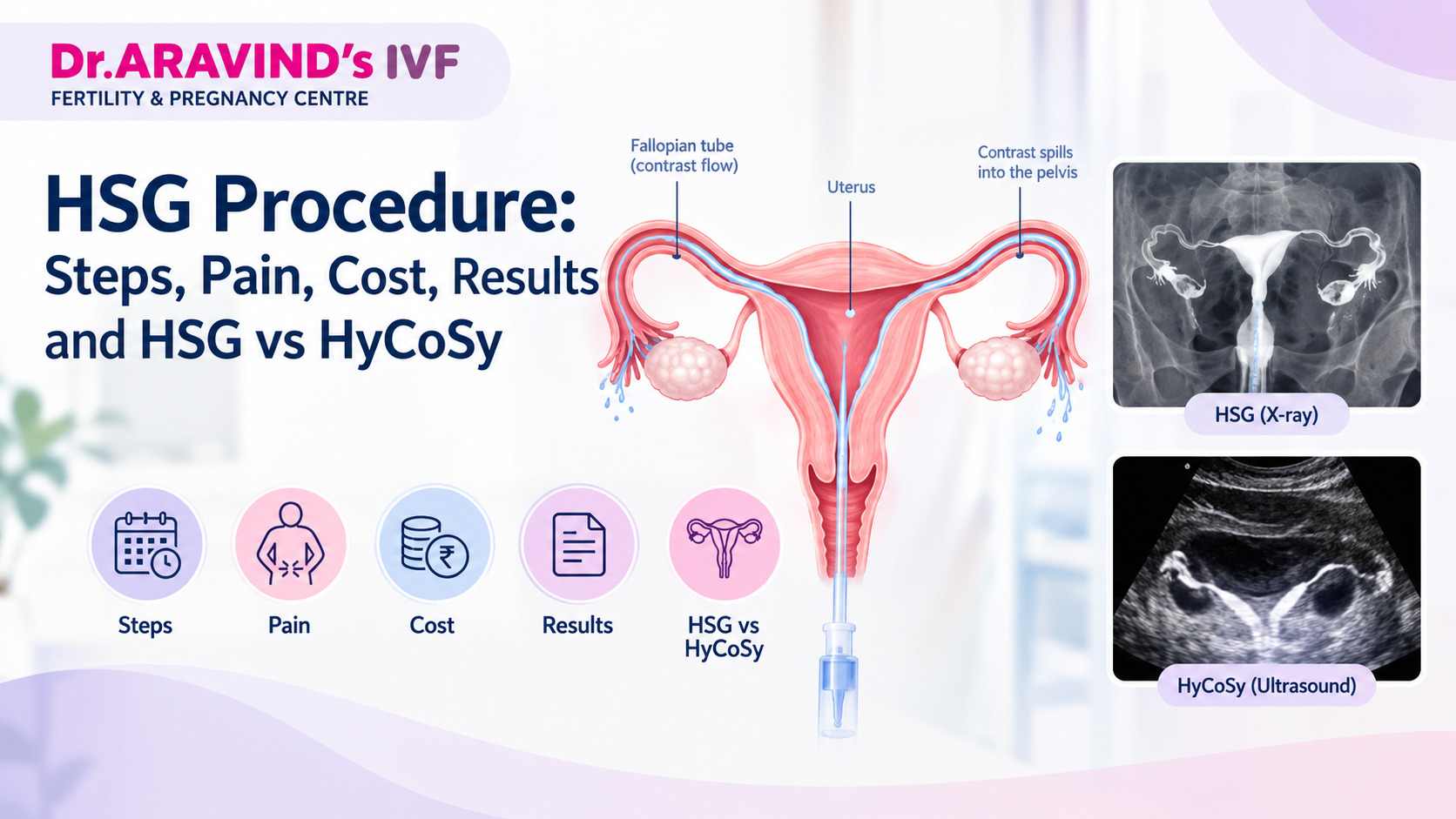
The HSG procedure, short for hysterosalpingography, is an X-ray test. A contrast dye is passed into the uterus. The dye shows up on X-ray. This lets the doctor see the inside of the uterus and the fallopian tubes.
It answers two questions:
Open tubes are needed for natural pregnancy and for treatments like IUI. Your doctor may suggest HSG if you have:
The best time is after your period stops and before you ovulate. This is usually between days 7 and 12 of a 28-day cycle. At this time, the lining is thin, so the pictures are clearer. You are also unlikely to be pregnant. Avoid unprotected sex in that cycle until the test is done.
Tell your doctor if any of these apply to you:
The test takes about 10 to 20 minutes.
Most women feel period-like cramps for a few minutes. Pain can be stronger if a tube is blocked. Slow breathing helps. Pain relief taken beforehand also helps. The cramps usually settle within an hour. Mild discomfort may last a day.
HSG is safe for most women. Possible effects are:
The radiation dose is low. Call your doctor if you get fever, foul discharge, heavy bleeding or worsening pain.
Aftercare: Rest if you feel tired. Use pads, not tampons. Avoid sex and swimming for a couple of days, or as advised.
HSG shows whether tubes are open. It does not show how well they work. It also does not check the ovaries.
The cost of an HSG varies by city, hospital and type of dye. The fee usually covers the X-ray, dye and radiologist. The doctor's consultation and any extra tests may cost more. Oil-based dye can also raise the price. In India, the total commonly runs to a few thousand rupees. Always ask for a written estimate before booking.
HyCoSy (hysterosalpingo-contrast sonography) checks the tubes using ultrasound and a safe contrast fluid or foam. There is no X-ray. A sonography test is the base of this method.
| Feature | HSG | HyCoSy |
|---|---|---|
| Method | X-ray with iodine dye | Ultrasound with contrast fluid or foam |
| Radiation | Low dose | None |
| Shows tube outline | Yes, clearly | Less detail |
| Shows uterine shape | Yes | Yes, with 3D scans |
| Iodine allergy | A concern | Not a concern |
| Pain | Mild to moderate cramps | Similar, often milder |
| Best for | Detailed tube and cavity picture | Radiation-free first check |
Neither test is always better. Your doctor will choose based on your history, your allergies and what needs to be seen.
An HSG is one part of a fertility check. Your age, cycle and partner's tests all matter too. Meet our fertility experts, read more in our fertility blog, or visit our fertility centre in Coimbatore. When you are ready, book your appointment with Dr. Aravind's IVF.
Medical disclaimer: This article gives general information only. It is not medical advice, diagnosis or treatment. Every woman's case is different. Please talk to a qualified doctor before making any health decision. Do not delay care because of something you read here.
Cost depends on the centre, the dye used and what is included. Ask the clinic for a full written estimate.
Yes. Some women conceive in the next few months. HSG is not a treatment, so follow your doctor's advice on timing.
Most women have mild to moderate cramps for a few minutes. Taking pain relief beforehand helps.
No. Avoid heavy bleeding days. The best time is after bleeding stops and before ovulation.
It is a good screening test. Results can sometimes be unclear because of tube spasm. Your doctor may repeat the test or advise laparoscopy.
Avoid tampons, sex and swimming for a couple of days, unless your doctor says otherwise.
Most women can. Some prefer to rest for the day.
No. HSG checks the tubes and uterus. Ovarian health is checked with ultrasound and blood tests.


