The best time to conceive is the fertile window around ovulation, not a particular hour of the day. Sperm can survive up to 5 days in the female reproductive tract, while the egg lives only 12 to 24 hours after release, so the days leading up to ovulation matter most. Whether you try in the morning or at night makes little difference. Choose a time when you are both relaxed. This guide explains the best time to get pregnant, how to find your ovulation days, how often to try and when to see a fertility specialist.
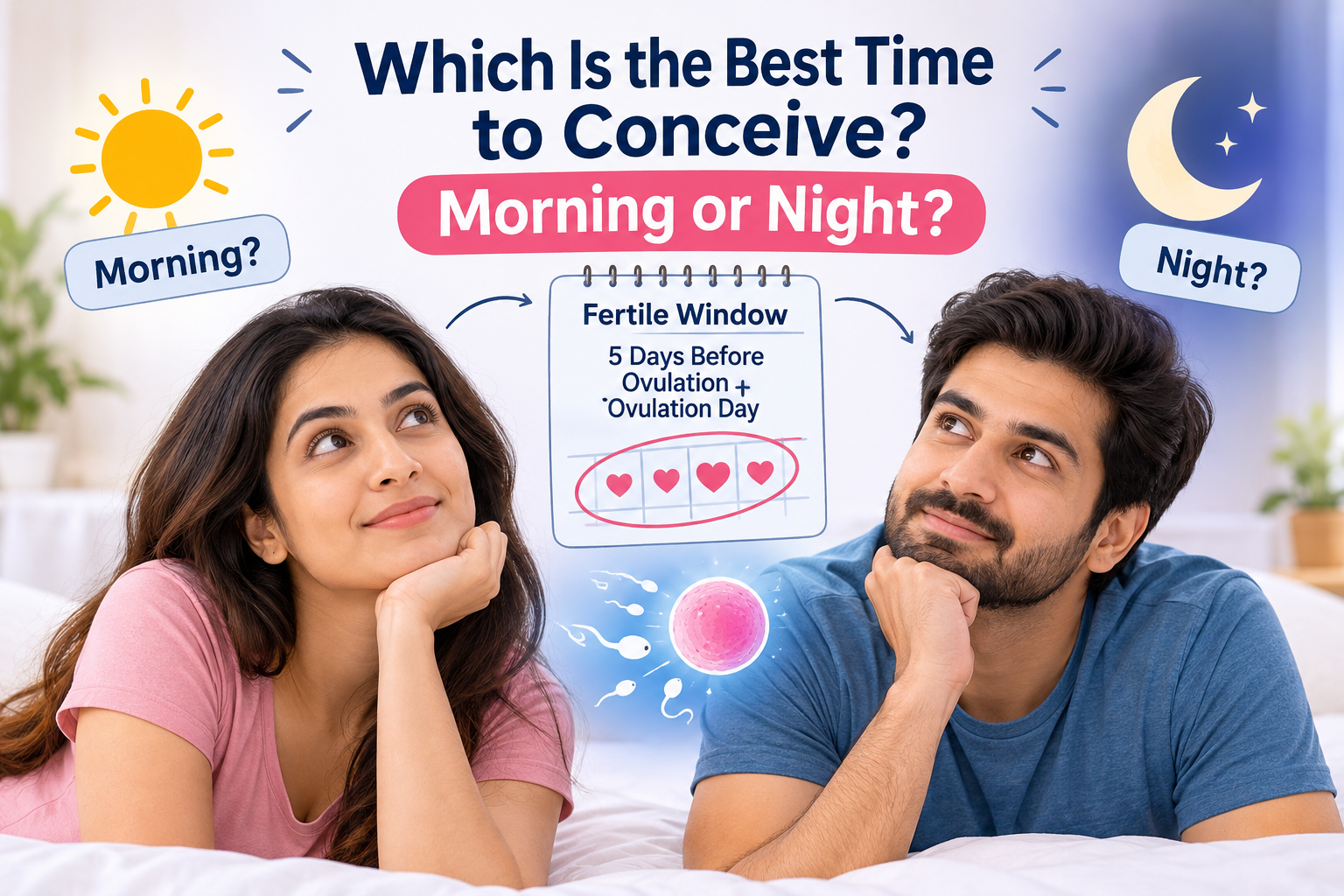
Short answer: the best time to get pregnant is the 5 days before ovulation and the day of ovulation. The 1 to 2 days before ovulation are generally the most fertile. Sex every day or every other day in this window gives the best chance. Morning or night does not matter as much as the day of your cycle.
The fertile window is the stretch of about 6 days in each cycle when pregnancy is possible. It exists because sperm can wait in the body for up to 5 days, but the egg survives only 12 to 24 hours after ovulation, as explained by YourFertility. Chances vary from person to person, so use this table as a guide.
Why does sex before ovulation matter? Sperm may already be present when the egg is released. If you wait until you think ovulation has happened, you may miss much of the chance.
There is no good evidence that sex at one time of day gives a higher pregnancy rate than another. What matters is that sex happens in the fertile window. Ovulation can occur at different times of the day, and couples cannot reliably predict the exact hour, so trying to hit a particular time on the clock is not useful.
Some people believe sperm is healthier in the morning because men often have morning erections. A morning erection is a normal physiological response and does not tell you how many sperm are present or how well they move. Some small studies suggest sperm concentration may be slightly higher in the morning, but the difference is small and has not been shown to change pregnancy rates. It is not a reason to avoid sex at night.
No. Night is neither better nor worse. If evenings are more relaxed for you both, that is a good time to try. Stress and tiredness can make regular sex harder, and regular sex matters more than the hour.
Pick the time you are both comfortable and unhurried. If you can only manage mornings or nights, that is fine. Consistency across the fertile window gives better odds than waiting for a perfect hour.
Ovulation usually happens about 14 days before your next period. The best days to conceive are the 5 days before that day and the day itself. Count from the first day of your period (day 1). These are estimates for regular cycles.
In a 28-day cycle, the fertile days begin around day 9, a few days after bleeding ends. With shorter cycles, ovulation can come soon after your period, and sperm that survive up to 5 days can still fertilise the egg. So pregnancy is possible even right after a period, although it is less likely in longer cycles.
You can use one or more of these methods. None needs to be perfect, and you do not need expensive tools.
If you use an LH kit, have sex on the day of a positive result and the day after. No home method can guarantee the exact time of ovulation, so using more than one gives a clearer picture.
With irregular cycles, ovulation is harder to predict, and calendar methods may mislead you. The American College of Obstetricians and Gynecologists (ACOG) notes that ovulation kits can be less reliable when periods are very irregular. If you cannot predict ovulation, sex every 2 to 3 days through the month covers the fertile window.
Irregular periods can be linked to PCOS, thyroid problems, significant weight changes or other hormonal causes. See a doctor if your cycles are often shorter than 21 days or longer than 35 days, or if you miss periods. You do not need to wait 12 months if irregular periods make it hard to find your fertile window. Read about irregular periods and infertility.
Research cited by ACOG suggests that sex every day or every other day during the fertile window gives the best chance of pregnancy. You do not need to have sex several times a day. Pressure makes trying harder, so choose a pattern you can keep.
Yes. Perfect timing cannot fully make up for sperm that are few, abnormal or do not move well. A semen analysis is a simple test that checks sperm count, sperm motility (how well sperm swim) and morphology (shape). Smoking, heavy alcohol use and long periods of heat to the groin area can affect sperm health. If conception takes longer than expected, both partners should be evaluated.
Read more: how to check sperm quality, normal sperm count and semen analysis and signs of infertility in men.
See a specialist if you have been trying without success for:
Early evaluation of both partners saves time. At Dr. Aravind's IVF, our specialists review both partners' history and may recommend tests, such as ovulation tracking, hormone tests or a semen analysis, based on your situation. They will then explain your options. Book your appointment.
If you have been trying without success, have irregular periods or are worried about sperm health, a fertility evaluation can help you understand the possible reasons. At Dr. Aravind's IVF, our specialists can review both partners and explain which tests or treatments may suit you. Book your appointment to discuss your next steps. For more guides, visit our fertility blog.

Neither is proven better. What matters is having sex in the fertile window. Choose a time that suits both of you.
There is no best hour. Ovulation can occur at any time, so focus on the days around ovulation rather than the time of day.
The best days are the 5 days before ovulation and the day of ovulation. In a 28-day cycle, that is roughly days 9 to 14. With shorter cycles, you can get pregnant soon after your period ends.
Every day or every other day during the fertile window is enough. If you cannot predict ovulation, every 2 to 3 days through the month works.
Some small studies suggest slightly higher sperm concentration in the morning, but it has not been shown to change pregnancy rates.
There is no good evidence that lying down or raising your legs helps. Resting a few minutes is fine if you are comfortable.
Pregnancy ke liye sabse sahi time ovulation ke 5 din pehle se ovulation ke din tak hai. Din ka time (subah ya raat) utna important nahi hai. (In short: the 5 days before ovulation and ovulation day.)
Apne cycle ke fertile window mein try kare. Regular 28-day cycle mein yeh lagbhag day 9 se day 14 hota hai. Agar periods irregular hain, har 2 se 3 din mein try kare. (In short: try in your fertile window; every 2 to 3 days if cycles are irregular.)
Under 35: 12 months. 35 to 39: 6 months. 40 or older: seek evaluation sooner. See a specialist earlier at any age if you have irregular periods or a known fertility condition.


