When a semen analysis shows no sperm, one of the first questions men ask is simple. If sperm is not coming out in semen, can doctors still find it?
In selected cases, the answer is yes. TESA, PESA and Micro-TESE are sperm retrieval procedures that allow specialists to look for and collect sperm directly from the male reproductive tract or testicular tissue. The right technique depends on why sperm is absent, where it is most likely to be found, and the couple's overall fertility treatment plan.
For couples considering IVF and ICSI, understanding the difference between these three procedures can turn a confusing decision into a much clearer one.
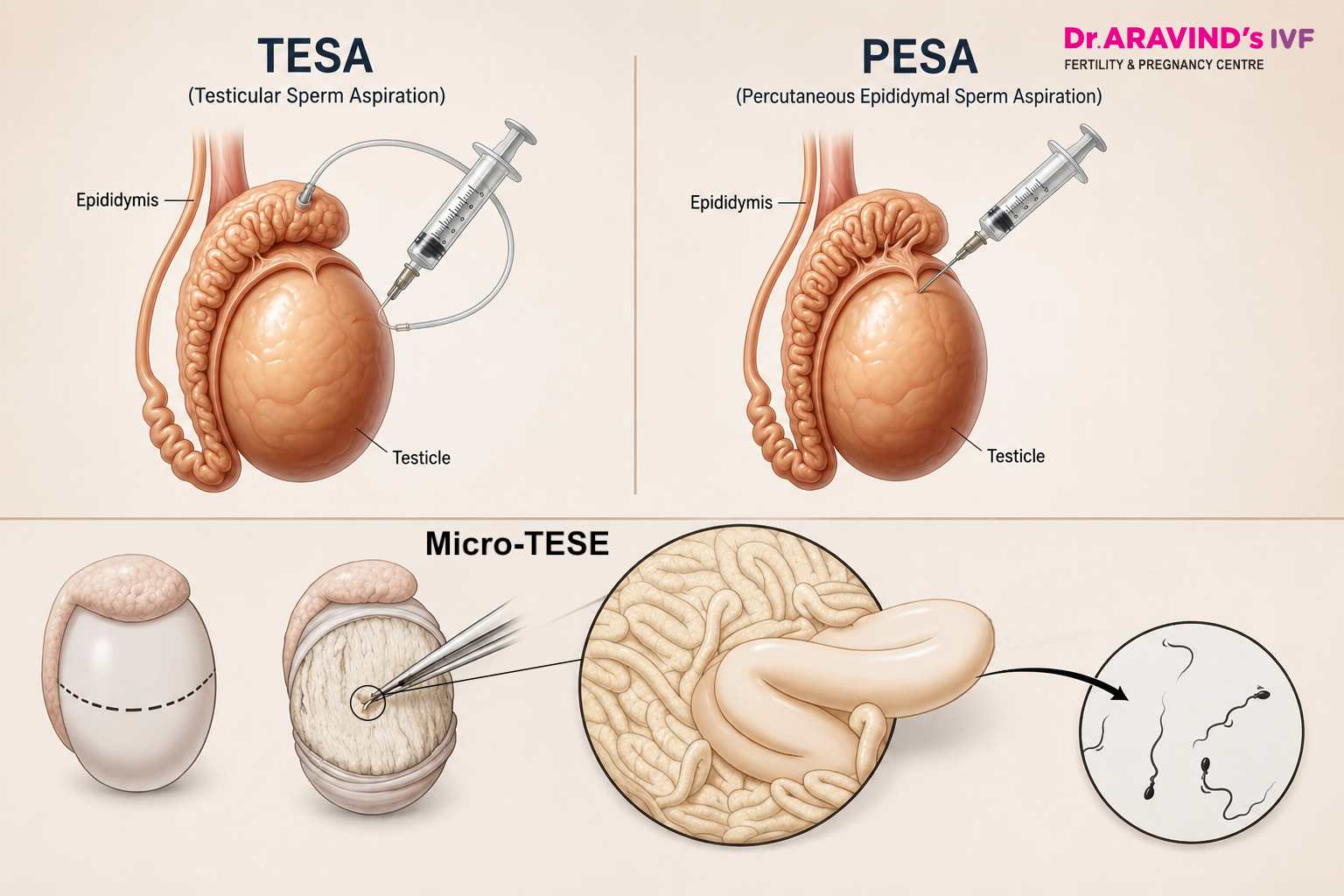
TESA, PESA and Micro-TESE are different approaches to surgical sperm retrieval, and they are not interchangeable. The main difference is where sperm is sought and how it is retrieved.
PESA aspirates sperm from the epididymis. TESA aspirates sperm from the testicle using a needle. Micro-TESE examines testicular tissue microsurgically to find areas that may contain sperm-producing tubules.
The choice depends on the underlying fertility diagnosis, not on which procedure sounds the most advanced.
PESA, or percutaneous epididymal sperm aspiration, is a minimally invasive sperm retrieval technique. A fine needle is used to aspirate sperm from the epididymis, a structure behind the testicle where sperm normally mature and are stored.
PESA is often considered in men with obstructive azoospermia, where sperm production is preserved but a blockage prevents sperm from entering the ejaculate. This obstruction can follow a vasectomy, or arise from an abnormality affecting the sperm transport pathway.
When sperm production is intact, sperm may still be present in the epididymis even though none appears in the semen. PESA is generally a quick procedure and can provide usable sperm for assisted reproductive treatment when retrieval succeeds.
TESA, or testicular sperm aspiration, uses a fine needle to obtain a sample directly from the testicle. Unlike PESA, which targets the epididymis, TESA looks within the testicle itself.
TESA can be considered in selected cases, particularly when sperm production is present but sperm cannot reach the ejaculate. It may also have a role in certain other clinical situations, but it is not automatically the preferred technique for every man with azoospermia.
This distinction matters. The underlying diagnosis should be evaluated before deciding whether TESA, PESA, TESE or Micro-TESE is the right fit. The AUA/ASRM guideline notes that sperm retrieval approaches in obstructive azoospermia can include percutaneous epididymal or testicular techniques, with the choice shaped by the patient's situation and available expertise.
Micro-TESE, or microsurgical testicular sperm extraction, is a more specialized procedure built to search testicular tissue for sperm. It plays a particularly important role in men with non-obstructive azoospermia (NOA), where sperm production may be severely reduced or present only in small, scattered areas.
During Micro-TESE, the surgeon uses an operating microscope to examine testicular tissue and identify regions that may contain sperm producing tubules. The AUA/ASRM guideline recommends microdissection TESE for men with NOA undergoing sperm retrieval, and the EAU guidance similarly identifies microdissection TESE as the technique of choice for sperm retrieval in NOA.
This makes Micro-TESE meaningfully different from a simple needle aspiration technique.
| Feature | PESA | TESA | Micro-TESE |
|---|---|---|---|
| Full Name | Percutaneous Epididymal Sperm Aspiration | Testicular Sperm Aspiration | Microsurgical Testicular Sperm Extraction |
| Retrieval Site | Epididymis | Testicle | Testicle |
| Technique | Needle aspiration | Needle aspiration | Microsurgical tissue retrieval |
| Best Suited For | Selected obstructive cases | Selected cases, especially some obstructive cases | Primarily non obstructive azoospermia |
| Surgical Complexity | Lower | Lower | More involved |
| Typical Recovery | Same day, mild soreness | Same day, mild soreness | Two to three days rest |
There is no universal best sperm retrieval procedure. The right option depends on the cause of infertility, prior treatment, clinical findings, and how likely sperm is to be found at the selected retrieval site.
TESA and PESA are often compared because both use needle aspiration. The main difference is the location from which sperm is retrieved.
PESA targets the epididymis and can be particularly useful when sperm production is preserved, but an obstruction blocks the sperm pathway. TESA targets the testicle directly and may be considered when sperm needs to be retrieved from testicular tissue itself.
Neither procedure is automatically superior. The appropriate technique depends on the individual's diagnosis and the specialist's assessment.
The biggest difference is how the testicle is searched. TESA uses a needle to aspirate a sample, while Micro-TESE involves microsurgical examination of testicular tissue to search for sperm producing areas.
This distinction becomes especially important in non-obstructive azoospermia, where sperm production can be patchy. If production is severely impaired, aspirating one small area may not offer the same chance of finding sperm as a carefully performed microsurgical search. For men with NOA undergoing surgical sperm retrieval, AUA/ASRM recommends microdissection TESE.
Micro-TESE is mainly considered when sperm production itself is impaired and sperm cannot be identified in the ejaculate. Before recommending it, the medical team typically reviews several pieces of information together.
This includes semen analysis results, hormonal findings, a testicular examination, previous medical or surgical history, genetic testing when indicated, any earlier sperm retrieval attempts, and the couple's assisted reproduction plan. The goal is to understand whether there is a reasonable medical basis for attempting retrieval, and which technique fits best.
Micro-TESE recovery time runs slightly longer than TESA or PESA, since it involves a small incision and more tissue handling under the microscope. Most men need two to three days of rest before resuming light activity, and around a week before returning to strenuous exercise or heavy lifting.
Mild swelling, bruising, or a pulling sensation in the area is normal during this window. Read our full guide on post surgical care after sperm retrieval for a day by day recovery checklist covering all three procedures, so you know exactly what to expect at each stage.
This is one of the most important questions patients ask, but there is no single success rate that applies to every man. Sperm retrieval outcomes vary depending on whether azoospermia is obstructive or non-obstructive, the underlying cause, hormonal profile, genetic factors, testicular function, previous treatment, surgical technique, and the specialist's and laboratory's experience.
For non-obstructive azoospermia, AUA/ASRM cites evidence showing that Micro-TESE generally outperforms non-microsurgical TESE and testicular aspiration for sperm retrieval. Published Micro-TESE success rates in NOA are commonly reported around 40 to 60 percent, but this figure should never be treated as a guaranteed personal outcome.
A personal assessment from your specialist is far more meaningful than applying one statistic to every patient.
Sperm retrieval is usually one part of a broader fertility treatment plan. When usable sperm is obtained, it may be used with intracytoplasmic sperm injection, or ICSI, during IVF. ICSI involves injecting a single sperm directly into an egg to help fertilization along.
Retrieved sperm may be used fresh or cryopreserved, depending on the clinical circumstances. AUA/ASRM states that either fresh or frozen surgically retrieved sperm can be used for ICSI. In obstructive azoospermia, sperm can often be retrieved and frozen ahead of assisted reproduction. In NOA, timing is often coordinated more closely with the treatment cycle, since the number of sperm retrieved can be limited.
Patients naturally want to know what the procedure feels like, and the honest answer depends on the procedure, the anesthesia used, and individual circumstances.
After sperm retrieval, some men experience mild soreness, tenderness, bruising, or swelling. Your doctor will walk you through the anesthesia plan, expected discomfort, medication, and recovery instructions before the procedure begins.
The more useful question is not simply whether it will hurt, but which procedure gives you the most appropriate opportunity to retrieve sperm based on your specific diagnosis.
Recovery depends on which procedure was performed. PESA and TESA are needle based procedures and typically involve a shorter recovery window. Micro-TESE is a microsurgical procedure and can require a somewhat longer recovery than a simple aspiration.
Patients should follow their treating team's instructions on physical activity, exercise, sexual activity, wound care, pain medication, and follow up visits. Recovery is not identical for every patient, so personalized guidance always takes priority over general timelines.
Sperm retrieved during a surgical procedure may be used fresh or frozen for later use, depending on the diagnosis, the number of sperm retrieved, laboratory protocols, and the overall IVF treatment schedule.
In obstructive azoospermia, sperm availability is often more predictable, which makes advance retrieval and cryopreservation a reasonable strategy. In non obstructive azoospermia, the number of sperm retrieved can be limited, so the fertility team may coordinate retrieval directly with the assisted reproduction cycle instead. There is no single timing strategy that fits every couple.
A failed retrieval does not necessarily mean every option has been exhausted. The next step depends on why sperm was not retrieved, whether the original diagnosis was correct, where sperm was expected to be located, the previous retrieval technique used, testicular function, and whether the underlying condition is obstructive or non obstructive.
In men with non obstructive azoospermia, Micro-TESE may be considered when surgical sperm retrieval is still medically appropriate. The decision should always be individualized rather than simply repeating the same procedure.
Yes. When viable sperm is retrieved, it can potentially be used for assisted reproductive treatment, commonly alongside ICSI.
Here's the distinction that matters most. Sperm retrieval success is not the same as pregnancy or live birth success. Even when sperm is retrieved successfully, outcomes still depend on many additional factors, including egg quality, the female partner's age and reproductive health, embryo development, and other IVF related factors. A responsible clinic will walk you through the full treatment pathway rather than promising an outcome based on sperm retrieval alone.
TESA, PESA and Micro-TESE each play a different role in male fertility treatment. PESA may be considered when sperm is available in the epididymis, particularly in selected obstructive cases. TESA uses needle aspiration to retrieve a testicular sample and may be useful in selected clinical situations. Micro-TESE offers a microsurgical approach to searching the testicle and is particularly important for sperm retrieval in men with non obstructive azoospermia.
The best procedure is not simply the newest or most advanced sounding one. It is the one that makes sense for the specific cause, the clinical findings, and the couple's fertility plan.
Being told there is no sperm in the semen can raise difficult questions, but sperm retrieval may offer a real option for selected men. Understanding the difference between PESA, TESA and Micro-TESE can help you have a more informed conversation with your fertility specialist about what comes next.
At Dr. Aravind's IVF Fertility and Pregnancy Centre, the treatment plan is built around your individual fertility evaluation, the suspected cause of sperm absence, and your assisted reproduction goals. If you have been advised to consider sperm retrieval, bring your semen analysis results and medical history to a qualified fertility specialist before deciding which procedure is right for you.
Book a consultation with Dr. Aravind's IVF Fertility & Pregnancy Centre to get a clear, personalized recommendation on whether TESA, PESA or Micro-TESE is right for you, along with honest success rates and transparent costs.
TESA uses needle aspiration, while Micro-TESE involves microsurgical examination and extraction of testicular tissue to search for sperm producing areas. Micro-TESE is particularly relevant for men with non obstructive azoospermia.
Not for every patient. Micro-TESE is specifically important in non obstructive azoospermia, where sperm production may be limited and unevenly distributed. TESA may be appropriate in selected cases depending on the diagnosis.
Micro-TESE recovery time is usually two to three days of rest before light activity, and about a week before returning to strenuous exercise, slightly longer than TESA or PESA due to the small incision involved.
Yes. If suitable sperm is retrieved, it can potentially be used with ICSI as part of IVF treatment.
The fertility team will typically reassess the diagnosis and discuss whether another retrieval approach is medically appropriate. In NOA, Micro-TESE may be considered for suitable patients.


