Kruger strict morphology counts a sperm as "normal" only if its head, midpiece, and tail all meet a very narrow shape standard. The WHO sixth-edition lower reference limit is 4% normal forms. Below 4% is called teratozoospermia, but it is not a verdict of infertility. Men with 0 to 3% have fathered pregnancies, so the full semen report, repeat testing, and your partner's fertility matter far more than this one number.
Key takeaways
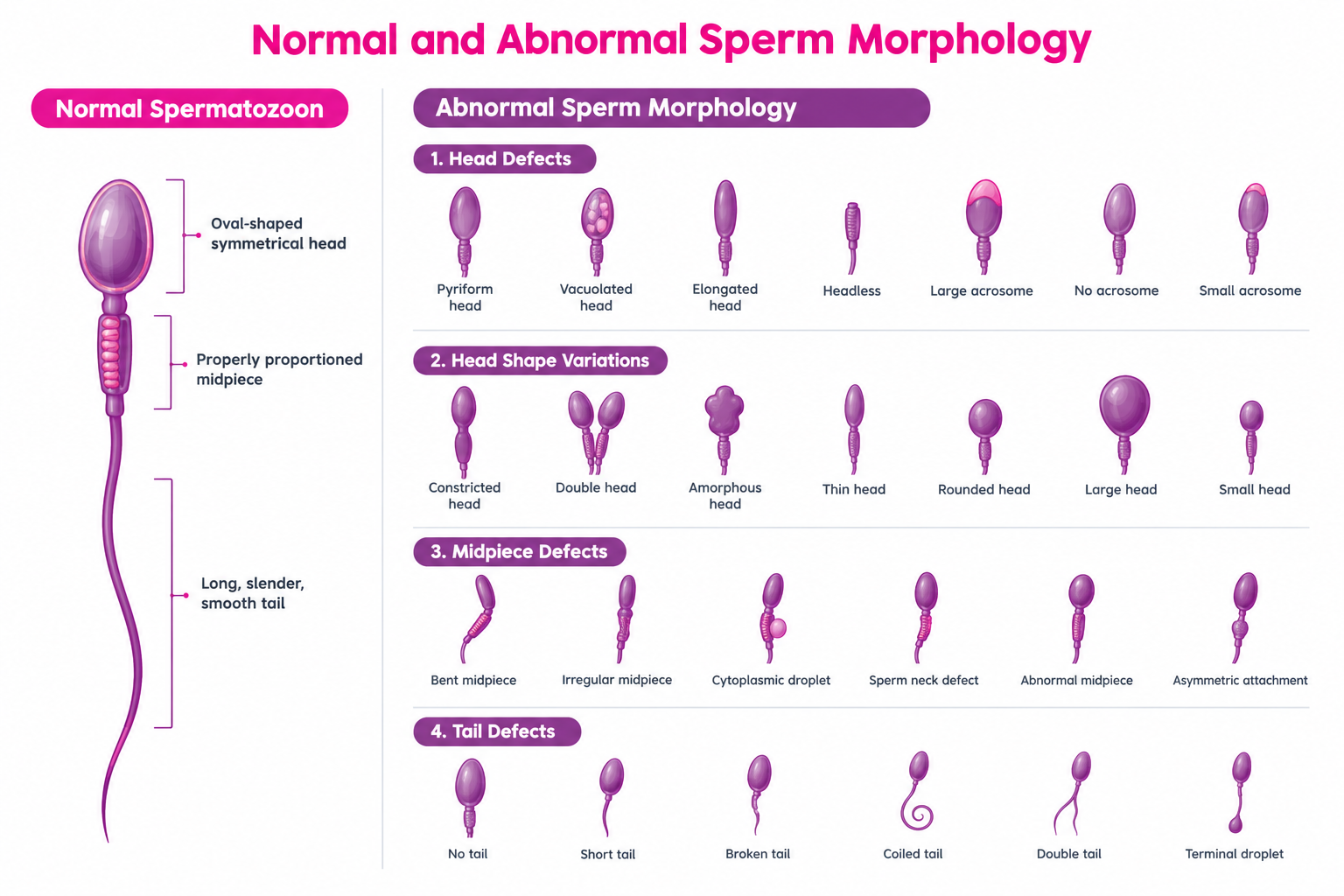
Sperm morphology refers to the shape and structure of sperm when examined under a microscope. The laboratory assesses different parts of the sperm, including:
The semen analysis report usually shows the percentage of sperm that meet the laboratory's criteria for normal shape. Morphology is only one part of the report. Other parameters may include semen volume, sperm concentration, motility, vitality and, in some cases, white blood cells or antibodies.
It is important to consider all these findings together. Judging male fertility based on morphology alone can give an incomplete picture of sperm health.
Kruger strict criteria are a detailed method of assessing sperm shape. Developed by Dr. Thinus Kruger's team in Tygerberg, South Africa, this approach is also known as the Tygerberg criteria.
Under this method, sperm are classified as having normal morphology only when they meet specific, strict structural requirements. Even relatively small variations in shape, such as a slightly bent tail or an irregularly shaped head, may be classified as abnormal.
This explains why a semen sample can contain millions of sperm but still show a low percentage of normal forms. A low morphology percentage does not automatically mean that the sperm cannot be used for fertility treatment. It means that only a small proportion meet the strict criteria for normal shape.
Laboratories may use different assessment methods and reference ranges. Check your semen analysis report for the morphology method used and the reference range provided alongside your result. Your fertility specialist can help interpret it along with the other semen parameters and your medical history.
The WHO sixth edition uses 4% as the fifth percentile of men in a reference group who had recently fathered a child. In plain terms, about one in twenty of those fertile men fell below that number.
So 4% is a statistical marker, not a cut-off between fertile and infertile.
| Your Result | How It Is Usually Described |
|---|---|
| 4% or higher | Within the reference range. |
| 1 to 3% | Below the reference limit; interpret alongside sperm count and motility. |
| 0% | Very low strict morphology result; usually repeated and reviewed with a specialist. |
Important: A result of 4% does not mean 96% of your sperm cannot fertilise an egg. It means about 4 in every 100 sperm met the strict visual definition of normal shape in that sample.
Morphology makes sense only when considered alongside the other semen analysis results. These are the lower reference limits your report may be compared with:
| Measure | WHO Sixth-Edition Lower Limit |
|---|---|
| Semen volume | 1.4 mL |
| Sperm concentration | 16 million per mL |
| Total sperm number | 39 million per ejaculate |
| Total motility | 42% |
| Progressive motility | 30% |
| Vitality (live sperm) | 54% |
| Normal forms (strict morphology) | 4% |
To understand the complete report, explore these related guides:
Low sperm morphology can have several possible contributing factors. In many cases, however, no single clear cause is identified. Some factors that may influence sperm shape include:
Yes. Sperm morphology can vary between semen samples and may change over time. Sperm take approximately two to three months to develop, so the effects of a recent illness or lifestyle changes may become noticeable in a later semen analysis rather than immediately.
If your doctor recommends repeating the test, follow the laboratory's instructions about abstinence duration and sample collection. Where possible, use the same laboratory and assessment method to make the results easier to compare.
Read our guide on sperm collection for IVF to understand how to provide a suitable semen sample.
No. Low sperm morphology does not automatically mean that natural pregnancy is impossible. It may reduce the chances of conception in some couples, but its significance depends on several factors, including:
A fertility specialist may pay closer attention when low morphology is repeatedly reported, other semen parameters are also abnormal or pregnancy has not occurred after an appropriate period of trying to conceive.
Sperm morphology can be one factor when choosing a fertility treatment, but it is never the only consideration. The decision depends on the complete semen analysis, the fertility history of both partners and other clinical findings.
However, ICSI does not repair sperm DNA damage and cannot guarantee fertilisation. Your specialist will explain whether it is appropriate based on your individual results.
Learn more about ICSI treatment and how it differs from conventional IVF.
Sperm morphology alone has limited ability to predict the outcome of IVF treatment. A low percentage of normal forms does not automatically mean that fertilisation or pregnancy will not happen.
Instead, your fertility team considers several factors together, such as:
These findings help your specialist and embryologist understand the overall fertility picture and discuss a suitable treatment approach.
No. Sperm morphology and sperm DNA integrity are different aspects of sperm health. Morphology describes the sperm's physical shape, while DNA integrity relates to the condition of the genetic material inside the sperm.
Some men with poor sperm morphology may have healthy sperm DNA. Similarly, sperm that look normal under a microscope may still have DNA damage. Therefore, morphology alone cannot confirm whether sperm DNA is normal or abnormal.
A sperm DNA fragmentation test may be considered in selected situations, such as recurrent pregnancy loss or repeated IVF treatment failure. It is not routinely required for every man with a low morphology result.
If your semen analysis shows low morphology, the next step is to understand the result in the context of your overall reproductive health. These steps may help you prepare for a discussion with your fertility specialist:
For a broader understanding of available options, read our guide to male infertility treatment.
Sperm morphology is assessed as part of a semen analysis. The laboratory typically prepares a thin layer of semen on a glass slide, stains the sample and examines the sperm under high magnification. Assessment may be performed manually by a trained laboratory professional or with computer-assisted methods.
The result can be influenced by several laboratory factors, including:
When reviewing your result, ask whether the laboratory used Kruger strict criteria and which reference range applies. Your specialist can explain what the percentage means alongside the other semen parameters.
Related reading: Sperm motility is another important parameter reported in a semen analysis. It describes how sperm move and is assessed separately from morphology.
Kruger strict morphology uses demanding criteria to classify sperm as having a normal shape. The WHO semen analysis guidelines commonly use 4% as the lower reference limit. However, this is a guide, not a pass-or-fail mark for fertility.
Your complete semen analysis, repeat test results, and individual medical history matter more than one morphology percentage. A low result does not automatically mean that natural pregnancy or fertility treatment will not be successful.
Every fertility journey is different. Get expert guidance to understand your test results, explore suitable treatment options and plan your next step with confidence.
Book Your ConsultationDr. Aravind's IVF Fertility & Pregnancy Centre
This article is for educational purposes and does not replace advice from your doctor. Reference limits describe findings in groups of men and should not be treated as an individual diagnosis.
It is the WHO sixth-edition lower reference limit for strict criteria, so 4% or above is within range. It is not a fertility guarantee, and a lower result does not rule out pregnancy.
Not necessarily. IVF or ICSI may still be possible. The doctor will weigh total motile count, vitality, egg factors and earlier fertilisation results.
Yes, pregnancy can happen. A 0% result should be interpreted clinically, often with repeat testing and other investigations, because it can also reflect the limits of the sample and the strict method.
No single value always wins. Count, motility, vitality, volume, morphology and total motile sperm should be read together.
It may change if a reversible cause is treated or an illness resolves, but improvement is not guaranteed.
Does low morphology always need ICSI? No. ICSI helps in selected cases, and your specialist should explain why it is advised.


