Sperm donation in India is legal and regulated under the Assisted Reproductive Technology (Regulation) Act, 2021. Donor sperm must be sourced and handled through a registered ART bank. Doctors usually discuss it only after a full evaluation, including whether surgical sperm retrieval is medically suitable. In sperm donation, sperm from a screened donor is used in IUI or IVF (with ICSI where needed) to help a person or couple achieve pregnancy.
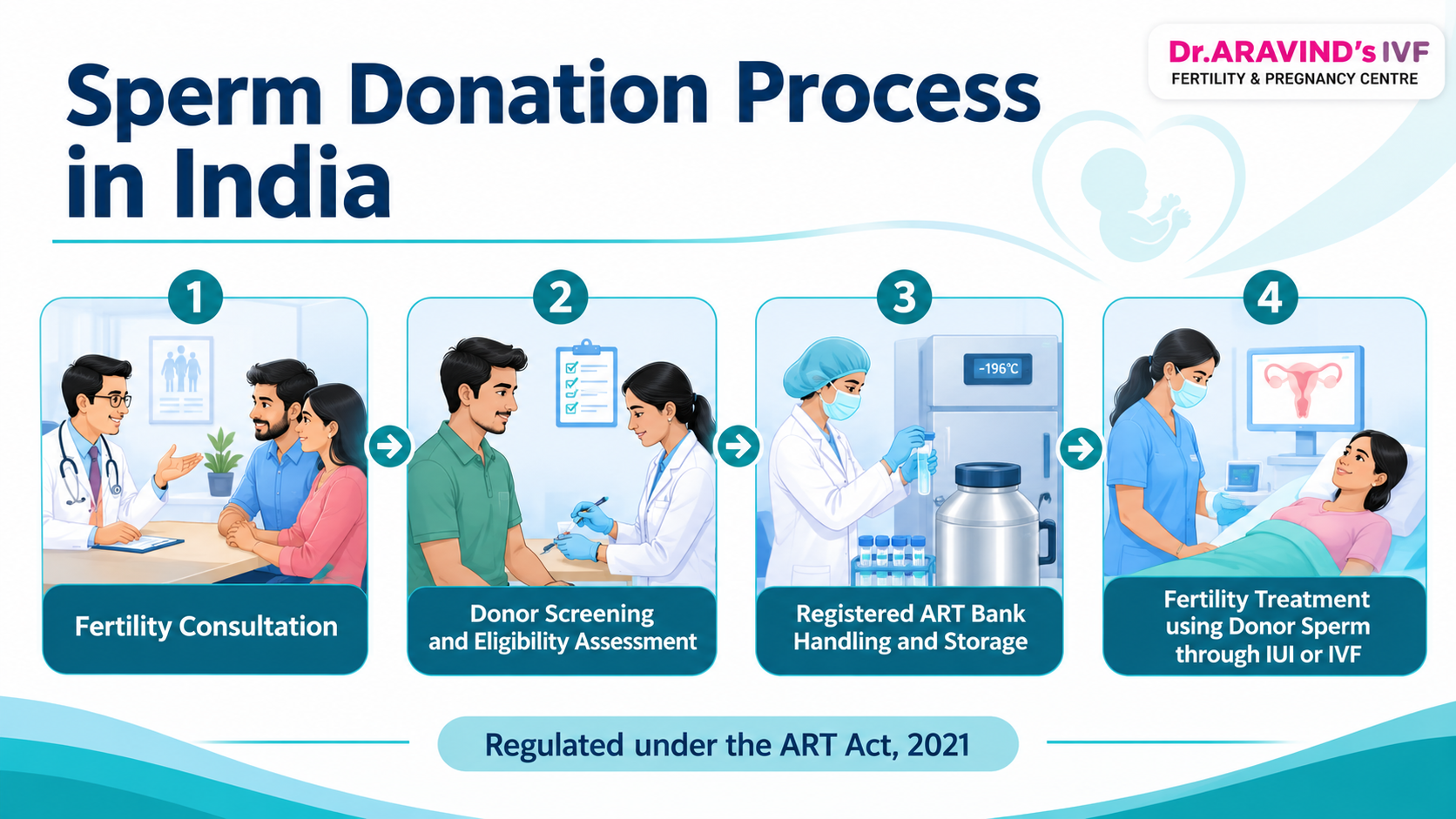
Yes. The ART Act, 2021 and the ART Rules, 2022 regulate sperm donation. Donor sperm must be collected, screened and stored by an ART bank registered under the ART Act, 2021. Its registration details should be verified through the appropriate official registry.
The Act regulates donor-gamete sourcing through registered ART banks and prohibits activities such as selling gametes, operating agencies for gamete trading and using intermediaries to obtain donors.
Donor sperm is discussed after a full evaluation of both partners, not as a first step.
A man with azoospermia (no sperm in the semen) is first assessed for surgical sperm retrieval such as PESA, TESA or micro-TESE. Whether it is medically suitable depends on the cause of azoospermia and his circumstances. If retrieval is not suitable, or no usable sperm is found, donor sperm may be discussed. Read more about azoospermia treatment options and sperm retrieval before ICSI.
When a serious genetic condition could be passed on, a couple may talk to their doctor and a genetic counsellor. Donor sperm may be one option discussed after genetic counselling, alongside other choices.
The Act recognises a woman seeking ART services, subject to the prescribed conditions. The clinic confirms eligibility.
Counselling before treatment is part of the process. The choice is personal, and no one is expected to decide in a single visit.
Under Section 21(g), ART services are subject to age limits: the woman must be above 21 and below 50, and the man above 21 and below 55. Age alone does not establish eligibility, and other requirements also apply.
A married couple may use donor sperm when the man’s evaluation shows that his own sperm cannot be used. The doctor reviews the couple’s history and tests first.
The Act recognises a woman seeking ART services, as well as a commissioning couple. Eligibility is subject to the prescribed conditions, so the clinic assesses each case and confirms eligibility at the consultation.
The Act defines a commissioning couple as an infertile married couple. How it applies to same-sex couples should be confirmed with your clinic and with legal advice.
A man who wishes to donate sperm must do so through a registered ART bank, not through a private arrangement. This is what sperm donor eligibility in India involves. Want to freeze your own sperm instead? That is a different service. See sperm freezing.
The Act allows banks to obtain semen only from men aged 21 to 55, inclusive. Banks also check general health, medical and family history, and the donor’s consent.
The prescribed screening tests include HIV types 1 and 2, hepatitis B, hepatitis C and syphilis (VDRL), as specified under Rule 10 of the ART Rules, 2022. Screening supports the safe use of donor sperm, but it cannot remove every health or genetic risk.
An ART bank must be registered under the ART Act, 2021, and registered banks are recorded in the National Registry of Banks and Clinics. It collects, screens and stores donor semen, and supplies it to registered clinics. Under the Act, one donor’s sperm cannot be supplied to more than one commissioning couple.
Ask any clinic for the name and registration number of its ART bank, and confirm that the bank is registered. For details of our service, see our sperm donor treatment page.
Book your appointment to discuss whether donor sperm is right for you.
Donor sperm can be used in these ways:
The doctor decides based on the woman’s age, ovarian reserve, tubal health and history. No treatment can guarantee a pregnancy.
Both the donor and the person seeking treatment give written consent. Under Section 31 of the Act, a child born through ART is treated as the biological child of the commissioning couple, and the donor relinquishes all parental rights. How this applies to other family arrangements should be confirmed with your clinic and legal advice.
The Act requires clinics and banks to keep information about the commissioning couple, woman and donor confidential. It allows disclosure to the National Registry, in a medical emergency at the request of the commissioning couple, or under an order of a competent court. Your clinic should explain how donor information is recorded, protected and handled before treatment.
Many people ask, “Can I choose my sperm donor?” and “Is donor sperm anonymous?” How donor information is matched, kept and shared is set by the Act and the rules, and no clinic can promise absolute anonymity in every situation.
The ART Act prohibits the sale of human gametes and makes certain activities involving gamete trading and intermediaries offences. Donor payment should not be arranged privately. Ask the registered ART bank or clinic for an itemised explanation of treatment and bank charges.
The cost of sperm donation in India depends on any applicable ART bank service charges and screening, the type of treatment (IUI, or IVF with ICSI), medicines, scans and how many cycles are needed. Ask for a written estimate that lists what is included.
See a specialist if you have been trying to conceive for 12 months (6 months if the woman is 35 or older), or earlier if a semen analysis shows no sperm or a serious genetic condition runs in the family. Read about the signs of infertility in men.
If you are in Coimbatore, Chennai or elsewhere in Tamil Nadu, our fertility specialists can review both partners and explain your options. Book a consultation.
Choosing donor sperm is a personal decision that deserves time, clear information and appropriate counselling. A fertility specialist can review your medical history, explain the available treatment options and answer questions about donor screening, consent and costs. If you are considering donor sperm treatment, book an appointment with Dr. Aravind’s IVF to discuss your circumstances and next steps.

Yes. It is regulated by the ART Act, 2021, and donor sperm must be sourced and handled through a registered ART bank.
Men aged 21 to 55 (inclusive) can donate through a registered ART bank, after testing and written consent.
The ART Rules, 2022 prescribe tests including HIV types 1 and 2, hepatitis B, hepatitis C and syphilis (VDRL).
The Act prohibits the sale of human gametes and makes certain activities involving gamete trading and intermediaries offences. Donor payment should not be arranged privately. Ask the registered ART bank or clinic for an itemised explanation of treatment and bank charges.
The Act recognises a woman seeking ART services, subject to the prescribed conditions. The clinic assesses each case and confirms eligibility at consultation.
The Act defines a commissioning couple as an infertile married couple. Confirm how it applies to your situation with your clinic and legal advice.
No. A bank cannot supply one donor’s gametes to more than one commissioning couple.
No. Under Section 31, the donor relinquishes all parental rights, and a child born through ART is treated as the biological child of the commissioning couple.
How donor information is matched and shared is set by the Act and rules. Your clinic explains what is allowed.
No. The doctor first assesses whether surgical sperm retrieval such as PESA, TESA or micro-TESE is suitable for the cause of azoospermia. Donor sperm is discussed if retrieval is not suitable or no usable sperm is found.
Dr. Aravind’s IVF offers fertility consultation in Coimbatore and Chennai. Book a consultation to find out which centre and services suit your case. You can also view the Chennai centre page: https://www.draravindsivf.com/chennai/chennai-detail


