A new sperm takes about 64 to 74 days to develop in the testicles, followed by several more days to around two weeks of maturing in the epididymis. In practice, the whole journey is usually described as roughly 2½ to 3 months. Sperm are made every day, so it is a continuous conveyor belt, not a monthly reset. That is why changes in health, medicines, or lifestyle take about 2 to 3 months to show up in a semen test.
Key points:
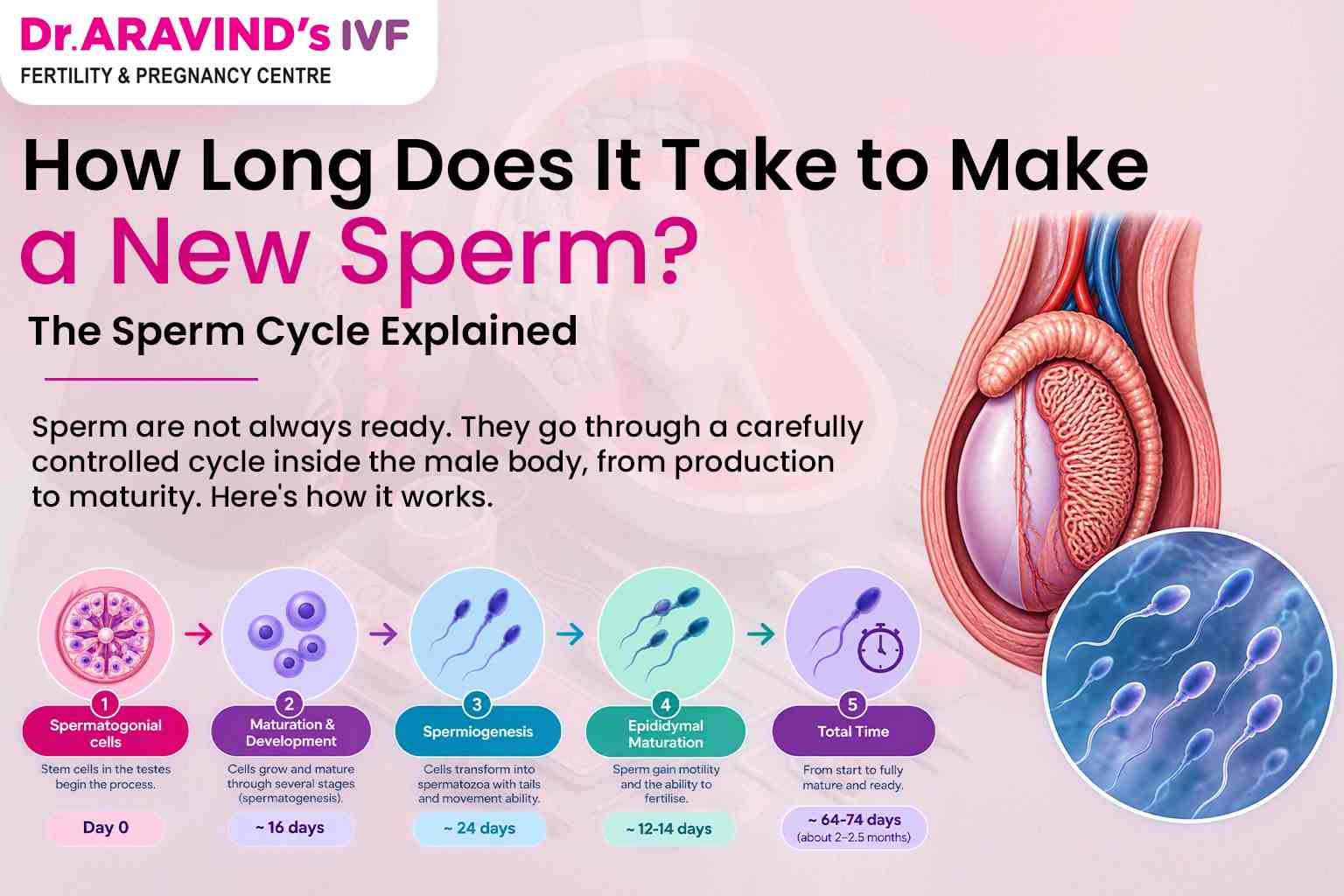
Spermatogenesis is the process by which immature cells inside the testicles develop into mature sperm. It takes place in tiny, coiled tubes called seminiferous tubules. During this process, the cells divide, their genetic material is reshuffled, and they gradually develop the characteristic head and tail needed for sperm function.
Hormones help regulate this process. Follicle-stimulating hormone (FSH) and luteinising hormone (LH), released by the brain's pituitary gland, work alongside testosterone produced by the testicles to support normal sperm production.
| Stage | Where | Roughly How Long | What Happens |
|---|---|---|---|
| 1. Early cell divisions | Testis | Around the first third of the cycle | Precursor (stem) cells divide and multiply. |
| 2. Meiosis | Testis | The middle weeks | Cells halve their chromosome number, so each sperm carries one set. |
| 3. Spermiogenesis | Testis | The final weeks | A round cell develops a head, midpiece and tail. |
| 4. Release | Testis to epididymis | End of testicular phase (total about 64–74 days) | Immature sperm leave the seminiferous tubules. |
| 5. Maturation | Epididymis | Several days to about two weeks* | Sperm gain the ability to swim. |
| 6. Storage and ejaculation | Epididymis and vas deferens | Until the next ejaculation | Mature sperm are stored and later released during ejaculation. |
Important note: *Published estimates of epididymal maturation time differ between studies and individuals. Treat these numbers as approximate.
The overall process takes approximately 2½ to 3 months from the beginning of sperm production to mature sperm, with individual variation.
To understand what a semen report measures at the end of this process, read our related guide:
Normal Sperm Count: Understanding Your Semen Analysis Report
Yes. Sperm production is continuous. At any moment, some sperm cells are just beginning development, others are halfway through the process, and mature sperm are waiting in storage. Ejaculation releases stored sperm, but it does not empty the production system.
The time since your last ejaculation can affect the volume and sperm concentration of your next sample. This is why laboratories ask you to follow a specific abstinence period before semen collection. See sperm collection for IVF.
No. Abstinence does not speed up sperm production. It allows more sperm to collect in storage, which may increase the volume or concentration of a semen sample. However, a longer waiting period may also mean that some stored sperm are older and have poorer movement.
The ideal abstinence period depends on whether the sample is being collected for testing, IUI, IVF or ICSI. Follow your clinic's instructions rather than trying to "save up" sperm without medical advice.
No. Frequent ejaculation does not stop sperm production or cause permanent damage. It may temporarily reduce the volume or concentration of sperm in an individual sample, but the testicles continue producing sperm.
By the time sperm appear in semen, they have already spent months developing. Therefore, a semen test performed today reflects factors that may have affected sperm production over the preceding months.
This timing matters in several situations:
These steps can support reproductive health, but they do not guarantee normal semen results or pregnancy.
Several medical conditions, treatments and lifestyle factors can affect sperm production and development, including:
Some of these factors are reversible, while others may require specialist treatment. Feeling healthy or having no testicular pain does not necessarily mean sperm production is normal.
Testosterone deserves special attention. External testosterone can suppress the brain's hormonal signals and significantly reduce sperm production. If you are trying to conceive, do not use testosterone or anabolic steroids without discussing the risks with a fertility specialist.
A semen analysis measures the final product of sperm production. It usually evaluates semen volume, sperm concentration, motility and morphology, and may also include vitality testing. However, it cannot directly show every stage of sperm development inside the testicles.
Depending on your medical history and semen results, your doctor may recommend:
Tests should be selected to answer a specific medical question and should be recommended when the results could help guide your treatment plan. For a detailed explanation, see the semen analysis test.
The three-month timeline is an approximate guide, not a guarantee that semen parameters will return to normal. Results may remain abnormal for several reasons:
A fertility specialist can compare your reports, review possible causes, and recommend the appropriate next step.
Understanding the sperm-production cycle can help couples decide when to repeat a semen analysis, whether to freeze sperm before medical treatment, whether to wait after an illness, or when to review treatment following lifestyle or medication changes.
However, waiting for three months is not always the right approach. The woman's age, ovarian reserve, available embryos, timing of cancer treatment, and current sperm results all need to be considered.
If ejaculation is not possible or no sperm are found in the semen, the fertility team may discuss frozen sperm, surgical sperm retrieval or ICSI treatment, rather than simply waiting for another sperm-production cycle.
The testicles produce sperm continuously, but each sperm takes roughly 64 to 74 days to develop, followed by a further few days to two weeks of maturation. This is why the effects of fever, medicines and lifestyle changes may appear in semen test results about two to three months later, sometimes longer.
For personal guidance on sperm health, semen analysis and fertility treatment options, consult the fertility team at Dr. Aravind's IVF Fertility & Pregnancy Centre.
Book an IVF consultationDr. Aravind's IVF Fertility & Pregnancy Centre
Sperm-production timelines are approximate. Illness, medicines, hormones, and testicular function can affect semen quality and recovery. This article is for educational purposes and does not replace professional medical advice.
Development in the testicles is usually put at about 64 to 74 days, then sperm mature in the epididymis for a further several days to around two weeks. The whole practical journey is roughly 2½ to 3 months, with individual variation.
A sample can change a lot in a month through normal variation, but a completely new cycle takes longer, so major improvement usually needs two to three months or more.
There's no fixed answer. A specialist weighs how severe the illness was, your current result, your partner's timeline, and whether backup sperm exists. Don't postpone treatment without discussing the full plan.
No. It may change the next sample's volume or concentration temporarily, but it does not stop sperm production.
It may, over the following sperm cycles, though how much varies. It benefits your general health and fertility, but there's no guarantee.


