Discover the real difference between IVF and test tube baby, how IVF works, common myths, and answers to frequently asked questions.
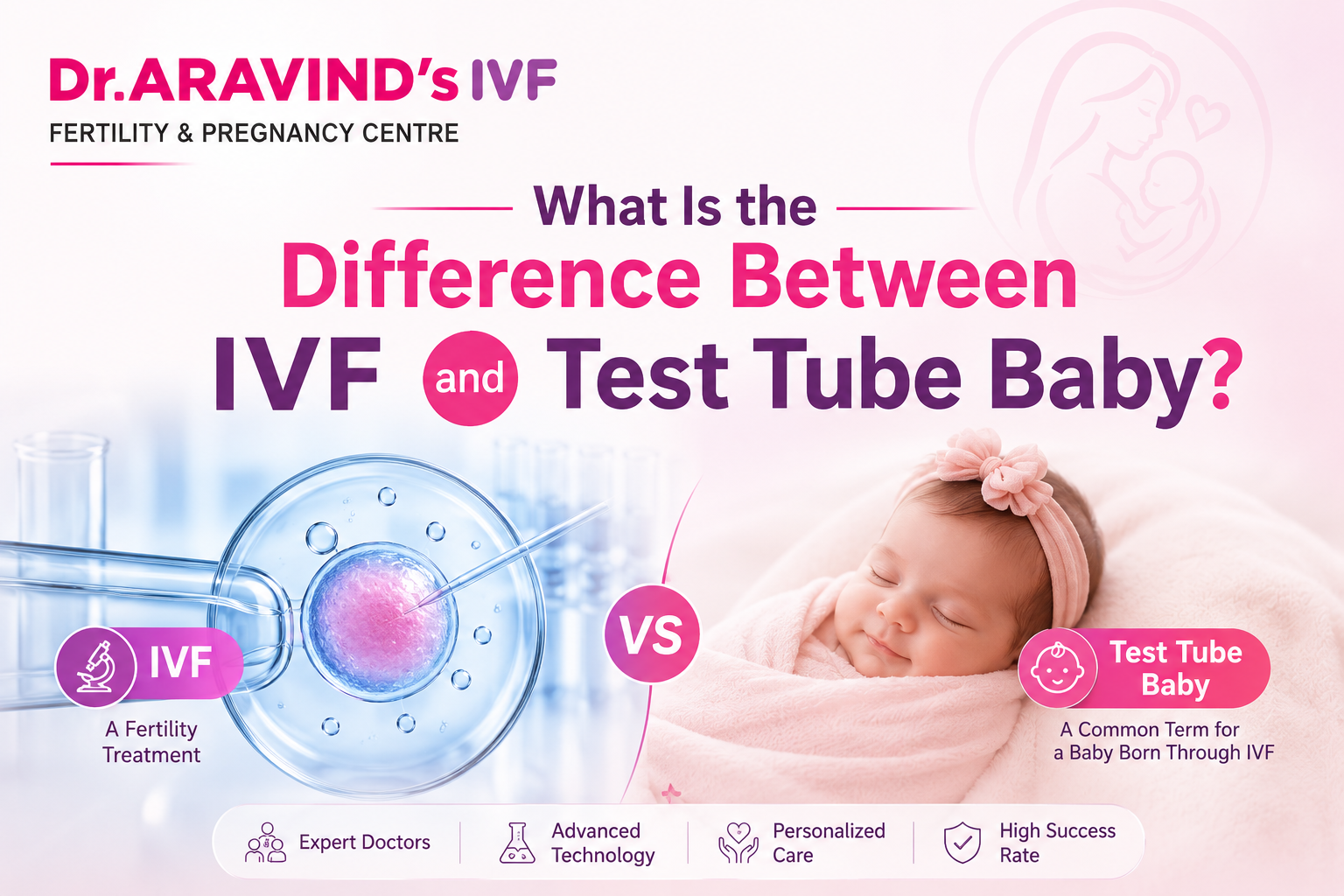
Have you heard two terms — IVF and test tube baby? Do they mean different things? No, they don't. Both terms mean the exact same treatment. That treatment is called In-Vitro Fertilization, or IVF for short. "Test tube baby" is just an old nickname. People started using it many years ago. It is not a medical term.
In this guide, we explain the real IVF meaning. We also show you what the test tube baby meaning truly is. You will learn how the process works. And you will see real results from Dr. Aravind's IVF, where we have completed over 70,000 IVF cycles with a 75% success rate.
IVF means the egg and sperm are joined outside the body. This happens in a lab, not inside the mother. A doctor takes the egg from the mother. Then a doctor collects sperm from the father. Both are placed in a small dish. This is called "in-vitro," which means "in glass." It does not mean inside a test tube.
If fertilization works, an embryo forms. The doctor then places this embryo inside the mother's uterus. From there, the baby grows just like in a normal pregnancy.
So, what is the difference between IVF and test tube baby? There is none. IVF is the real name. "Test tube baby" is just a nickname for the same thing.
The nickname started in 1978. That year, the world's first IVF baby was born. Her name was Louise Brown. She was born in the UK. News reporters needed an easy way to explain IVF to the public. So, they used the phrase "test tube baby." People pictured a baby growing inside a glass tube. That picture was never true.
India also has an early IVF story. A baby named Durga was born through IVF in Kolkata. This happened just months after Louise Brown's birth. India was one of the first countries in the world to have an IVF baby.
The nickname stuck. People still use it today, even though it is not correct.
| Point | IVF | Test tube Baby |
| What it is | The real medical treatment | A nickname for a baby born through IVF |
| Where fertilization happens | In a small lab dish | Same — the "test tube" is just a name, not real |
| Where the baby grows | Inside the mother's uterus | Same — never grows outside the body |
| Who uses this term | Doctors and hospitals | News, older people, everyday talk |
Health of the baby | Normal and healthy | Same — no difference at all |
So, IVF vs test tube baby is not really a fight between two treatments. It is just one treatment with two names.
What Are the Steps in the IVF Process
Here is how IVF works in simple steps:
After this step, the mother is cared for just like any pregnant woman. She gets normal checkups and normal care
Doctors suggest IVF treatment when other, easier methods have not worked. This includes:
There is no actual difference between IVF and a test tube baby. IVF (In Vitro Fertilization) is the fertility treatment in which an egg and sperm are fertilized outside the body in a laboratory. A baby born through this process is commonly called a test tube baby. The term "test tube baby" is simply an older, non-medical name for a child conceived through IVF.
Yes. A test tube baby is a baby conceived using IVF treatment. During IVF, fertilization takes place in a specialized laboratory before the embryo is transferred into the woman's uterus. The pregnancy then develops naturally inside the womb.
The phrase test tube baby became popular because people believed fertilization happened inside a test tube. In reality, modern IVF procedures use laboratory dishes and advanced incubators rather than test tubes. The name remains widely recognized, but IVF is the correct medical term.
Yes. Although fertilization occurs in a laboratory during IVF, the baby grows naturally in the mother's uterus and is born like any other baby. IVF only assists with conception, not pregnancy development
Yes. Most IVF babies are healthy and develop normally. Numerous studies have shown that children born through IVF have growth, intelligence, and overall health similar to those conceived naturally. Regular prenatal care and a healthy pregnancy remain important.
A complete IVF cycle typically takes 4 to 6 weeks, including ovarian stimulation, egg retrieval, fertilization, embryo culture, embryo transfer, and pregnancy testing.


