The first thing Dr. Aravind's IVF Fertility and Pregnancy Centre doctors deal with when couples arrive needing help with fertility problems, their treatment plans, dietary requirements and their medication needs. The discussion starts with sleep, which people consider to be an ordinary activity, but it holds extreme importance. The article marks this lost chance, which it tries to bring back through its content. Proper sleep hygiene and fertility are closely connected, and many couples are unaware of how strongly sleep affects reproductive health.
People need sleep because it functions as a biological process that enables their body to perform essential functions, which include cell repair, memory consolidation, immune response control and hormone creation and hormone regulation. You require between seven and eight hours of sleep each night because insufficient sleep disrupts your hormonal system. The hormonal system needs to function properly for people to achieve their reproductive objectives.
People who want to get pregnant through natural methods or through IVF or who want to understand their reproductive health, should learn how their sleeping habits affect hormone production because this knowledge will help them most this year. The article shows that people need to sleep eight hours because it serves as a biological need, which Dr. Aravind's IVF clinic has established through three decades of scientific research and clinical experience. Proper sleep and IVF success are now widely discussed in fertility medicine because hormone balance directly affects implantation and embryo development.
Sleep hygiene ranges from practices like removing electronic and digital devices from the bedroom to optimizing the sleeping environment, such as using earplugs and white noise to minimize disturbances in and around the bedroom. The duration of your time spent sleeping does not depend on how long you remain active in your bed. People who practice sleep hygiene need to manage all aspects of their sleep experience, which includes their sleep timetable, their sleep surroundings, their nighttime activities and their sleep patterns. Good sleep habits for pregnancy can naturally support hormonal stability and reproductive health.
The Components of Good Sleep Hygiene:
The National Sleep Foundation states that adults need between seven and nine hours of sleep each night to achieve their best health condition. People today face difficulties in obtaining high-quality sleep because their daily activities require them to be exposed to screens and experience various types of stress, together with their shift work and social commitments. Research shows that most urban adults sleep under seven hours each night, which increases their chances of developing various health issues, including hormonal disorders and difficulties with their reproductive system. These healthy routines are among the best ways for people searching for how to improve sleep for fertility and establish the best sleep schedule for conception.
Your body functions according to a 24-hour internal clock system, which scientists refer to as the circadian rhythm. Your body employs its biological clock system to manage all its bodily functions while determining the timing and quantity of hormone production that occurs in your body. Your endocrine system functions at its peak performance when your sleep schedule matches your natural circadian rhythm and you maintain consistent sleep times throughout the night. The body experiences hormonal turmoil when the regular sleep pattern of a person is disrupted.
The brain connects with reproductive organs through the HPG axis, which functions as the primary pathway for hormonal control. Signals from the hypothalamus directly to the pituitary gland lead to the release of hormones from the ovaries or testes. The entire process depends on sleep as its main requirement. Hence, restlessness influences the waves of gonadotropic-releasing hormone (GnRH) secretion coming from the hypothalamus, which can ultimately impair hormonal balance and affect the sleep and ovulation cycle.
Luteinising Hormone (LH) and Follicle-Stimulating Hormone (FSH): The body generates LH and FSH hormones, which function as the primary controllers of ovulation and sperm development through their distinct patterns of secretion during sleep. Partial sleep deprivation causes major disruptions to these sleep patterns, which leads to delayed or complete interruption of ovulation in women and decreases male sperm parameters. This explains the significant sleep deprivation fertility impact seen in couples struggling to conceive.
Melatonin: The sleep hormone, melatonin, which people know as the sleep hormone, actually functions as more than a bedtime signal. The substance operates as a powerful antioxidant that defends both eggs and sperm against oxidative harm. Between 2:00 and 4:00 in the morning are the hours when the melatonin level reaches its peak. Nighttime light exposure through phones, tablets and streetlights prevents melatonin production, which decreases its ability to protect reproductive cells. The protective effects of melatonin on eggs have led multiple IVF clinics worldwide to recommend melatonin supplements for patients who need to undergo egg retrieval.
Cortisol: The stress hormone known as cortisol follows a natural daily cycle, which starts at its highest level in the morning to assist with waking and then decreases throughout the remaining hours of the day. People who experience insufficient sleep will have their cortisol levels maintained at high levels during nighttime and early morning hours. The body maintains high cortisol levels, which results in decreased testosterone production in men and impaired LH surge function needed for ovulation in women. The process creates inflammation inside the uterus, which prevents successful embryo implantation from occurring.
Testosterone: The testosterone sleep connection is essential for reproductive health in both men and women. The hormone testosterone functions as an essential component for both men and women because it affects their sexual desire and energy levels and their ability to reproduce. Sleep provides men with a natural method to produce approximately 70% of their daily testosterone, which reaches its peak level during the rapid eye movement (REM) sleep stage. Men who sleep less than five hours per night for one week will experience a decrease of 10 to 15 percent in testosterone levels, which scientists have found to be equivalent to ageing 10 to 15 years for hormone production.
Growth Hormone (GH): The body releases growth hormone during deep sleep, which includes slow-wave sleep. The hormone serves essential functions because it supports tissue repair and immune defense and it enables women to develop follicles and men to produce mature sperm. Chronic sleep deprivation reduces GH secretion, which leads to reproductive process disturbances.
Prolactin: Prolactin levels increase during sleep, and the hormone supports immune defence while enabling breast milk production. Sleep disturbances lead to high prolactin levels, which inhibit ovulation and decrease sperm production. Sleep Apnea causes numerous awakenings at night, which results in hyperprolactinemia and hence infertility in both men and women.
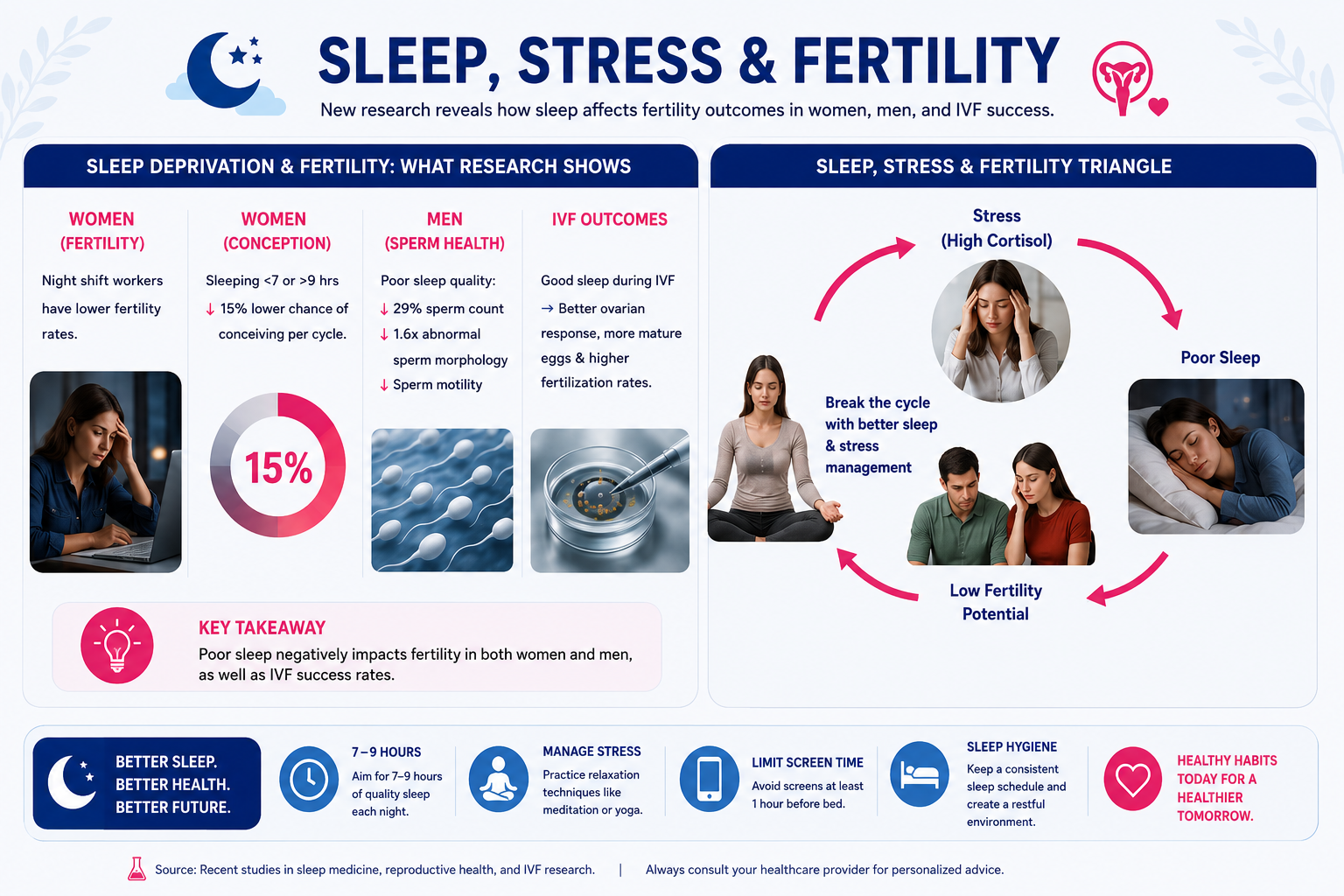
The relationship between insufficient sleep and lower reproductive capacity has been established as a scientific fact through multiple research studies, which show this connection. The journal Fertility and Sterility published a groundbreaking research study that discovered that women who performed night shifts experienced lower fertility rates than women who worked standard daytime shifts.
Researchers found that disrupted circadian rhythms caused hormonal dysregulation, which resulted in their findings. Another study published in the Journal of Sleep Research found that women who slept less than seven hours or more than nine hours per night had a15 percent lower probability of conceiving in any given menstrual cycle compared to women who slept seven to eight hours. People must achieve their optimal sleep duration because sleep and hormone production affect their fertility.
For men, the evidence is equally compelling. Research published in the American Journal of Epidemiology found that men who reported poor sleep quality had a 29 percent lower sperm count and a 1.6-fold increase in the proportion of sperm with abnormal morphology shape. Sleep disturbances caused significant reductions in sperm motility, which describes the ability of sperm to swim in men. The sleep patterns of women who receive IVF treatment function as indicators of their treatment cycle results. The women who achieved sufficient sleep throughout the night demonstrated improved ovarian response to stimulation, increased mature egg retrieval and higher fertilization rates. The mechanism works through optimal LH and FSH secretion, which occurs during the stimulation phase because both hormones become highly sensitive to sleep quality.
The sleep-fertility relationship shows its most intriguing element through the way circadian rhythms match the timing of menstrual cycles. The hormonal events that govern each phase of the menstrual cycle — follicular development, ovulation, and the luteal phase — are controlled through circadian clock timing, and they react to any interruptions in their normal state.
Women who work shifts or who have unpredictable sleeping patterns experience menstrual cycle problems, which include changes in cycle duration and anovulatory cycles and heightened premenstrual symptoms. The disruptions occur because circadian misalignment triggers specific effects that impact GnRH pulsatility and ovarian hormone release. Kisspeptin serves as the main hormone in this situation because it functions as a neuropeptide that controls the HPG axis through its regulatory powers.
The neurons that produce kisspeptin become affected by light-dark cycles because their normal functions stop working after people experience sleeplessness for extended periods. The ovulation process gets blocked when kisspeptin signalling becomes weak because all subsequent biological events need kisspeptin to proceed.
The triangle of sleep, stress, and fertility maintains its existence through self-reinforcing loops. Sleep problems lead to increased cortisol production, which results in decreased reproductive hormone levels. The body experiences increased cortisol, which leads to greater anxiety and results in difficulties with controlling emotions, which makes fertility treatment more challenging. The complete process of fertility treatment includes multiple elements, which make it difficult for patients to achieve restful sleep. The primary task for fertility patients involves breaking this continuous pattern, which affects their ability to conceive.
The counselling team at Dr. Aravind's IVF provides assistance to patients through the identification of their stress-related sleep problems, which they then help patients create solutions for. Cognitive behavioural therapy for insomnia (CBT-I) — a structured programme that teaches patients to reframe thoughts about sleep — has been shown to be more effective than sleep medication in the long term and is increasingly recommended in fertility care settings.
Mindfulness-based stress reduction (MBSR) serves as an evidence-based method that treats both sleep problems and high stress hormone levels. MBSR programmes have been shown to decrease cortisol levels, which leads to enhanced sleep quality and, in certain cases, increases pregnancy success rates in women who receive fertility treatments.
Sleep hygiene holds greater significance for patients who receive IVF treatment through Dr. Aravind's IVF facility because it affects their entire treatment process.
The Ovarian Stimulation period begins with daily hormone treatments, which last between 10 and 14 days to stimulate multiple follicle development. Your ovarian response during this period requires sufficient sleep because your body releases growth hormones through deep sleep, which directly supports your follicle development. Sleep disturbances during the stimulation period will result in fewer mature eggs being collected during the egg retrieval process.
Through sleep, melatonin production creates a protective barrier that shields developing eggs from oxidative harm that occurs within the follicular fluid. The antioxidant-rich environment created through excellent sleep before egg retrieval will enhance fertilization rates by protecting your eggs from damage.
The period after embryo transfer represents one of the highest stress moments throughout the entire IVF process. High cortisol levels from stress and lack of sleep will hinder uterine receptiveness, which decreases the odds of successful implantation. The two-week waiting period requires people to use sleep hygiene practices together with stress management techniques because these methods benefit their emotional state and their biological functions.
People who have sleep problems need to make lifestyle changes because these changes will solve most of their sleep issues. You should consult your doctor if you experience any of the following.
Dr Aravind's IVF Fertility and Pregnancy Centre provides complete fertility treatment through its holistic arrangement for fertility treatment. Our team considers sleep disorder management as a vital component of fertility treatment, which we execute through our partnerships with sleep specialists. You should bring up your sleep problems at your consultation because your information might provide essential details that will transform everything.
Scientific evidence establishes that sleep functions as an active body state during which essential hormonal processes occur. Sufficient high-quality sleep is essential for every reproductive hormone process, which begins with LH and FSH release and ends with deep sleep growth hormone production. The number eight hours serves as a standard time frame, which enables all processes to develop completely while following their designated order of events. When people reduce their sleep period, which lasts eight hours by any amount between thirty minutes and three hours, they begin a process that results in hormonal shortages that lead to gradual fertility decline throughout their entire life.
Dr. Aravind's IVF Fertility & Pregnancy Centre provides complete fertility treatment, which treats actual patients, instead of treating their specific medical conditions. We recommend you start your sleep improvement work now, because productive work follows sleep improvement. The existing situation that people face requires one particular change to activate all subsequent transformations. Following proper sleep hygiene and fertility practices and maintaining the best sleep schedule for conception can significantly support reproductive health and overall well-being.
You can schedule your appointment through draravindsivf.com to meet our qualified fertility specialists who work at our facilities located throughout Tamil Nadu, Kerala and other areas. Your path to becoming a parent starts with a better sleep experience at night.
Yes. Poor sleep may reduce ovarian response, affect egg quality, increase stress hormones, and lower implantation success during IVF treatment.
Sleep hygiene refers to healthy sleep habits that improve sleep quality, such as maintaining a regular sleep schedule, avoiding screens before bed, limiting caffeine, and creating a dark, quiet sleep environment.
Melatonin acts as a powerful antioxidant that helps protect eggs and sperm from oxidative damage. Healthy sleep naturally supports melatonin production, which may improve reproductive health.
Yes. Chronic stress and sleep deprivation increase cortisol levels, which can interfere with ovulation, sperm quality, and hormonal balance, making conception more difficult.
Men who consistently sleep less than 5–6 hours may experience lower testosterone levels, reduced sperm count, poor sperm motility, and abnormal sperm morphology.


