hCG does not have to double exactly every 48 hours after embryo transfer. In many early pregnancies, it rises by more than half over two days, and the rise doctors find reassuring becomes smaller as the starting number gets higher. Your doctor interprets the percentage rise, actual values, symptoms and scan findings together. One pair of numbers or an online calculator cannot determine whether a pregnancy is healthy.
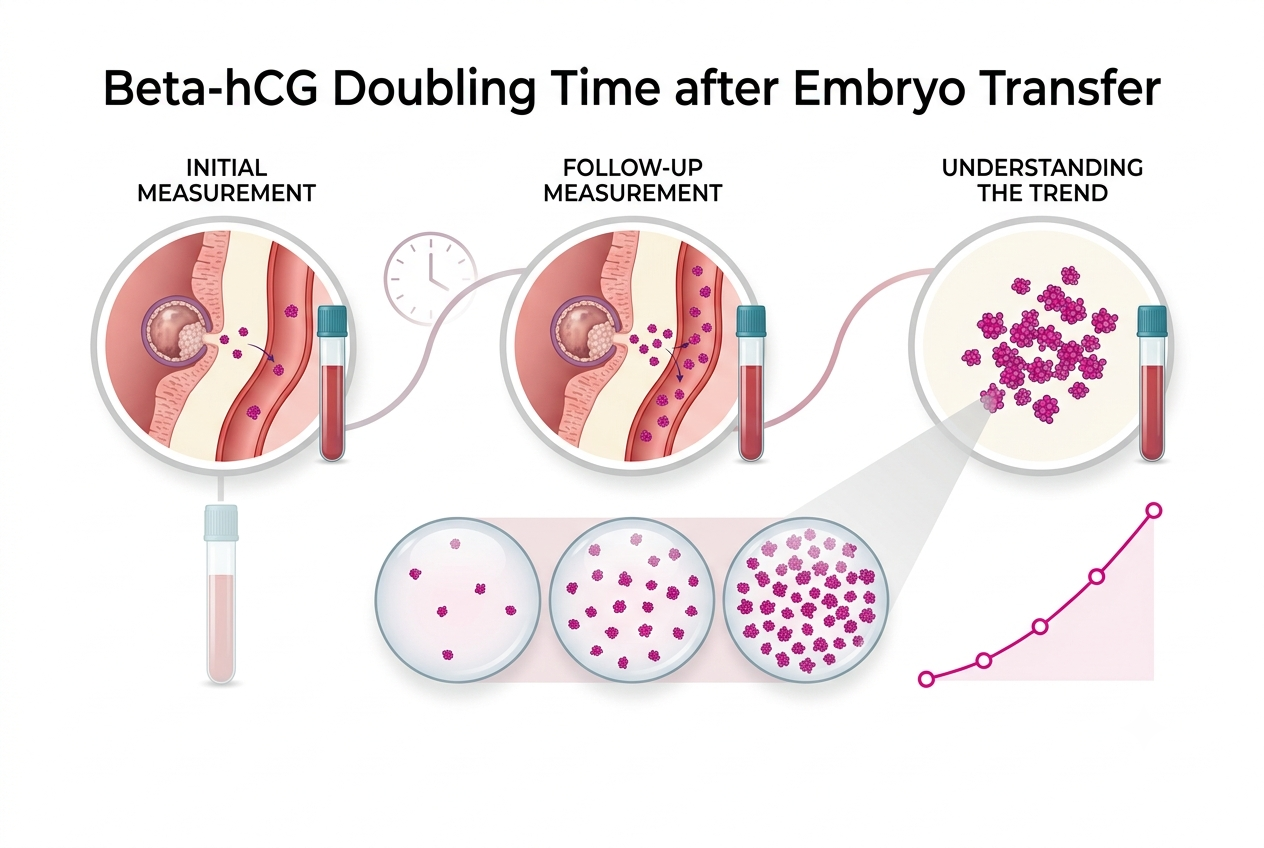
Doubling time is an estimate of how long your hCG would take to double, calculated from two blood test results taken at known times. The calculation needs the first hCG value, the second value, and the time between the tests.
In early pregnancy, hCG does not rise in a straight line. It generally increases faster when the numbers are low, and the rate of increase slows as the levels rise. Therefore, an hCG result that falls short of an exact doubling in 48 hours is not automatically a reason to worry. Your doctor will interpret the trend alongside your symptoms and ultrasound findings.
For more information about your initial test, read what your first beta-hCG after IVF tells you.
No. It is a handy picture, but not a rule every pregnancy must meet. In healthy early pregnancies inside the womb, the smallest rise considered reassuring over about 48 hours can be well under 100%, particularly when you start from a higher number.
| Starting hCG | Commonly cited minimum rise over about 48 hours |
|---|---|
| Below 1,500 mIU/mL | About 49% |
| 1,500 to 3,000 mIU/mL | About 40% |
| Above 3,000 mIU/mL | About 33% |
hCG levels can rise at different rates from one pregnancy to another. Several factors may influence the results, including:
Your embryo transfer date helps your doctor estimate how far along the pregnancy may be, but it cannot identify the exact day implantation occurred. Your doctor will interpret your hCG trend alongside your symptoms and, when appropriate, ultrasound findings. If you experience severe or one-sided abdominal pain, shoulder-tip pain, fainting or heavy bleeding, seek urgent medical care.
The usual working is:
They may also estimate a doubling time. These calculations only help when the tests were taken at the right interval and reported in the same units.
| Case | First beta | Second beta (about 48 h later) |
Rise | How a doctor may see it |
|---|---|---|---|---|
| A | 150 | 260 | 73% | Above the usual minimum for this starting level; still interpret alongside symptoms and scan findings. |
| B | 150 | 200 | 33% | Below the commonly cited minimum for this starting level; repeat testing and closer review may be needed. |
| C | 2,400 | 3,400 | 42% | Above the commonly cited minimum for this starting level. |
| D | 4,000 | 5,500 | 38% | Above the commonly cited minimum for this starting level. |
A slower hCG rise can happen when testing very early, but it can also be associated with a pregnancy that is not developing normally or an ectopic pregnancy. Your doctor will assess the results alongside your symptoms and medical history. Your clinic may:
Never stop progesterone just because an online calculator shows a slower hCG rise. Continue your prescribed medicines unless your fertility team advises otherwise. Learn more about progesterone after embryo transfer.
A falling hCG level can mean that the pregnancy is not continuing. Your doctor may recommend repeat blood tests until the level reaches an appropriate endpoint or the pregnancy's outcome is clear.
A falling hCG level does not immediately rule out an ectopic pregnancy. Seek urgent medical care if you experience abdominal or one-sided pelvic pain, shoulder-tip pain, fainting, severe dizziness or heavy bleeding, even if your hCG level is low or decreasing.
The pregnancy may be too early to see on ultrasound, or the pregnancy dates may differ from the initial estimate. If the hCG level is high enough that a pregnancy inside the uterus would usually be visible, your doctor may investigate further.
However, no single hCG value can confirm the pregnancy's location or outcome by itself. Ultrasound quality, pregnancy dating and the possibility of multiple pregnancies can all affect the findings. Your doctor may recommend repeating the ultrasound and beta-hCG test before making a diagnosis.
A transvaginal ultrasound is usually scheduled when it is likely to provide useful information, often around six weeks of pregnancy. Timing depends on your pregnancy dates, symptoms, hCG trend, and clinic protocol.
During the scan, your doctor may assess:
Your doctor will determine the most appropriate scan date based on your individual circumstances.
No. hCG levels vary widely, even in singleton pregnancies. A rapid rise cannot reliably diagnose twins or another multiple pregnancy. An ultrasound is used to determine how many pregnancy sacs are present.
No. One pair of results showing a slower-than-expected rise is not enough to diagnose a miscarriage. Your doctor will interpret repeated hCG measurements alongside your symptoms and ultrasound findings.
It is reasonable to ask your fertility team for a clear follow-up plan, including when to repeat your blood test, when to have your scan and which symptoms need urgent attention. Avoid trying to predict the outcome from an online chart alone.
| Feature | Biochemical pregnancy | Ectopic pregnancy |
|---|---|---|
| What it is | A very early pregnancy that stops developing before an ultrasound can confirm it. | A pregnancy implanted outside the womb, most often in a fallopian tube. |
| Urgency | Often resolves without emergency treatment, but medical follow-up is still important until the pregnancy is resolved. | Can become a medical emergency if it ruptures or causes internal bleeding. |
| hCG pattern | Usually falls, although the trend must be monitored until the outcome is clear. | May rise slowly, rise in a pattern that appears normal, or fall. |
A beta-hCG calculator can calculate the change between two blood test results, but it cannot tell you whether a pregnancy is healthy. It cannot diagnose pregnancy viability, twins, or an ectopic pregnancy.
The result may also be misleading if the blood tests were not taken approximately 48 hours apart or if different laboratory testing methods were used. Your doctor will interpret the actual hCG values, the time between tests, your symptoms, and ultrasound findings together.
Use an online calculator as a learning tool rather than a diagnostic test. Review your actual laboratory reports with your fertility team to understand what your results may mean for your pregnancy.
hCG doubling time after embryo transfer is a useful estimate, not a pass-or-fail rule. Many early pregnancies show a rapid rise in hCG, but levels do not always double within 48 hours, particularly as the starting value increases. Repeat blood tests, symptoms and ultrasound findings together provide a clearer picture than an online calculator alone.
Discuss your beta-hCG reports, follow-up blood tests and ultrasound timing with your fertility team.
Book an IVF consultationMedical disclaimer: Serial beta-hCG results require medical interpretation. Do not diagnose a miscarriage or ectopic pregnancy using an online calculator or a single pair of blood test results. This article is for educational purposes only and cannot determine the viability or location of a pregnancy. Seek urgent medical care for severe or one-sided abdominal pain, shoulder-tip pain, fainting or heavy bleeding.
Often quickly in early pregnancy, but it need not double exactly every 48 hours. The acceptable rise depends partly on the starting value and has to be read by your doctor.
It can fit a progressing pregnancy in some situations, depending on the starting level, but your doctor needs to look at the whole picture.
A fast rise does not prove twins or guarantee a healthy pregnancy. Keep your planned follow-up and scan.
Some people need one positive test and then a scan. Others need several because the first value was low or borderline, they have symptoms, or the trend needs clearing up.
Progesterone supports the womb lining and is not used to judge hCG rise. Do not change it based on hCG results unless your clinic says so.


