Premenopause vs perimenopause is mostly a question of timing, and the two terms are not always used in the same way. This guide explains the meaning, age, symptoms and difference between premenopause and perimenopause, so you can make sense of changes in your body.
Short answer: premenopause generally refers to the reproductive years before the menopausal transition. Perimenopause is the transition towards menopause, when cycles and hormone levels may change. Symptoms such as hot flushes can appear, but pregnancy may still be possible because ovulation can continue.
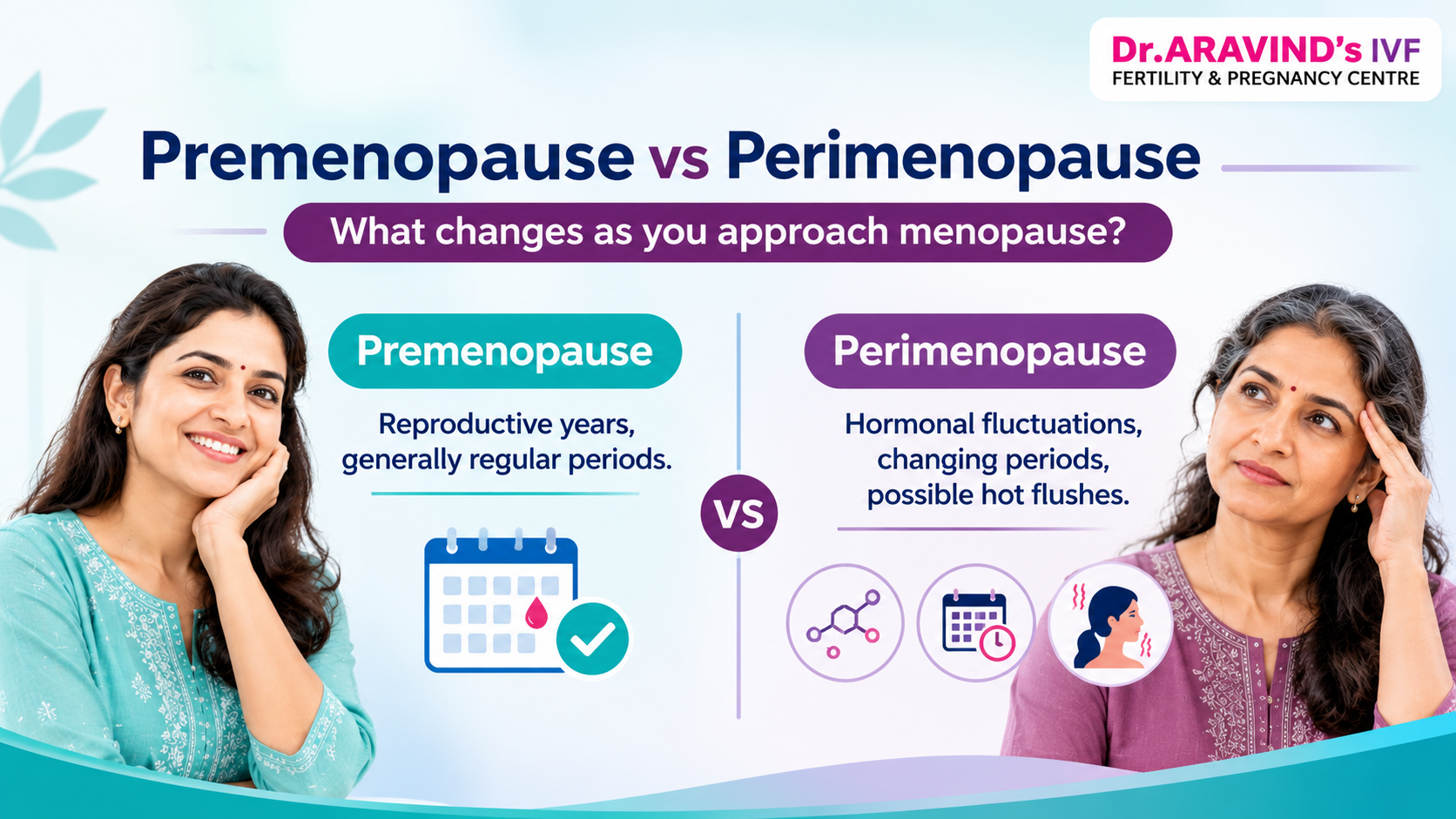
Premenopause generally describes the reproductive years before the menopausal transition begins. Ovulation is regular for most women and periods follow a fairly steady pattern. In most ovulatory cycles a follicle releases an egg, oestrogen builds the uterine lining and progesterone supports it after ovulation. If pregnancy does not occur, hormone levels fall and a period begins. Irregular periods in these years can also be due to PCOS or thyroid problems, so premenopause does not require perfectly regular cycles.
In everyday use, "premenopausal" means the regular-cycle years before perimenopause. In some medical settings, it simply means "not yet postmenopausal", which can include the perimenopause years. It is also not a formal stage in the standard STRAW+10 staging system, which uses reproductive stage, menopausal transition and postmenopause.
Perimenopause means "around menopause". It is the transition during which the ovaries release eggs less regularly and hormone levels rise and fall unpredictably. The WHO describes perimenopause as beginning when menopause-associated signs first appear and continuing until one year after the final menstrual period. STRAW+10 treats the formal menopausal transition as ending at the final period, but recognises that "perimenopause" is commonly used for the broader span through the first 12 months after it. Read our guide on perimenopause vs menopause.
Premenopause covers the reproductive years, so it has no fixed starting age. Fertility starts to decline gradually in the later reproductive years.
Perimenopause commonly begins during the 40s, although the timing varies and some women notice changes earlier. If you have persistent menstrual changes in your 30s, see a doctor to check for other causes rather than assuming it is perimenopause. On average it lasts about 4 years, but the length varies widely and cannot be predicted for any one woman. A 2021 meta-analysis of Indian studies reported an average age of natural menopause of about 46.6 years among women in India. This is a population estimate, not a prediction for any one woman.
These patterns are general descriptions, not diagnostic rules. Symptoms can overlap between stages and may have causes unrelated to menopause.
Changes in the period are often the first clue. You may notice:
You can still have regular periods in early perimenopause. If your cycles are very unpredictable, read our guide on irregular periods.
Yes. You can get pregnant during premenopause, and pregnancy remains possible during perimenopause because ovulation can still occur, even when periods are irregular. Fertility declines with age and miscarriage risk rises, so conception may take longer. If you do not want to get pregnant, keep using contraception, and ask your doctor when it is safe to stop.
If you are trying to conceive and cycles are unpredictable, a fertility assessment may include:
Depending on the findings, options may include IUI or IVF.
This self-check is informational, not a diagnosis.
According to the STRAW+10 criteria, a persistent difference of 7 days or more between consecutive cycle lengths (recurring within 10 cycles) marks the early transition, and a gap of 60 days or longer marks the late transition. These are clinical staging markers, not a self-diagnosis rule.
NICE guidance differs by age. For otherwise healthy women over 45 with typical symptoms, such as recent hot flushes and period changes, perimenopause is identified clinically, without blood tests, and AMH, oestradiol and antral follicle count should not be used for diagnosis. FSH may be considered at ages 40 to 45 with symptoms and cycle changes, or under 40 if menopause is suspected. Suspected premature ovarian insufficiency under 40 needs clinical assessment and two raised FSH results 4 to 6 weeks apart. Hormonal contraception can mask period patterns and complicate test interpretation. Your doctor decides which tests are appropriate. No single test, including AMH, can identify your stage on its own.
You cannot prevent perimenopause, but you can prepare for it:
See a doctor if you have any of the following:
If your periods are changing or you want to conceive, a proper evaluation can bring clarity. At Dr. Aravind's IVF, our specialists can review your history, advise on tests and explain your options. Book your appointment to discuss your next steps.

Premenopause is the reproductive years with generally regular cycles. Perimenopause is the transition before menopause, when hormones fluctuate, periods change and symptoms such as hot flushes may begin.
No. Premenopause usually means the years before menopausal changes begin. Perimenopause is the transition itself. Some doctors use "premenopausal" to mean "not yet postmenopausal".
Premenopause has no fixed starting age. It generally refers to the reproductive years before menopause-related changes begin.
Period changes usually come first: shorter or longer cycles, skipped periods or heavier or lighter bleeding. Hot flushes, night sweats and sleep changes may follow.
Yes. In early perimenopause, periods can stay fairly regular while other symptoms such as night sweats or sleep changes begin.
Yes. Ovulation generally continues in premenopause and can still occur in perimenopause, so pregnancy is possible in both, although fertility declines with age. Use contraception if you do not want to conceive, and ask your doctor when it is safe to stop.
Perimenopause before 40 is less common. If you have persistent menstrual changes or menopause-like symptoms in your 30s, consult a doctor. Thyroid disorders, PCOS and premature ovarian insufficiency may need to be assessed.
No. AMH estimates egg quantity (ovarian reserve) in a fertility assessment, but it cannot diagnose perimenopause, measure egg quality or predict the exact age of menopause.


