Couples who start their fertility treatments for the first time face a sudden surge of medical terms, which creates a difficult situation to handle. IVF (In Vitro Fertilization) and ICSI (Intracytoplasmic Sperm Injection) stand as two of the most frequently studied medical procedures. The two treatments exist to help couples achieve successful pregnancies, but their operational methods, treatment purposes and usage methods show essential differences. Understanding the IVF vs ICSI difference and the difference between IVF and ICSI creates a crucial need for couples to comprehend their differences when choosing their future family development path.
Our clinic provides service from Dr. Aravind, who has dedicated over 30 years to his practice at IVF Fertility & Pregnancy Centre, a leading fertility clinic in Tamil Nadu and the best fertility hospital in Chennai, which has completed more than 70000 IVF procedures. This article explains ICSI and traditional IVF in simple language, which helps you determine which treatment option will suit your specific needs better.
In Vitro Fertilization which people usually call IVF, stands as one of the most established assisted reproductive technologies worldwide. The Latin term "in vitro" which means "in glass", describes the process because fertilization takes place outside the body in laboratory conditions.
The IVF procedure starts with doctors giving women hormonal treatment. The fertility drugs that doctors give to women enable their ovaries to create multiple mature eggs during one cycle instead of producing one egg. The egg retrieval process starts when doctors perform a minor surgical procedure under sedation to take the eggs from the woman. The male partner or donor provides a semen sample, which doctors collect at the same time.
The laboratory staff places the retrieved eggs together with processed sperm in a special culture dish. The sperm proceed to fertilize the eggs by choosing which eggs to fertilize through their natural selection process. The self-selection method forms the foundation of traditional IVF because it attempts to recreate the natural process that occurs in the human body. Doctors first cultivate the fertilized embryos for three to five days before they transfer the highest quality embryo to the woman's uterus, a process that contributes to the IVF treatment success rate.
The following conditions should lead couples to seek traditional IVF treatment.
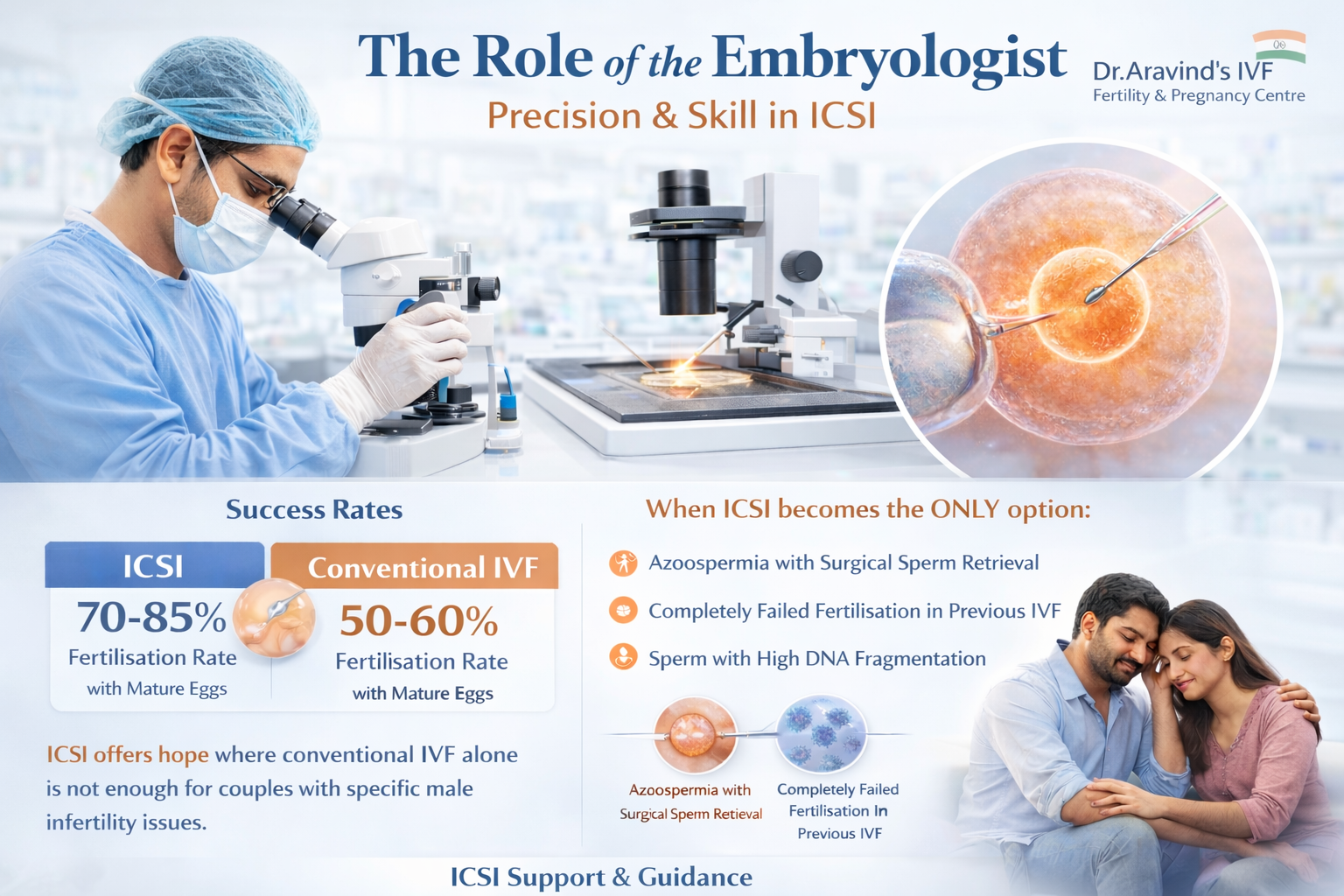
The medical procedure Intracytoplasmic Sperm Injection, which people refer to as ICSI, represents an advanced method of IVF that requires embryologists to use a special needle to inject one sperm directly into a fully developed egg. The sperm in traditional IVF must reach the egg without assistance, but in this process, embryologists use their microscope to conduct the necessary work.
ICSI, which medical professionals first introduced in 1992, has become a worldwide standard approach for male factor infertility treatment. The procedure accounts for a major share of global assisted reproduction treatments, and Dr. Aravind's IVF clinic delivers it with exceptional accuracy and expertise.
The ICSI implementation begins with the same procedures as standard IVF treatment, which requires the woman to receive ovarian stimulation and undergo egg retrieval while the male partner produces a sperm specimen. The laboratory operations that follow differ completely from the first process.
Using a specialized microscope, the embryologist selects one healthy sperm from the sample. The process involves immobilizing the sperm before placing it into a slender hollow needle. The holding pipette maintains the mature egg's position while the needle travels through the egg's outer layers to inject sperm into the egg's cytoplasm, which constitutes the internal egg material. The exact procedure of ICSI injection defines the process.
The injected eggs undergo fertilization first before entering the development stage, which proceeds to complete embryo formation. The fertilized eggs (embryos) are monitored over the following days, and the best-quality embryo is transferred into the uterus — exactly as in conventional IVF.
ICSI provides the highest success rate for couples who experience these conditions:
The table below summarises the key differences between conventional IVF and ICSI across several important dimensions:
The technical requirements for embryology teams differ between ICSI and IVF despite their apparent simple distinction.
The process begins with traditional IVF, which relies on sperm washing and density gradient centrifugation to prepare sperm for medical procedures. The process creates pure active sperm, which medical professionals use to fertilize eggs through natural sperm movement to reach the egg's outer protective layer. The ICSI process requires embryologists to perform more complex steps, which result in improved outcomes. The scientists examine each sperm sample through advanced zoom technology to identify the presence of normal cell structure elements and proper movement patterns, and DNA damage. The process requires scientists to select one particular sperm cell, which they will use to fertilize the egg while skipping the process of passing through the outer protective layer.
In ICSI, the embryologist's role is dramatically elevated. The success of the procedure depends on three factors, which include precise execution, professional experience and skilled injection methods. A poorly executed injection can damage the egg or impair fertilization. The clinic needs to hire highly skilled staff members who possess advanced expertise in embryology, according to the requirements of Dr. Aravind's IVF clinic.
The primary inquiry that couples present to me shows their interest in comparing ICSI pregnancy results with those obtained through standard IVF methods. The answer requires specific details because infertility treatment depends on each patient's medical condition.
When examining male factor infertility cases, ICSI shows better results because it achieves 70 to 85 percent fertilization success with mature eggs through injected sperm, whereas conventional IVF reaches 50 to 60 percent success. This situation becomes critical when there exists an apparent decrease in sperm functioning capabilities.
The research does not demonstrate better pregnancy outcomes or live birth success for ICSI compared to standard IVF for couples who do not show male infertility traits. In this situation, conventional IVF creates a natural selection process through which sperm compete to achieve fertilization, which provides biological benefits.
Dr. Aravind's IVF Fertility & Pregnancy Centre develops individualized treatment plans that match the unique needs of every patient. The clinical team evaluates specific parameters for each couple, which include sperm analysis reports, ovarian reserve tests and previous treatment history to select the approach that will most likely lead to a healthy pregnancy.
The infertility solution ICSI becomes essential for couples who need this method because they cannot achieve biological parenthood through other means. The situations that lead to this include
A man needs to undergo surgical procedures that collect sperm directly from his reproductive tract because he can not produce sperm through two distinct medical conditions, which include obstructive azoospermia and non-obstructive azoospermia. The laboratory uses TESA, PESA and Micro-TESE as techniques to extract testicular sperm. ICSI becomes the only possible method to achieve fertilisation because the retrieved sperm count remains extremely low, with only a few sperm available for use.
A small but significant proportion of couples experience total fertilization failure in their first IVF cycle, which results in all of the eggs remaining unfertilized after sperm and eggs are combined. ICSI becomes necessary for subsequent cycles because it allows the complete elimination of natural sperm penetration barriers.
High DNA fragmentation occurs when genetic material in sperm DNA sustains physical damage, which results in broken DNA strands. Sperm DNA fragmentation occurs at high levels because it leads to fertilisation problems and lessens the quality of embryos while also increasing the likelihood of miscarriage. ICSI, combined with IMSI advanced sperm selection techniques, provides an improved chance to choose genetically pure sperm.
The process of fertility treatment encompasses more than medical aspects because it includes deep emotional impacts. Couples undergoing IVF or ICSI treatment experience equal parts of anxiety, hope, uncertainty and grief. The IVF clinic at Dr. Aravind provides complete assistance to patients who require emotional support throughout their treatment process.
Patients experience great difficulty when they have to select between IVF and ICSI because they need ICSI, which occurs when doctors diagnose a male fertility problem. Men who deal with infertility issues experience hidden feelings of guilt and shame, which require professional assistance through special counselling programs. The clinic at Dr. Aravind's IVF offers specialized counselling services which help both partners throughout their entire treatment process from the initial diagnosis to the final embryo transfer.
Most couples face real budget constraints because they need to understand how IVF and ICSI treatments differ in their financial costs between these two procedures. In India, ICSI treatment costs more than standard IVF because ICSI requires special laboratory equipment and highly skilled embryologists and additional time for the microinjection procedure.
The higher fertilization rates that ICSI provides for patients with severe male infertility establish ICSI as a medically necessary treatment because it lowers overall fertility treatment cost India through its ability to decrease the number of required treatment cycles until pregnancy occurs, Dr. Aravind's IVF provides treatment plans that achieve clinical effectiveness while remaining affordable to patients through their flexible EMI payment system, which removes financial barriers to treatment.
The success rate of fertility treatments depends mainly on the proficiency of a fertility clinic and its entire staff. When assessing a fertility clinic, you should evaluate these essential factors:
Dr. Aravind's IVF Fertility & Pregnancy Centre meets all of these standards, which the centre proves through its more than 30 years of medical practice, Guinness World Record achievement and trust from thousands of families who visit the centre from Chennai and multiple locations in Tamil Nadu and its surrounding areas. Selecting the best fertility hospital in Chennai or the best ICSI centre in Chennai is crucial for treatment success. The multiple Chennai centres, which operate in Karapakkam, Urapakkam, Madipakkam, Vadapalani, Tambaram and various locations in Tamil Nadu, provide easy access to expert fertility services throughout the region.
Every couple experiences their own unique journey from infertility to parenthood, and IVF and ICSI selection requires personal decision-making, which should be made under the guidance of an experienced fertility expert. Traditional IVF remains a powerful and effective treatment for many forms of infertility. ICSI provides men with a new opportunity to achieve biological fatherhood because it has removed barriers that previously prevented access to this ability.
The two methods share one objective, which involves bringing a healthy newborn into the world to fulfil the aspirations of a family. Understanding the difference between IVF and ICSI helps couples make informed decisions. Whether choosing IVF or ICSI treatment in Chennai, the goal remains achieving a healthy pregnancy. Dr. Aravind's IVF and Pregnancy centre develops all its activities around the central objective, which includes all clinical choices and laboratory operations, all mental health services and all efforts dedicated to achieving your goals.
Our specialist team will help you find the best treatment options available through our consultation service, which you can schedule at any time. ICSI has revolutionized male factor infertility treatment. Your journey to becoming a parent starts with one important conversation.
The main difference is in how fertilization happens. In IVF, sperm fertilizes the egg naturally in a lab dish, while in ICSI, a single sperm is directly injected into the egg.
ICSI shows higher fertilization rates (70–85%) compared to IVF (50–60%), especially in cases of male infertility. However, overall pregnancy rates may be similar in couples without male factor issues.
ICSI is recommended for severe male infertility, low sperm count, poor sperm motility, azoospermia, or previous IVF fertilization failure.
Yes, ICSI is slightly more expensive due to advanced laboratory techniques and expertise required for sperm injection.
Yes, IVF works well for many couples, especially when sperm quality is normal and there are no severe male fertility issues.


