A couple faces their most essential choice when they decide to start their fertility treatment. The path becomes difficult because couples need to handle multiple aspects, which include medical consultations, diagnostic tests, procedures and their emotional commitment to the process and the financial requirements of treatment. Fertility medication costs account for one of the largest expenses in a fertility cycle, while their actual costs remain unclear to most people.
You are not alone if you have experienced that moment when your fertility doctor gave you a prescription list that made you feel overwhelmed because of its extensive drug content. Couples who begin fertility treatment understand basic IVF treatment cost in India and IUI costs, but they experience shock when they discover that medication expenses can reach 30 to 50 percent of total treatment costs. At Dr. Aravind’s IVF center known for offering affordable fertility treatment in Chennai, we consider financial transparency to hold equal value with our commitment to clinical excellence. Patients who understand their condition become more capable of making decisions about their health and future.
The article provides a complete overview of all drugs used during standard fertility cycles, which includes details about each drug’s function and its current price in India. The guide assists you in budgeting and planning your first IUI or third IVF attempt by providing essential questions to ask.
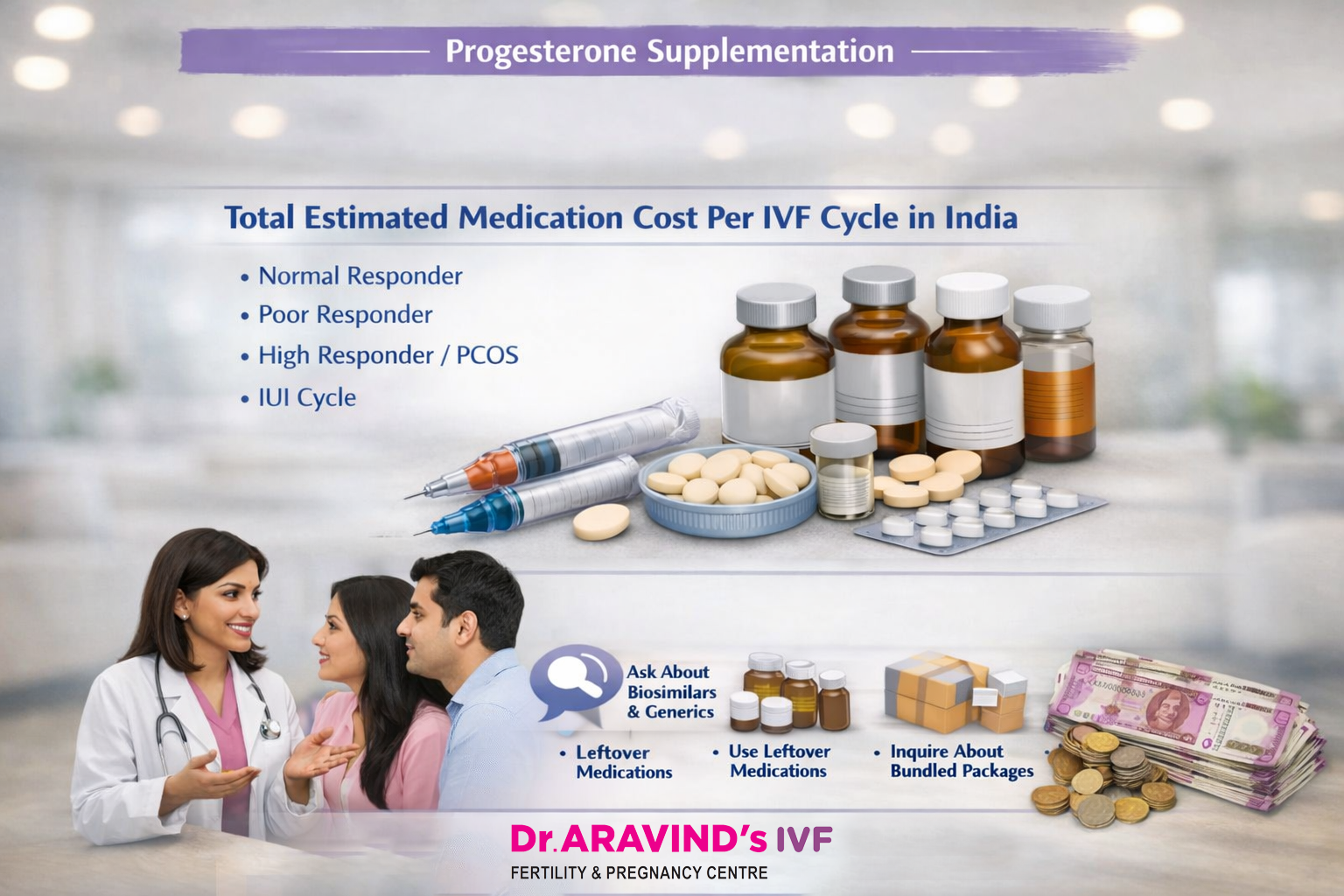
Fertility treatments function as a scientific partnership that unites medical knowledge with the natural processes of your body. The two elements of the treatment both depend on medications, which create a link between them. Your body follows a natural pattern that results in one egg production during each monthly cycle. The IVF process requires a stimulated cycle, which uses medications to force the ovaries to generate multiple eggs at once. This method increases the possibility of obtaining usable eggs, which will undergo successful fertilization and result in pregnancy.
The medical field uses drugs to stop early ovulation while also preparing the uterine lining to receive embryos and maintaining the body’s hormonal balance throughout all stages of treatment. Each drug plays a specific, irreplaceable role — which is why the medication list for a single IVF cycle can include anywhere from five to twelve different medications.
The price of the medications depends on the brand name, the existence of a generic option and the dosage, which doctors determine based on how each patient reacts, their weight and the treatment plan that the fertility doctor selects. Two patients at the same clinic going through the same treatment can end up spending very different amounts on medications, simply because their bodies respond differently to stimulation.
Before the actual stimulation of the ovaries begins, many fertility specialists prescribe a short course of medications to regulate the cycle and create the best possible starting conditions.
The first oral contraceptive to use OCPs is used 2-4 weeks before the start of the upcoming menstrual cycle. The answer to this question becomes clear through scientific explanations. OCPs work as a natural cycle barrier, which enables medical professionals to choose the optimal time for beginning their treatment. The cost of OCPs is minimal, typically between ₹100 and ₹400(Approximately) for the required course.
The GnRH Agonists function as Downregulation agents through their usage of GnRH agonists, which include Leuprolide and Buserelin during the pre-stimulation phase. The medical team uses these medications through one of two delivery methods, which include injections and nasal sprays that last between one and two weeks. The medical costs for this product range between ₹1,500 and ₹5,000(Approximately) because the price depends on both the selected brand and the length of time it will be used.
This is where the bulk of the medication cost is concentrated. Gonadotropins — injectable hormones that stimulate the follicles in the ovaries to grow and mature — are the most expensive category of fertility drugs. The process of stimulation uses two primary types of medications.
FSH operates as the main factor that drives the process of follicle development. Gonal-F, Follistim, and Fostimon plus their biosimilar equivalents, which include Recagon and Ovublins, represent the common brands that doctors in India prescribe. The cost per injection vial or pen can range from ₹800 to ₹3,500(Approximately), depending on the brand and the unit dosage. The standard stimulation protocol needs 8 to 14 days to complete, with daily injection requirements. The cost of FSH for a patient will range between ₹15,000 and ₹60,000(Approximately) based on their prescribed daily dosage, which can go from 75 IU to 450 IU throughout the treatment cycle.
HMG contains both FSH and LH (Luteinizing Hormone) and is often prescribed alongside or instead of pure FSH. The product category includes Menogon, Menopur, and Merional. The costs for FSH drugs range between ₹900 and ₹2,800(Approximately) per vial. The total stimulation expenses will rise when FSH injections are combined with other treatments.
Recombinant FSH (rFSH) functions as a laboratory-produced pure form of FSH, which provides more consistent dosing results than urinary FSH products but comes with higher costs. The combination of biosimilar and urinary-derived gonadotropins provides a financial advantage to patients who respond to these treatments without affecting their treatment results.
The full cost of stimulation medications depends on how well your ovaries respond to treatment. Patients who have diminished ovarian reserve need to use higher medication doses because they require extended treatment time, which results in increased treatment costs. The risk of ovarian hyperstimulation syndrome (OHSS) leads doctors to prescribe lower doses to patients with PCOS, as this approach results in lower treatment expenses.
Phase 3: GnRH Antagonists — Preventing Premature Ovulation
The body initiates ovulation through LH surge release after follicles reach their predetermined size. The eggs would be released before the retrieval procedure in a stimulated cycle, which would result in a lost cycle. The GnRH antagonists prevent the LH surge, which occurs too early, because they enable an expert to keep the eggs until the moment he decides to trigger their retrieval.
Common antagonists prescribed in India include Cetrotide (cetrorelix) and Orgalutran (ganirelix). These medications require patients to receive daily subcutaneous injections for 3 to 5 days during the final phase of their stimulation treatment. The total antagonist expenses range from ₹5,000 to ₹15,000 (Approximately) per cycle because each injection costs between ₹1,500 and ₹3,000(Approximately).
The administration of a trigger shot occurs when the follicles achieve their complete development, which requires two to three follicles to reach a size of 18 to 20 mm.
The most common trigger used in medical practice is hCG, human chorionic gonadotropin which comes in three different forms: Ovitrelle, Pregnyl and Lupi-HCG. The trigger requires one injection, which costs between ₹800 and ₹2,500(Approximately), depending on which brand is selected.
Doctors administering treatment to patients who have high OHSS risk use the GnRH agonist trigger method, which includes Lupride. The treatment option provides safer results for high-responders at a cost range of ₹400 to ₹1,200(Approximately) for each individual dose. Some clinics use a dual trigger, which combines hCG with a GnRH agonist to optimise final egg maturation in specific clinical situations.
Phase 5: Luteal Phase Support — Preparing for Embryo Transfer
The body requires hormonal treatment after egg retrieval and embryo transfer to protect the uterine lining while assisting with the process of embryo implantation. The luteal support period begins when patients receive their first medication after egg retrieval and continues until they take their first pregnancy test, which leads to extended treatment when results show positive findings.
Progesterone functions as the primary medication for this stage. Patients prefer vaginal progesterone suppositories, which include Crinone gel, Cyclogest, Susten and Gestofit, because these products deliver progesterone directly to their uterine tissue. The treatment requires patients to take their medication either two or three times every day, with prices ranging from ₹25 to ₹80(Approximately) for each unit. The price for a two-week treatment period ranges between ₹1,000 and ₹3,500(Approximately).
FET patients need estradiol to create the necessary conditions that their uterine lining requires before they start their progesterone therapy. Patients can choose between oral tablets (Progynova) and patches (Estradot), which cost between ₹500 and ₹2,000(Approximately) for the complete treatment. The medication oral dydrogesterone (Duphaston) can be combined with vaginal progesterone treatment. The treatment costs between ₹300 and ₹800 (Approximately).
Your fertility specialist will recommend extra medications that are not used in all treatment cycles but are essential to treat your specific medical condition and risk factors.
Doctors prescribe LMWH medications such as Clexane and Lonopin to treat patients who experience recurrent implantation failure or who have clotting disorders. Patients administer the injections by themselves once every day at a price range of ₹200 to ₹600(Approximately) for each injection. The total expenses for the 14-day treatment period will increase between ₹3,000 and ₹8,000 (Approximately).
Doctors prescribe low-dose aspirin to help patients achieve better blood circulation to their uterus, while the medicine costs less than ₹100 for the complete treatment cycle. The total costs will increase by approximately ₹200 to ₹1,000 when doctors prescribe thyroid medications and steroid medications that include prednisolone and dexamethasone, along with Metformin for PCOS patients. The cost of intralipid infusions, which some patients use to treat recurrent implantation failure, ranges between ₹3,000 and ₹6,000(Approximately) for each treatment session.
The estimate of medication costs for a standard IVF cycle in India based on the earlier breakdown shows the following results:
The IVF procedure costs, laboratory fees, monitoring scans, blood tests and embryologist fees remain excluded from these figures. Dr. Aravind's IVF centre maintains its dedication to providing affordable fertility treatments that deliver high-quality medical services. Our team develops budget-friendly medication solutions for patients, which we create according to their health needs and financial limitations.
Patients can use various effective methods that enable them to handle fertility medication costs while continuing their medical treatment.
There are two options available, which include biosimilars and generics that provide equal effectiveness to branded fertility drugs at a lower cost.
Your specialist can advise on which alternatives are appropriate for your protocol. Your specialist can use unused medications from your previous treatment cycle to create an extended supply of drugs for your upcoming treatment cycle.
Clinics like Dr. Aravind's IVF provide all-inclusive treatment packages that combine procedures with monitoring and medications into one package. The packages offer predictable expenses, which usually result in savings compared to purchasing each item separately.
Recording your medication use and remaining supply helps you prevent medication waste and avoid buying medications you already have.
Dr. Aravind's IVF centre has provided reliable fertility services for more than 30 years, while conducting over 80000 IVF procedures, which resulted in a 75 percent live birth success rate. Our philosophy has always been that world-class treatment should not be a privilege restricted to the few. Our centres throughout Tamil Nadu, Kerala, Karnataka and Andhra Pradesh provide top-quality fertility services at prices that are affordable to all customers.
Our specialists will provide a detailed list of all medication expenses you will incur during your upcoming treatment session. We believe that no couple should be surprised by a bill — you deserve to know exactly what you are paying for and why.
Disclaimer: The Above Mentioned Cost is approximately detailed for this article to understand the IVF cost awareness. To know the exact cost, consult the doctor.
The total expenses for medications during a fertility cycle require estimation because the procedure functions as both preparation work and a self-advocacy and decision-making process. The knowledge of medication functions and their respective costs enables you to establish effective dialogue with your fertility specialist while searching for suitable treatment options and developing accurate treatment path expectations.
Your commitment to fertility treatment represents one of the most significant financial commitments you will ever undertake at Dr. Aravind's IVF Fertility and Pregnancy Centre. The centre ensures that every rupee you spend receives treatment through clinical excellence, open communication and authentic dedication to your goal of becoming a parent.
No. The type, dosage, and duration of fertility medications are personalized to each patient based on their age, AMH levels, antral follicle count, body weight, diagnosis, and prior treatment history.
It is strongly advisable to purchase medications only from licensed pharmacies with a valid prescription. Counterfeit or improperly stored medications can compromise cycle outcomes.
Most clinics recommend purchasing medications phase by phase rather than all at once, since dosages may be adjusted based on monitoring. This also prevents wastage if medications need to be changed.
Currently, government subsidies specifically for fertility medications are limited in India. However, some state governments and select hospitals offer subsidised or free IVF under social welfare schemes. Our counselling team at Dr. Aravind’s IVF can guide you on any available options.
Yes, significantly. Protocols such as mini-IVF or natural cycle IVF use fewer or no gonadotropins, making them much cheaper in terms of medication, though they typically yield fewer eggs and may not be suitable for all patients.


