Egg freezing cost in India depends on four things: tests, stimulation medicines, the egg retrieval procedure and yearly storage. There is no single price, because medicine doses and the number of cycles differ from one woman to another. This guide explains how much egg freezing may cost, what decides the price, how the process works and the best age to freeze eggs. The decision involves more than comparing prices. You can also read about our egg freezing treatment.
Short answer: egg freezing cost in India is usually quoted per cycle, with storage charged separately each year. The final amount depends on the medicines needed, the number of cycles, retrieval and laboratory charges, and how long the eggs stay frozen. Ask your clinic for an itemised written quote. Younger age generally gives better outcomes, but no single age suits everyone.
Freezing eggs, also called egg freezing or oocyte cryopreservation, means collecting a woman's eggs, freezing them rapidly by a method called vitrification and storing them for future use. Women freeze their eggs when they want to delay pregnancy, before treatments such as chemotherapy that can affect the ovaries, or when ovarian reserve may fall earlier than expected. It keeps options open, but it does not guarantee a baby later.
Clinics usually quote the cost of freezing eggs per cycle, and the final bill depends on how your body responds. The table shows the main components of egg freezing costs. We do not print a fixed figure here, because the amount depends on the medicine dose, the number of cycles and the clinic.
A cycle quote may cover assessment, monitoring scans, retrieval and freezing, but inclusions vary between clinics. Always confirm whether medicines and anaesthesia are part of the package.
Medicines, yearly storage renewal, repeat cycles and the later thawing and transfer are often billed separately. Before you begin, ask the clinic:
Compare the complete expected cost, not just the advertised package price, and make sure both quotes list the same items.
Ovarian reserve testing, such as AMH and antral follicle count, estimates how many eggs may be collected and guide the medicine plan. They do not directly measure egg quality or guarantee an outcome. Read what a good AMH level means.
Doses and duration are adjusted to your age, ovarian reserve and response, which can change the cost.
Some women need more than one cycle to store enough eggs. Each cycle adds its own medicine, monitoring and procedure charges, so the total can be a multiple of a single cycle.
These cover the retrieval procedure, anaesthesia, and the laboratory handling and freezing of the eggs.
Storage is usually charged yearly, so longer storage adds to the total. The ART Act, 2021 limits storage of a donor's gametes and embryos to ten years. It does not clearly state how this applies to a woman's own eggs frozen electively, so ask your clinic in writing how storage rules apply to you and what the yearly charge will be.
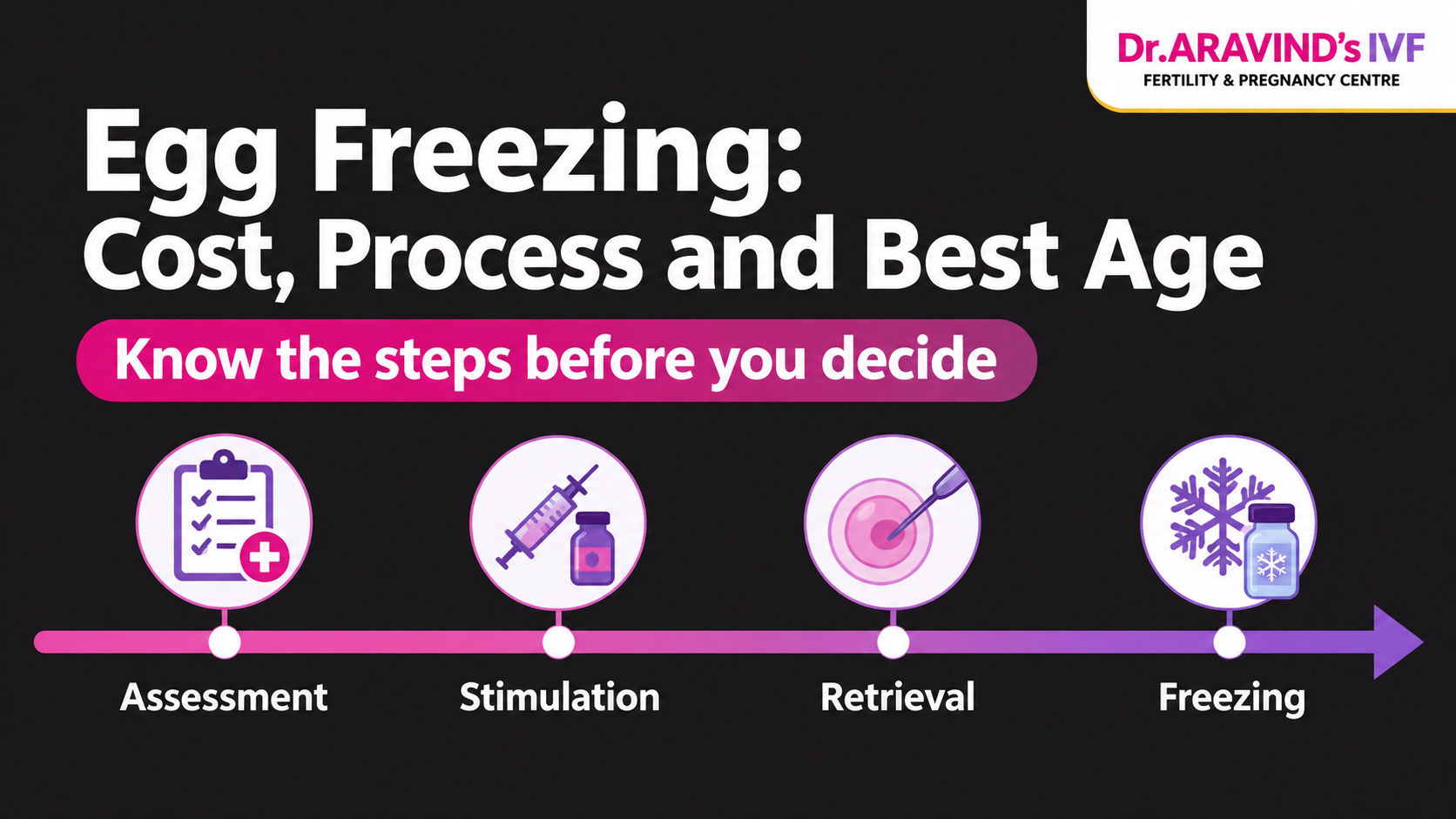
Here is how egg freezing is done. The process of freezing eggs has an active phase of about two weeks, and the table gives an approximate timeline that can change with your response.
Your doctor reviews your history and tests your ovarian reserve, then plans the medicines for your cycle.
Hormone injections help several follicles grow. Scans and blood tests are repeated every few days so the dose can be adjusted. Do not change the dose or timing of injections without your doctor's instructions.
Eggs are collected with a fine needle guided by ultrasound, under sedation. The number of eggs collected and the number of mature eggs suitable for freezing may differ.
Mature eggs are frozen very quickly so that ice crystals do not form, then stored in liquid nitrogen. After retrieval you may feel mild cramps or bloating, and your doctor will advise when to resume normal activities.
When you are ready, the eggs are thawed and fertilised, usually by ICSI, which places one sperm inside each egg. The resulting embryos can be transferred, or frozen for a frozen embryo transfer.
Women often ask when to freeze their eggs and what age is ideal. Egg quantity and quality fall with age, so outcomes are generally better when eggs are frozen younger. The table shows general patterns, not predictions.
The 2021 ASRM guideline notes that live birth rates are better when eggs are frozen at a younger age, but it also says there are insufficient data to name an optimal age. Ovarian reserve varies between women of the same age, so testing gives a more personal picture of egg quantity, but it cannot predict whether a pregnancy will follow. Freezing later is still possible, but each egg is less likely to result in a pregnancy. See egg quality.
The ART Act, 2021 allows ART services for women above 21 and below 50 years of age. This statutory eligibility for ART services should not be read as a simple age limit for every egg freezing situation. Ask your clinic how it applies to egg freezing, and whether it applies when eggs are frozen or used.
Egg freezing stores unfertilised eggs and needs no sperm at the time, so it suits women who are not ready for pregnancy yet or who face medical treatment. In embryo freezing, eggs are fertilised first and the embryos are frozen, which is common after IVF. Embryo freezing needs sperm, so it usually suits couples.
Egg freezing has possible risks and limits:
Egg freezing does not guarantee a future pregnancy. Outcomes depend on your age at freezing, the number of mature eggs stored, how many survive thawing, fertilisation and later treatment results. ASRM also notes that published data on future pregnancy outcomes are limited.
Consider a consultation if:
You do not need to decide immediately.
If you are considering egg freezing, a proper assessment can give you clarity on your ovarian reserve, options and costs. At Dr. Aravind's IVF, our specialists can explain each step. Book your appointment to discuss your plan.

The cost varies by clinic and by how you respond to treatment. It usually includes assessment, medicines, retrieval and freezing, with storage charged yearly. Ask for an itemised written quote before you begin.
Outcomes are generally better at a younger age, but there is no single best age. Ovarian reserve testing shows egg quantity but cannot predict pregnancy.
It depends on your age and ovarian reserve. ASRM states there is insufficient evidence to give an exact number for each age, so your doctor will estimate it after testing.
The active part of a cycle usually takes about two weeks, from stimulation to retrieval. Assessment tests are done before that.
Vitrified eggs can be stored for many years in the laboratory, but legal and clinic limits matter. The ART Act limits storage of donor gametes and embryos to ten years, but it does not clearly state how this applies to your own eggs, so ask your clinic in writing.
No. Results depend on your age at freezing, the number of mature eggs stored, survival after thawing and later treatment outcomes.
Egg freezing is generally considered safe, with side effects such as bloating and mood changes. OHSS and procedure-related risks are uncommon. Your doctor will explain your risks.
Yes. Frozen eggs are thawed and fertilised, usually by ICSI, and the resulting embryos are transferred to the uterus.


