Looking for the Best IVF Treatment in Chennai? Learn how IVF works, what to consider when choosing an IVF centre, treatment costs, success factors, and the key steps involved in the IVF journey.
IVF expenses can vary considerably depending on the treatment plan.
Before beginning treatment, ask what is included in the estimated cost.
Potential components may include:
There is no single IVF cost that applies to every patient. A detailed estimate from the clinic can help you understand your expected expenses before treatment begins.
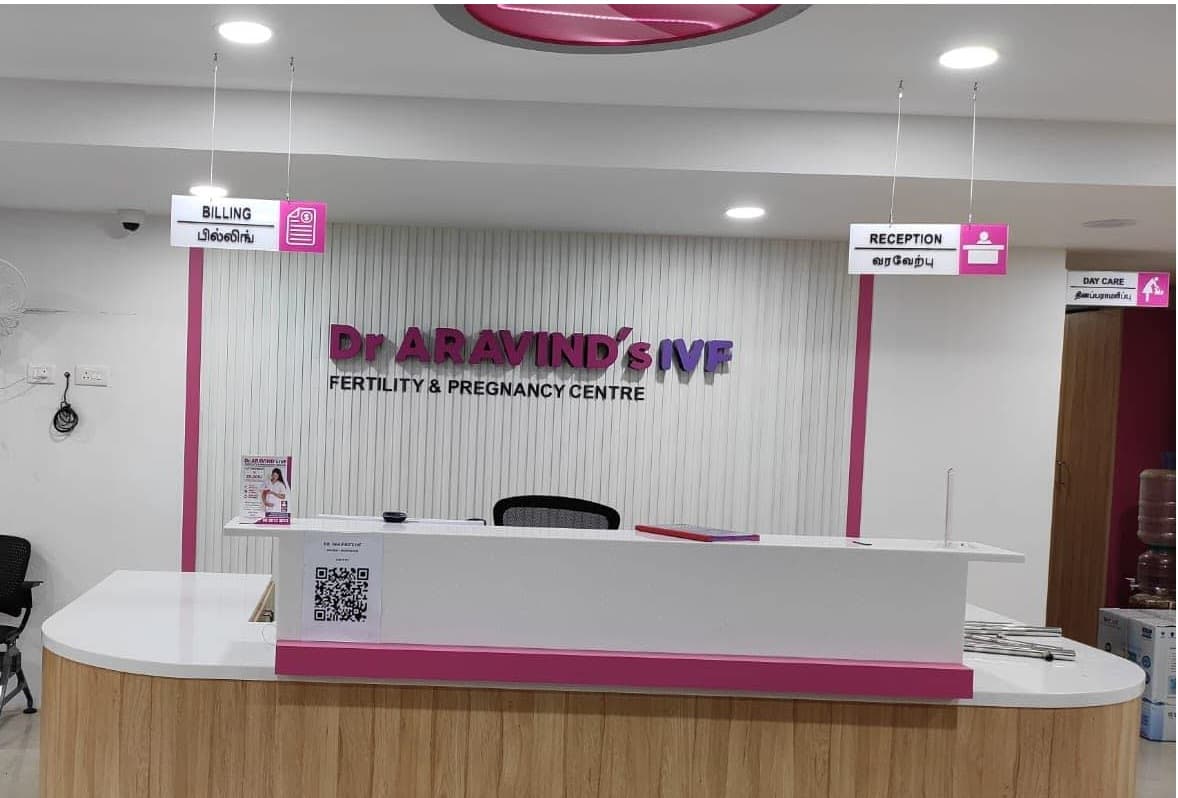
Dr. Aravind's IVF Fertility & Pregnancy Centre provides fertility and assisted reproductive services in Chennai.
The clinic's official information lists fertility treatments including IVF, IUI, ICSI, blastocyst culture and transfer, hysteroscopy, laparoscopy, PESA and TESA, along with other fertility-related services.
Dr. Aravind's IVF also has multiple Chennai locations, allowing patients to choose a location that is convenient for consultation and follow-up.
When evaluating a fertility centre, patients can consider the range of services available, the qualifications of the fertility team, laboratory facilities, communication, treatment transparency and the availability of appropriate follow-up care.
The first consultation is an opportunity to understand why pregnancy has not occurred and whether IVF is appropriate.
Your fertility specialist may review:
Depending on your circumstances, additional investigations may be recommended.
The consultation should also give you an opportunity to understand your treatment options and ask questions before making a decision.
Before beginning treatment, consider asking:
Having these questions ready can make your consultation more productive.
Understanding the treatment process can make IVF feel less unfamiliar.
The fertility team reviews both partners' medical and fertility history and recommends appropriate investigations.
Prescribed fertility medicines may be used to stimulate the development of multiple follicles. The response is monitored through scans and, where required, blood tests.
When the follicles reach the appropriate stage, eggs are collected through an egg-retrieval procedure.
The collected eggs are combined with sperm in the laboratory. In selected cases, ICSI may be used to inject a single sperm directly into an egg.
Fertilized eggs are monitored as they develop into embryos under laboratory conditions.
When appropriate, an embryo is transferred into the uterus. Depending on the treatment plan, embryos may instead be frozen for later transfer.
Your fertility team will advise you when to take a pregnancy test following embryo transfer.
The actual timeline and treatment protocol can vary from one patient to another.
IVF and IUI are different fertility treatments and may be recommended for different circumstances.
| IVF | IUI |
| Fertilization occurs in a laboratory | Fertilization occurs inside the body |
| Eggs are retrieved | Eggs are generally not retrieved |
| Embryos are created before transfer | Prepared sperm is placed into the uterus |
| More involved treatment process | Generally less invasive |
| Used for selected infertility conditions | Used for selected infertility situations |
Neither treatment is universally appropriate for every couple. Your fertility specialist can explain which options may be suitable based on your diagnosis.
Intracytoplasmic sperm injection (ICSI) is a laboratory technique in which a single sperm is injected directly into an egg.
It may be considered in selected situations, particularly certain forms of male-factor infertility or when there are specific reasons to use this fertilization technique.
ICSI is not automatically necessary for every IVF patient. The fertility team should explain why it is being recommended in your particular case.
In some IVF cycles, embryos may be frozen for later use.
A frozen embryo transfer involves transferring a previously frozen embryo into the uterus during a later treatment cycle when the conditions are considered appropriate.
Whether embryo freezing or a later frozen embryo transfer is recommended depends on the individual's treatment plan and clinical circumstances.
One of the most common questions patients ask is about IVF success rates.
However, there is no single success percentage that applies to every couple.
IVF outcomes may be influenced by factors such as:
For this reason, patients should be careful when comparing clinics based only on a headline success-rate percentage.
Ask the clinic:
Most importantly, remember that IVF cannot guarantee pregnancy or a live birth from an individual treatment cycle.
The cost of IVF treatment in Chennai varies according to the patient's treatment plan.
Expenses can involve consultations, diagnostic tests, fertility medicines, monitoring, egg retrieval, embryology services, embryo transfer and additional procedures.
For some patients, ICSI, embryo freezing, frozen embryo transfer or other procedures may be recommended. These can affect the total cost.
Rather than comparing clinics only by their advertised starting price, ask for a detailed estimate that explains:
This gives couples a clearer understanding of the financial side of treatment.
IVF involves several stages, and the experience can differ between patients.
Some people experience discomfort from fertility injections, monitoring procedures or the egg-retrieval process. The egg-retrieval procedure is performed using appropriate medical and anaesthesia or sedation arrangements according to the clinical setting and patient needs.
Your fertility specialist should explain what you can expect and how discomfort will be managed.
If you have concerns about pain, anxiety or previous difficult experiences with medical procedures, discuss them with your care team before treatment.
The duration of an IVF cycle varies according to the treatment protocol, response to medication, embryo strategy and whether additional procedures are required.
Some patients may complete the main stages within a few weeks, while others may need a different schedule.
Your fertility specialist can provide a more accurate timeline after reviewing your test results and deciding on the appropriate protocol.
After embryo transfer, your fertility team will provide instructions about medication, follow-up and pregnancy testing.
It is important not to interpret every early symptom as evidence of pregnancy because medicines and normal hormonal changes can cause symptoms that may feel similar to early pregnancy symptoms.
Follow the medication and testing instructions given by your fertility team and contact the clinic if you have concerning symptoms.
There is no single IVF protocol that is suitable for everyone.
For example, a patient with reduced ovarian reserve may require a different treatment strategy from someone with a different fertility diagnosis. Similarly, previous IVF history, sperm factors and uterine findings can influence treatment planning.
Personalized care allows the fertility team to consider the patient's test results, medical history and response to treatment when deciding how to proceed.
This is why couples should avoid selecting treatment solely because a particular procedure is advertised as advanced or successful.
Depending on the patient's diagnosis, a fertility centre may provide several treatment options.
Intrauterine insemination places prepared sperm into the uterus around the time of ovulation.
ICSI involves injecting a single sperm directly into an egg during the laboratory fertilization process.
These sperm-retrieval techniques may be considered in selected male-factor infertility conditions when sperm cannot be obtained through routine ejaculation.
Hysteroscopy allows a doctor to examine the inside of the uterus and may be used for diagnosis or treatment of certain uterine conditions.
In selected IVF cycles, embryos may be cultured to the blastocyst stage before transfer.
The choice of treatment depends on the patient's medical circumstances and should be discussed with a qualified fertility specialist.
Before choosing an IVF centre, consider the following checklist:
Check the qualifications and experience of the fertility specialists.
Understand whether the clinic provides the treatment options relevant to your diagnosis.
Ask about embryology services, embryo culture and quality-control procedures.
Request a clear explanation of what the treatment estimate includes.
Choose a clinic where you can understand your diagnosis, treatment plan and possible alternatives.
Ask what support and follow-up are provided during and after treatment.
Consider how convenient the clinic is for consultations, monitoring and follow-up visits.
A productive consultation is not only about receiving a treatment recommendation. It should help you understand the reason for infertility and the options available.
A useful consultation should allow you to understand:
Take notes during your appointment and ask the doctor to explain anything that is unclear.
Dr. Aravind's IVF Fertility & Pregnancy Centre provides fertility evaluation and assisted reproductive services in Chennai.
Patients considering treatment can discuss their fertility history, available treatment options, expected treatment stages and estimated costs with the fertility team.
The clinic's Chennai services include IVF and other assisted reproductive and fertility procedures. The availability of multiple fertility treatments allows the medical team to consider different options depending on each patient's clinical needs.
Rather than deciding on treatment based solely on an online search, a consultation can help you understand which approach may be appropriate for your situation.
Choosing an IVF centre is a personal decision. The most useful starting point is to understand your fertility condition, discuss your treatment options with a qualified specialist and obtain clear information about the expected process and costs.
If you are considering Best IVF Treatment in Chennai, schedule a fertility consultation to discuss your medical history, investigations and available treatment options.
The goal should not be to choose a treatment simply because it is advertised as advanced. It should be to find an appropriate, evidence-informed treatment plan based on your individual fertility needs.

There is no single IVF treatment that is best for every patient. The appropriate approach depends on factors such as age, ovarian reserve, sperm parameters, infertility diagnosis, previous treatment and other medical findings.
Compare the qualifications of fertility specialists, available treatments, embryology facilities, cost transparency, communication, follow-up care and location. Most importantly, make sure the recommended treatment is appropriate for your individual medical condition.
There is no single age at which IVF is guaranteed to work. Female age is an important factor in fertility and IVF outcomes, but ovarian reserve, egg quality, sperm factors, uterine health and the cause of infertility also matter.
IVF cost varies depending on the treatment plan, medicines, investigations, laboratory procedures and additional treatments. Ask the clinic for a detailed estimate before starting treatment.
Patients may experience discomfort during injections and some procedures. The experience varies between individuals, and the fertility team can explain how procedures are performed and how discomfort is managed.
No. IVF cannot guarantee pregnancy or a live birth. Outcomes vary according to several patient and treatment-related factors.
No. Depending on the diagnosis, treatments may include ovulation induction, IUI, IVF, ICSI, surgical procedures and other fertility treatments.
If you have concerns about conception or have been trying to become pregnant without success, a fertility consultation can help identify possible causes and discuss appropriate options. The recommended timing can vary according to age and individual circumstances.
The timeline varies depending on the treatment protocol and whether additional procedures are required. Your fertility specialist can provide a more individualized timeline after assessment.


