Women's health is not a destination that you reach once and forget. It is a lifelong journey that evolves through every stage of life. From the teenage years when the body begins to change, to the phase of planning a family, and eventually through menopause, each stage of this journey requires thoughtful care and attention.
Navigating this journey successfully requires more than occasional doctor visits. Women need the support of a knowledgeable healthcare professional who understands the complexities of women’s reproductive health, uses modern medical technologies, and truly cares about their well-being. In India, which has become a hub for advanced medical care, many women often face the challenge of choosing between general gynecological care and specialized fertility treatment.
This article explores the broader landscape of women’s reproductive health, inspired by insights from Dr. Aravind's IVF Fertility & Pregnancy Centre, a trusted name in reproductive medicine. By understanding the role of a gynecologist, knowing when to consult a fertility specialist, and learning about modern treatment options, women can make informed decisions about their health and future.
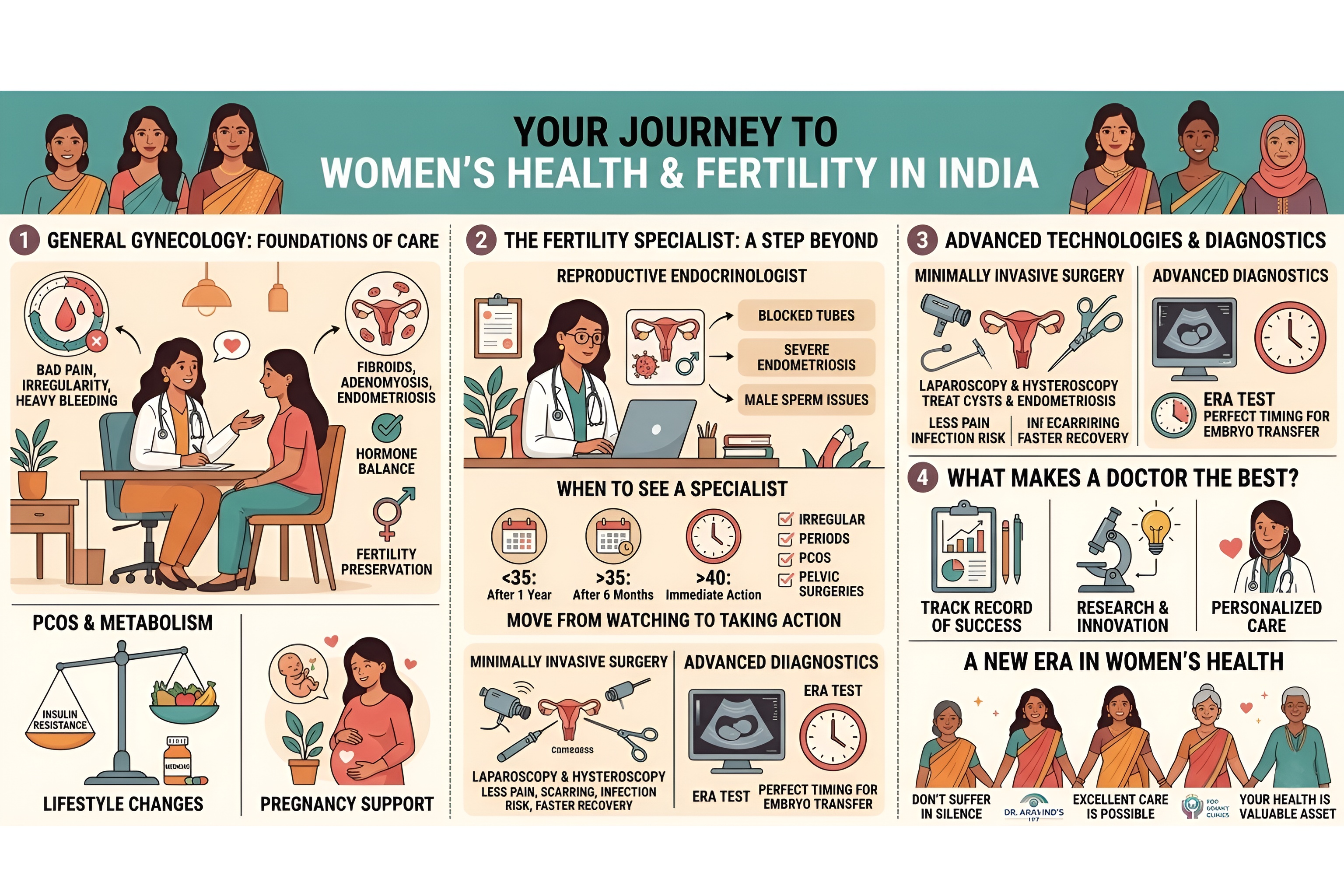
A lot of people think that you only need to see a gynecologist when you are pregnant.. Really a gynecologist is a doctor who helps women with their health throughout their lives. From the time you see a doctor as a teenager to when you are older and go through menopause a gynecologist is there to help you.
A gynecologist helps with a lot of things including problems, problems with your body and sexual health. One common reason people see a gynecologist is because they have problems with their periods. This can include bad pain, irregular periods or very heavy bleeding. These problems are not normal parts of being a woman. They can be signs of underlying issues like fibroids, adenomyosis or endometriosis.
A good gynecologist does not just give you medicine to make the symptoms go away. They try to find out what is causing the problem. They use tests and blood work to make sure your hormones are balanced and that you can still have babies.
Nowadays more and more women have problems like ovary syndrome (PCOS). This means gynecologists have to know a lot about hormones and metabolism. To help women with PCOS doctors use a combination of medicine, nutrition advice and lifestyle changes to help manage insulin resistance.
Gynecologists also help women when they are pregnant. They make sure both the mother and the baby are healthy through tests, nutrition advice and checking on the baby's growth.
In India the gynecologist is not just someone with a lot of degrees. They are someone who's very good at their job and who also cares about their patients. Women's health issues can be very personal. Sometimes there is a stigma. A good doctor listens to you without judging you. Explains things in a way that makes sense. This helps build trust, which's important for getting good care.
At places like Dr. Aravind's IVF the goal is to make the patient a partner in their care not someone who is receiving care.
A gynecologist is the expert for women's health but sometimes you need to see a specialist for help having a baby. This is a step and knowing when to do it can make a big difference in whether you can get pregnant.
A fertility specialist is a gynecologist who has training in how the body gets pregnant and the hormones that are involved. While a general gynecologist can do fertility tests a specialist can handle more complex cases. This includes problems like blocked fallopian tubes, severe endometriosis and issues with the man's sperm.
At places like Dr. Aravind's IVF the goal is to move from watching to taking action. They use tests to figure out exactly what is stopping you from getting pregnant which can save you a lot of emotional stress and uncertainty.
The field of women's health has changed a lot with technologies. The best hospitals are not the ones that do the surgeries but the ones that do the least invasive surgeries.
Now when making a big cut in your stomach doctors can use tiny cameras and small cuts to do surgeries. This is called laparoscopy and hysteroscopy. It can be used to treat endometriosis, remove cysts and even do hysterectomies. The benefits include pain, less scarring, less risk of infection and you can go back to your normal life quickly.
Diagnostics have gone beyond simple ultrasounds. One big breakthrough is the Endometrial Receptivity Analysis (ERA) test. It helps figure out the time when your uterus is ready for a pregnancy. By knowing this doctors can time the transfer of the embryo perfectly which increases the chances of getting pregnant.
When looking for the gynecologist you are not just looking for someone who knows a lot. You are looking for someone who's also a good guide. The best doctors have three qualities:
They have a track record of helping people in complex cases.
They stay up to date with the latest in research and technologies.
They treat you as a person, not a patient. They care about your health, they explain things clearly and they help you make good choices about your care.
Taking care of women's health in India is entering a new era. Women do not have to suffer in silence or accept that they cannot have babies. With gynecologists specialized fertility experts and new technologies it is possible to get excellent care.
The path to health starts with choosing the right doctor, someone who knows a lot and cares about you. Your health is your valuable thing and choosing the right partner to help you with it is the most important decision you will make.
Wrapping up, women in India have more options than ever when it comes to reproductive health. Top-notch gynecologists are there to guide you through the basics, while fertility experts step in when things get complicated.
Add in some of the best surgical technology around, and the possibilities really open up. When women find doctors who blend skill with genuine care, it’s not just about good health—it’s about feeling strong and in control, for themselves and the people they love.
A gynecologist treats women’s reproductive health conditions, including menstrual problems, hormonal disorders, pregnancy care, fertility issues, and menopause management.
Couples should consult a fertility specialist if they cannot conceive after 12 months of trying (or 6 months if the woman is over 35).
A reproductive endocrinologist is a fertility specialist trained in hormonal and reproductive disorders, helping couples with infertility treatments like IVF.
It refers to procedures like laparoscopy and hysteroscopy, which use small incisions and cameras to treat reproductive conditions with faster recovery.
The Endometrial Receptivity Analysis (ERA) identifies the best time for embryo implantation, improving IVF success rates.


