The process of in vitro fertilization (IVF) brings couples to a significant life achievement when they welcome their first child. After they experience the emotional challenges that come from receiving injections and undergoing egg retrievals and undergoing embryo transfers and finally obtaining a life-changing positive test, couples start their journey into parenthood with one crucial question: Can we have a second child? The particular question here asks whether we must undergo complete IVF treatment again or if natural conception after IVF has become possible for us.
The answer, while nuanced and deeply individual, provides patients with better results than they previously expected. Science has recorded numerous cases of spontaneous natural conception in women who previously needed IVF to get pregnant — and the reasons behind this phenomenon are fascinating.
The article presents scientific information together with elements that affect your fertility and essential details which you need to understand about your second pregnancy after IVF treatment.
The need for assisted reproduction should be reviewed to determine whether natural conception can occur after IVF treatment. The term infertility describes multiple medical conditions which include various permanent and temporary medical conditions. Couples choose IVF as their treatment option because of these common medical conditions:
The medical conditions, which include unexplained infertility and mild PCOS and specific hormonal imbalances, show potential for treatment success because they tend to get better after a woman experiences her first successful pregnancy. The physical condition of pregnancy produces changes that lead to different hormonal patterns and decrease body inflammation while boosting ovarian health, improving fertility after IVF success. The phenomenon operates according to scientific principles that define biological systems.
Multiple peer-reviewed studies have investigated whether women who needed IVF treatment for their first baby can achieve natural conception for their future pregnancies. The findings are consistently surprising to many patients.
Research published in respected reproductive medicine journals has found that between 15% and 25% of couples who conceived their first child via IVF go on to achieve a spontaneous, unassisted second pregnancy. The success rate of the second attempt at IVF differs based on the initial cause of infertility, the age of the mother and the time elapsed since the first IVF treatment. These findings answer a common question: can you get pregnant naturally after IVF first baby?
The 'uterine priming effect' stands out as one of the most compelling explanations for this phenomenon. The uterine environment undergoes alterations throughout pregnancy until the point of delivery. The first successful pregnancy leads to changes in the uterine lining that result in better implantation conditions and increased receptivity. The pregnancy hormones progesterone and oestrogen establish long-lasting beneficial effects on reproductive system functions that continue after the woman gives birth.
Factors That Influence Natural Conception After IVF
The ability to achieve natural conception for a second child through IVF treatment exists for some women. Your individual likelihood for this possibility will be determined by multiple factors.
This factor holds the greatest significance. Women with unexplained infertility have the highest rates of spontaneous second pregnancy, often because the underlying issue was never permanent to begin with. Women with complete sperm absence in their partner and severe tubal blockage and significantly reduced ovarian reserve will face greater challenges conceiving naturally.
Women experience a natural decrease in their fertility abilities as they grow older. Your ovarian reserve will decrease from your IVF baby in your early 30s to your current age of 38 or 40 because your remaining eggs have both decreased in quantity and lost quality. Natural conception becomes more challenging in your late 30s and early 40s because you had good egg production during your first IVF cycle. The best current ovarian reserve indicators are your Anti-Mullerian Hormone (AMH) level and your antral follicle count (AFC).
Some couples try for a second child shortly after the first IVF baby, while others wait several years. Age-related fertility changes will develop at a faster rate when couples experience longer breaks between their attempts to conceive. Couples who want a second child should consult a fertility specialist in Chennai to discuss their planned timeline because they will have access to more options through earlier evaluations.
Male factor infertility accounts for nearly half of all infertility cases. Your partner needs to undergo new sperm testing because your IVF treatment failed because of both low sperm count and low motility. Sperm quality can change because of various factors, but some men will experience improvement while others will not.
Breastfeeding prevents ovulation from occurring because high levels of prolactin are present. Natural conception becomes impossible when you continue to nurse your baby. After you stop nursing your baby, regular menstrual cycles will begin, which allows for better assessment of your hormonal status.
Some couples who conceived easily — or with assisted reproduction — find that trying for a second child takes much longer than expected or encounter the same barriers. The condition exists as secondary infertility, which has a higher prevalence than most people recognize.
Secondary infertility occurs when new elements emerge that did not exist during the previous attempt to achieve pregnancy. The same medical problem that led to the first IVF treatment continues to exist in this situation.
You need to consult a fertility specialist after six months of unsuccessful natural attempts if you are over 35 or after twelve months if you are under 35. At Dr. Aravind's IVF Fertility and Pregnancy Centre, we perform full assessments through hormonal blood tests, ultrasound and sperm analysis to pinpoint the specific issue before we recommend any treatment plan.
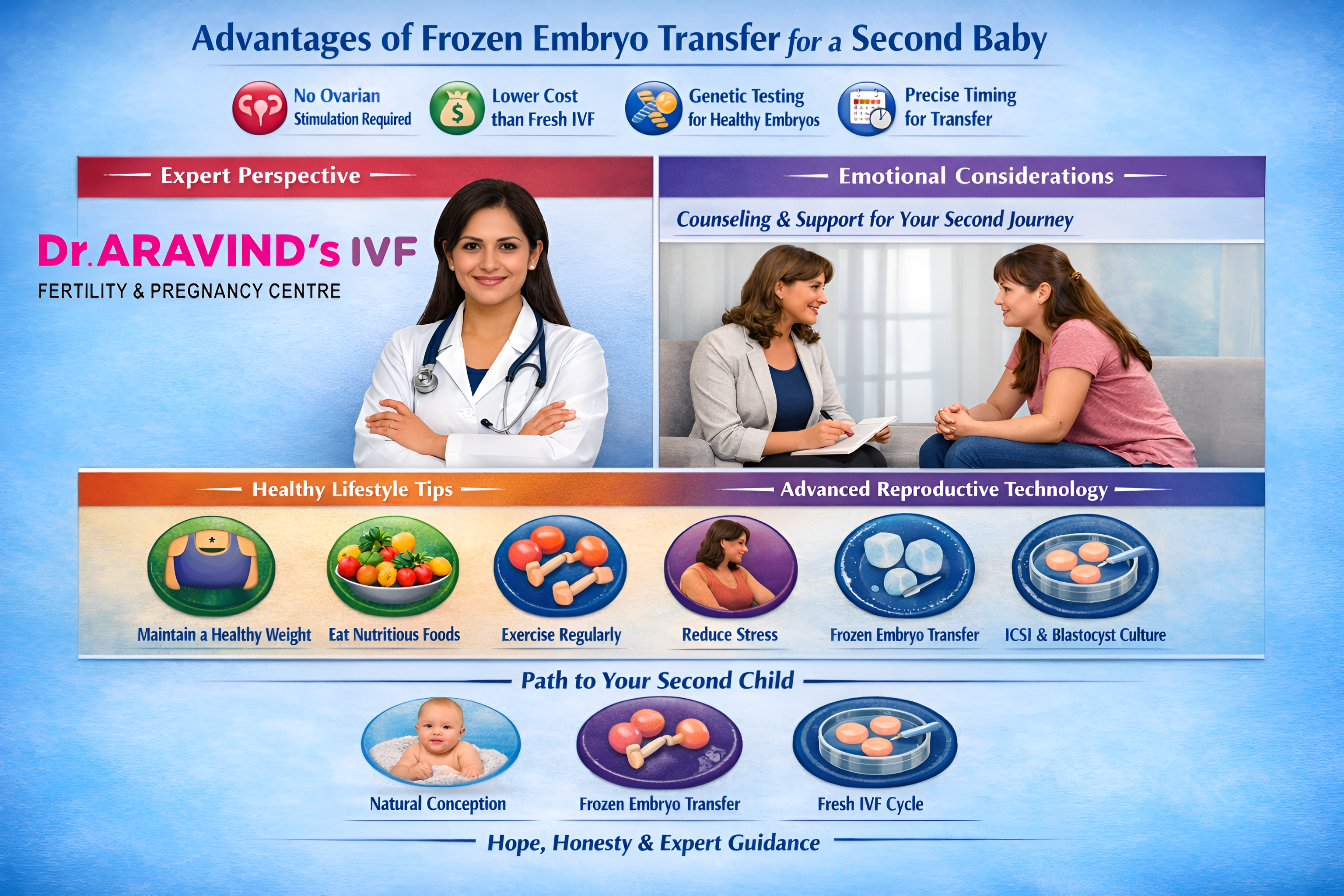
The easiest method for couples to achieve their second child after IVF treatment is through Frozen Embryo Transfer. Your first IVF cycle produced frozen surplus embryos, which now serve as your first resource for future use. Frozen embryo transfer requires fewer medical procedures than complete IVF treatment. The procedure operates by thawing existing embryos, which are then transferred to your prepared uterus without requiring any egg retrieval or ovarian stimulation. Our facility at Dr. Aravind's IVF uses special embryo vitrification methods, which maintain frozen embryo viability to achieve success rates that match those of fresh embryo transfers.
Your family planning process should include discussions about extra embryo storage because it provides potential future IVF benefits that need to be planned together with your physician. The procedure delivers a second pregnancy solution, which eliminates the need for a complete stimulation cycle.
The Dr. Aravind IVF Fertility and Pregnancy Centre uses personalised methods for each individual who seeks to plan their second pregnancy. The medical staff at the centre recommends that couples should start their fertility evaluation for a second child when the woman reaches her mid-30s. The biological clock keeps moving forward after a woman achieves pregnancy through IVF treatment.
The specialists at the centre commonly recommend a 'fertility health check' before a couple even begins trying for a second child. The process requires the couple to complete an updated AMH test and undergo a transvaginal ultrasound examination, which checks their uterine and ovarian reserve capacity and provides a new semen analysis. The couple and their specialist work together to evaluate all the available information, which will enable them to decide between natural conception, frozen embryo transfer and fresh IVF cycle initiation.
The centre has been operating for 30 years and has achieved more than 20,000 successful births to assist thousands of couples who face this decision process. The team provides couples with information about their options, which they should use to make decisions together.
Fertility treatment brings extensive emotional challenges, which parents who previously underwent IVF must face during their second treatment. The first IVF experience brought easy results for some patients, while other patients faced multiple unsuccessful attempts, which created intense emotional distress. The desire to begin a second pregnancy causes people to experience their previous emotions from that period again.
Your anxiety about the second journey shows you have a natural reaction to your situation. Speaking with a counsellor — especially one who specialises in fertility and reproductive mental health — can be enormously helpful. Dr. Aravind's IVF Fertility & Pregnancy Centre provides patients with essential psychological and emotional assistance which supports their entire process from conception to pregnancy because the facility understands the psychological and physiological aspects of fertility.
The care team encourages couples to express their expectations to each other while discussing their needs with their healthcare professionals. Some couples feel a sense of guilt about 'wanting more' after a successful IVF, as if they should simply be grateful for what they have. The emotion needs clarification because it exists as a natural human response while family expansion drives people to seek assistance.
You will achieve better results for both natural conception and your upcoming FET or fresh IVF cycle through health improvements and lifestyle changes.
Modern reproductive technology provides excellent solutions when natural conception fails to happen within an expected period. A fresh IVF cycle achieves higher success rates today because of advancements that include frozen embryo transfer and Preimplantation Genetic Testing for Aneuploidy (PGT-A) and AI-based embryo selection and enhanced laboratory culture methods.
The clinic of Dr. Aravind uses cutting-edge reproductive technologies which include high-magnification ICSI and blastocyst culture and time-lapse embryo monitoring for their entire range of treatment cycles. The technologies provide equal access to all patients who undergo their first round of IVF as well as those who proceed to their second and third and fourth attempts at fertility treatment.
The question of whether natural conception is possible after IVF is one that deserves a thoughtful, medically grounded answer — not a dismissal, and not false hope. The evidence shows positive results because a substantial number of couples achieve natural conception after IVF for their second child after undergoing IVF treatment. Your chances depend on your unique situation, which includes your initial diagnosis, your present age, and your partner's existing medical condition.
The most important thing you can do is get informed. A fertility re-evaluation at Dr. Aravind's IVF Fertility & Pregnancy Centre will give you a clear picture of where you stand today — and from there, you and your care team can chart the most effective path to your second child together.
The path to building a family consists of three options: natural conception, frozen embryo transfer, and fresh IVF cycle; however, achieving a healthy and content family unit remains the ultimate objective.
Yes, natural conception after IVF is possible. Studies show that around 15–25% of couples may conceive naturally after their first IVF baby, depending on the underlying fertility condition.
Not always. Some couples conceive naturally, while others may use frozen embryo transfer (FET) or undergo another IVF cycle, depending on their fertility status.
Key factors include age, ovarian reserve (AMH levels), original infertility diagnosis, partner’s sperm health, and time since the first IVF pregnancy.
Secondary infertility refers to difficulty in conceiving again after a previous pregnancy. It may occur due to new or existing fertility issues.
If you are under 35, consult a specialist after 12 months of trying. If over 35, seek help after 6 months of unsuccessful attempts.


