Couples who seek assisted reproduction to become parents face an intimate experience which leads them to ask Dr. Aravind's IVF Fertility Centre staff about their chances to succeed with IVF treatment. The single most important biological factor that determines IVF success rates for patients who undergo the treatment is their age. People who reach their late twenties or their early forties need to learn how age influences their reproductive capabilities and success rates for IVF
in different age groups because this knowledge will enable them to make better treatment decisions.
Dr. Aravind's IVF center operates as one of India's most established fertility clinics after completing more than 70000 IVF procedures which resulted in a 75 percent live birth rate. The complete guide presents IVF success rates according to different age groups together with scientific explanations of how age impacts fertility and modern reproductive technologies which enhance your success rate across all age categories.
The essential requirement for understanding age effects on IVF success begins with an explanation of age impacts on IVF results. Women have permanent reproductive systems that start with certain egg quantities because their body cannot produce new sperm like men. As a woman ages, two key changes occur that directly affect IVF success rates:
The age-success gradient which appears in all worldwide IVF success rate statistics emerges from two factors which include diminishing ovarian reserve and declining egg quality. The clinic at Dr. Aravind's IVF employs modern diagnostic equipment which includes the AMH test and antral follicle count and Preimplantation Genetic Testing to overcome existing obstacles while achieving better results for each patient.
The study presents complete success rate information for IVF procedures, which was evaluated according to each age group. The live birth rates for each embryo transfer cycle serve as the primary success measure, which shows the most clinically relevant outcome, and the results match the data from top Indian and international fertility clinics.
| Age Group | Success Rate | Egg Quality | Key Factor |
|---|---|---|---|
| Under 35 | 50–65% | Excellent | Peak fertility |
| 35–37 | 40–50% | Good | Slight decline |
| 38–40 | 25–35% | Moderate | Ovarian reserve |
| 41–42 | 15–20% | Reduced | Donor egg advised |
| 43 and above | 5–10% | Poor | Donor egg recommended |
IVF success rates reach their highest levels when women undergo treatment between the ages of 35 and 35. Dr. Aravind's IVF and most top fertility clinics show live birth success rates between 50 and 65 percent for this age group during each treatment cycle. The positive results happen because of multiple factors which include:
The female reproductive system experiences changes between the ages of 30 and 35. Women who belong to the age group between 35 to 37 can achieve 40 to 50 percent success rates for IVF in different age groups which counts as excellent medical performance. The period marks the start of a visible reduction in both the quantity and quality of eggs produced. At Dr. Aravind's IVF facility women from this age group receive:
IVF success rates start to drop more significantly after women reach their late thirties when success rates fall to 25-35 percent for each transfer. The decline occurs because both egg quality suffers more severe degradation and chromosomal abnormalities become more common. Successful pregnancies become achievable for most women in this age group through proper implementation of treatment procedures. Dr. Aravind's IVF Fertility Centre implements the following clinical protocols:
Dr. Aravind's IVF centre provides comprehensive fertility treatments through its sequential embryo transfer protocol and Paternal Lymphocyte Immunization (PLI) therapy program which supports women in this age group who experience recurrent implantation failure.
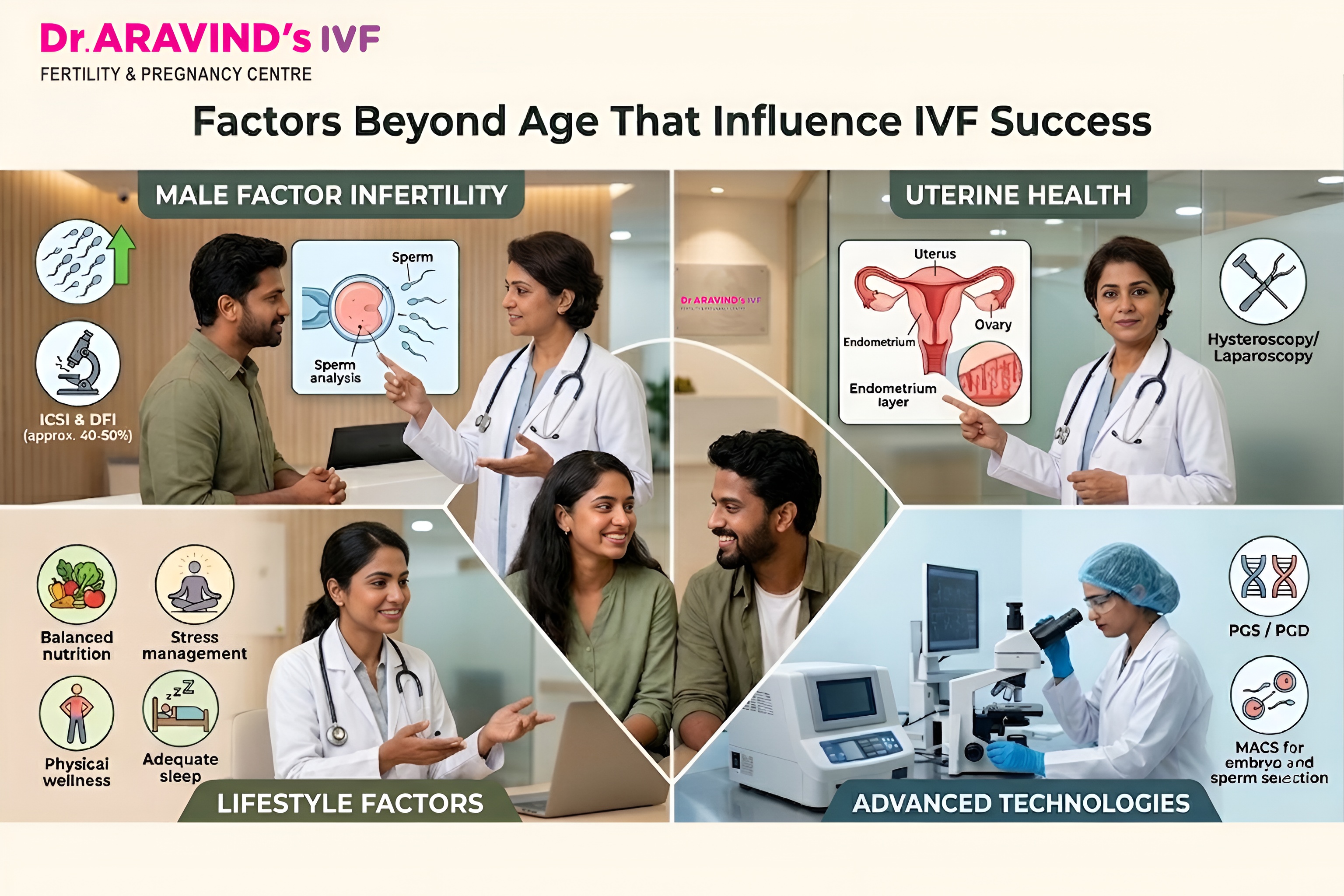
The success rates of IVF procedures depend primarily on a patient's age but there exists another factor that affects success rates. Dr. Aravind's IVF team examines all essential factors:
The more time you spend with a fertility expert, the more treatment choices you will receive. Here are general guidelines based on age:
Women who want to delay pregnancy but face decreasing fertility because of their advancing age can use egg freezing and embryo freezing (cryopreservation) as their best option. Women who freeze their eggs at their best quality before they reach 35 years old can later have children without experiencing the biological effects of aging.
Dr. Aravind's IVF offers a fertility preservation program which provides egg freezing, sperm freezing and embryo freezing services together with complete pre-freezing evaluations. The approach becomes essential for women who undergo cancer operations and for women who have early menopause in their family history and for women who want to postpone their family planning.
Couples who understand IVF success rates according to different age groups can enter their fertility path with proper expectations which they should know will get better through expert medical help during all points of their journey.
Success rates for IVF in different age groups decreases with increasing age yet modern reproductive medicine technologies which include AI-based embryo selection and donor egg programs have made it possible for multiple couples to achieve parenthood despite their age.
The most important step is to act early, seek specialist guidance, and choose a clinic with the experience, technology, and compassionate care to give you the best possible chance. Dr. Aravind's IVF center has provided treatment to more than 25000 families and we will continue to offer the same services to your family.
IVF success rates in India reach 50 to 65 percent for women younger than 35 who undergo treatment at leading facilities such as Dr. Aravind's IVF.
Women above 40 can undergo IVF procedures yet their success rates with their own eggs remain under 20 percent. The use of donor eggs in IVF procedures enables patients to achieve success rates of 60 percent or more which exceeds their original success rates.
Couples generally need between two and three IVF cycles to achieve successful pregnancy results. The number depends on age, diagnosis, embryo quality, and individual response to stimulation protocols.
The AMH (Anti-Mullerian Hormone) test functions as a measurement for ovarian reserve which enables prediction of egg production during stimulation. A low AMH result shows decreased ovarian reserve yet it does not prevent IVF success since both quality and quantity of eggs remain essential.
Women between their early thirties and mid-thirties should choose egg freezing because it allows them to postpone their childbearing plans. The practice of freezing eggs at their optimal quality serves as a biological protection method which safeguards against fertility decline that happens with advancing age.


