ICSI treatment is an advanced IVF technique where one healthy sperm is injected directly into a mature egg. This guide explains who needs ICSI, how it differs from IVF and IUI, and the step-by-step procedure. You will also find realistic success rates by age, the cost of ICSI in India, possible risks and limitations, tips to improve your chances, how to choose a clinic, and answers to common questions, so you can make an informed decision with your fertility specialist.
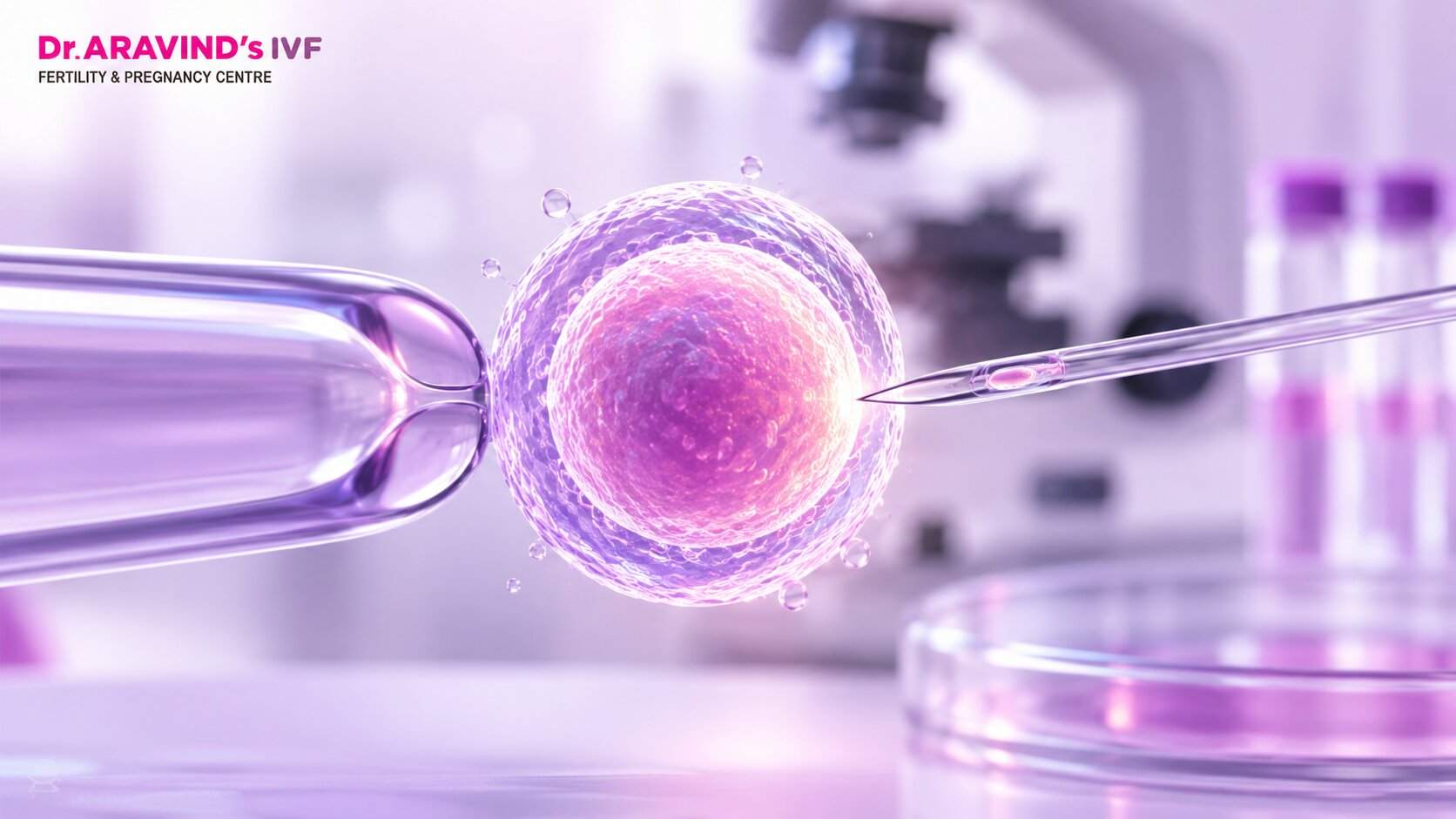
If your fertility specialist has suggested ICSI, you probably have three questions: do we really need it, how likely is it to work, and what will it cost? This guide answers all three in plain language, with realistic numbers for India.
ICSI treatment (Intracytoplasmic Sperm Injection) is a laboratory fertilisation technique used within an IVF cycle. An embryologist picks a single healthy sperm and injects it directly into a mature egg, so fertilisation does not depend on the sperm swimming to and entering the egg on its own.
In conventional IVF, eggs and sperm are placed together in a dish and fertilisation happens on its own. In ICSI, the embryologist uses a fine glass needle under a high-power microscope to place one sperm inside each mature egg. The eggs are checked the next day for fertilisation, and healthy embryos are grown in the lab for transfer.
ICSI does not improve egg quality, treat the uterus, or guarantee implantation. It solves one specific problem: getting sperm and egg together when that step is likely to fail.
| Feature | IUI | Conventional IVF | IVF with ICSI |
|---|---|---|---|
| Where fertilisation happens | Inside the body | In the lab dish, naturally | In the lab, by sperm injection |
| Eggs retrieved | No | Yes | Yes |
| Best suited for | Mild factors, open tubes, adequate sperm | Tubal, ovulatory or unexplained causes with normal sperm | Severe male factor, surgical sperm, fertilisation failure |
| Sperm needed | Moderate numbers | Moderate numbers | One healthy sperm per egg |
| Relative cost | Lowest | Higher | Highest (ICSI add-on) |
Your specialist decides after assessing both partners. ICSI is commonly recommended when:
If the male partner's sperm is normal, ICSI is generally not necessary, even when the cause is tubal damage, PCOS, endometriosis, unexplained infertility or the woman's age. The ASRM committee opinion on non-male-factor ICSI notes that studies have not shown better live birth rates and some data suggest slightly lower ones. ESHRE-presented European data and a UK registry analysis reached similar conclusions, and randomised trials in couples with normal or non-severe male factor have not shown a live-birth advantage. If a clinic recommends ICSI for everyone, ask why it is needed for you.
India regulates assisted reproduction under the ART (Regulation) Act, 2021, which sets age limits commonly cited as 21–50 years for women and 21–55 years for men. Confirm current rules with your clinic, and choose an ART-registered centre. Read how age affects fertility in women and men before planning your cycle.
The injection itself happens in the lab, so neither partner feels it. The woman's discomfort comes from stimulation injections and the sedated egg retrieval. For men, a semen sample is painless. If sperm must be retrieved surgically, local or general anaesthesia is used and mild soreness for a few days is common.
There are three different numbers, and clinics often quote the most flattering one:
Indicative live birth ranges per cycle commonly reported by Indian clinics, for women using their own eggs:
| Woman's age | Approximate live birth rate per cycle |
|---|---|
| Under 35 | 35–50% |
| 35–37 | 25–40% |
| 38–40 | 15–30% |
| Over 40 | Below 20% |
These are not guarantees. Results depend on egg quality, embryo quality, sperm health, uterine condition, how many embryos are transferred, and whether embryos are fresh or frozen. Because ICSI only changes how fertilisation happens, it does not raise the pregnancy rate for a couple who did not have a fertilisation problem.
When comparing clinics, ask: Is this live births or pregnancies? Per cycle or per transfer? For which age group? Is the data audited?
Your doctor may discuss add-ons in selected cases, not for everyone:
Published Indian clinic price pages in 2026 show that ICSI is usually priced as an add-on to an IVF cycle. Actual costs vary by city, clinic and medicines.
| Cost item | Typical range |
|---|---|
| ICSI add-on to an IVF cycle | ₹15,000–₹30,000 |
| Complete IVF-ICSI cycle (consultation, stimulation monitoring, retrieval, ICSI, culture, transfer) | About ₹1.2–₹3 lakh; higher in some metros |
| Surgical sperm retrieval (PESA, TESA, Micro-TESE) | Extra, depends on procedure |
| Embryo freezing and later FET | Extra |
| Genetic testing (PGT-A) | Extra |
What changes the cost: your age and medicine dose, number of eggs retrieved, embryo culture duration, surgical sperm retrieval, freezing, genetic testing, and the number of cycles needed.
Before you pay, ask: what the package includes, whether medicines are separate, what happens if the cycle is cancelled, and the cost of a frozen transfer. Most standard health insurance policies exclude infertility treatment, so check your policy wording. For an exact estimate for your case, book an ICSI consultation.
Dr. Aravind's IVF runs centres across South India, including Coimbatore and Chennai. Meet our fertility experts and read real patient success stories.
Not sure whether you need ICSI or conventional IVF? A proper assessment answers this. Book an ICSI consultation or call +91 90 2012 2012.
Disclaimer: This article is for general education and does not replace personalised medical advice. Costs and success rates are indicative and vary by individual and clinic.
Not for every couple. ICSI is better when there is a significant sperm problem or earlier fertilisation failure. With normal sperm, conventional IVF gives comparable live birth rates.
It varies. Some couples conceive in the first cycle; many need two or three, especially with advancing age. Your doctor can estimate this from your test results.
The large majority are healthy. Genetic counselling is recommended when male infertility has a genetic cause.
Yes. This is one of its main uses.
About 3–4 weeks to embryo transfer, with the pregnancy test 10–14 days later.
No. It helps fertilisation, but implantation depends on embryo quality and the uterus.
Most standard policies exclude it. Check your policy or ask your clinic's billing team.


