The entire IVF process presents multiple challenges for couples who deal with infertility. The period between the first consultation and embryo transfer contains crucial decision points that require careful consideration. Selecting the embryo for transfer stands as one of the most vital processes throughout history, which presents extremely difficult challenges and is considered one of the best embryo selection techniques in modern reproductive medicine. The trained eye of an embryologist who uses standardized grading systems to assess embryos through microscopy established the primary basis for this choice since 1960, forming the foundation of what is now known as embryo grading IVF, as explained in clinical practice. While their expertise is irreplaceable, human assessment has inherent limitations: it is time-consuming, subjective, and unable to detect genetic or molecular nuances invisible to the eye.
Artificial Intelligence currently stands as the technology that is revolutionizing all existing systems in artificial intelligence IVF treatment.
Fertility specialists now use AI-powered embryo selection tools to find embryos that have the highest chances of successful implantation. The systems use deep learning and computer vision to analyze embryonic development patterns through their extensive datasets, which provide an objective data-driven analysis that improves expert embryologist clinical judgment.
Dr. Aravind's IVF Fertility & Pregnancy Centre has more than 30 years of reproductive medicine experience, which applies to our network of clinics throughout Tamil Nadu and South India. The article examines how AI transforms the embryo selection process, its implications for patients, and its status as the most significant advancement in current fertility treatment methods.
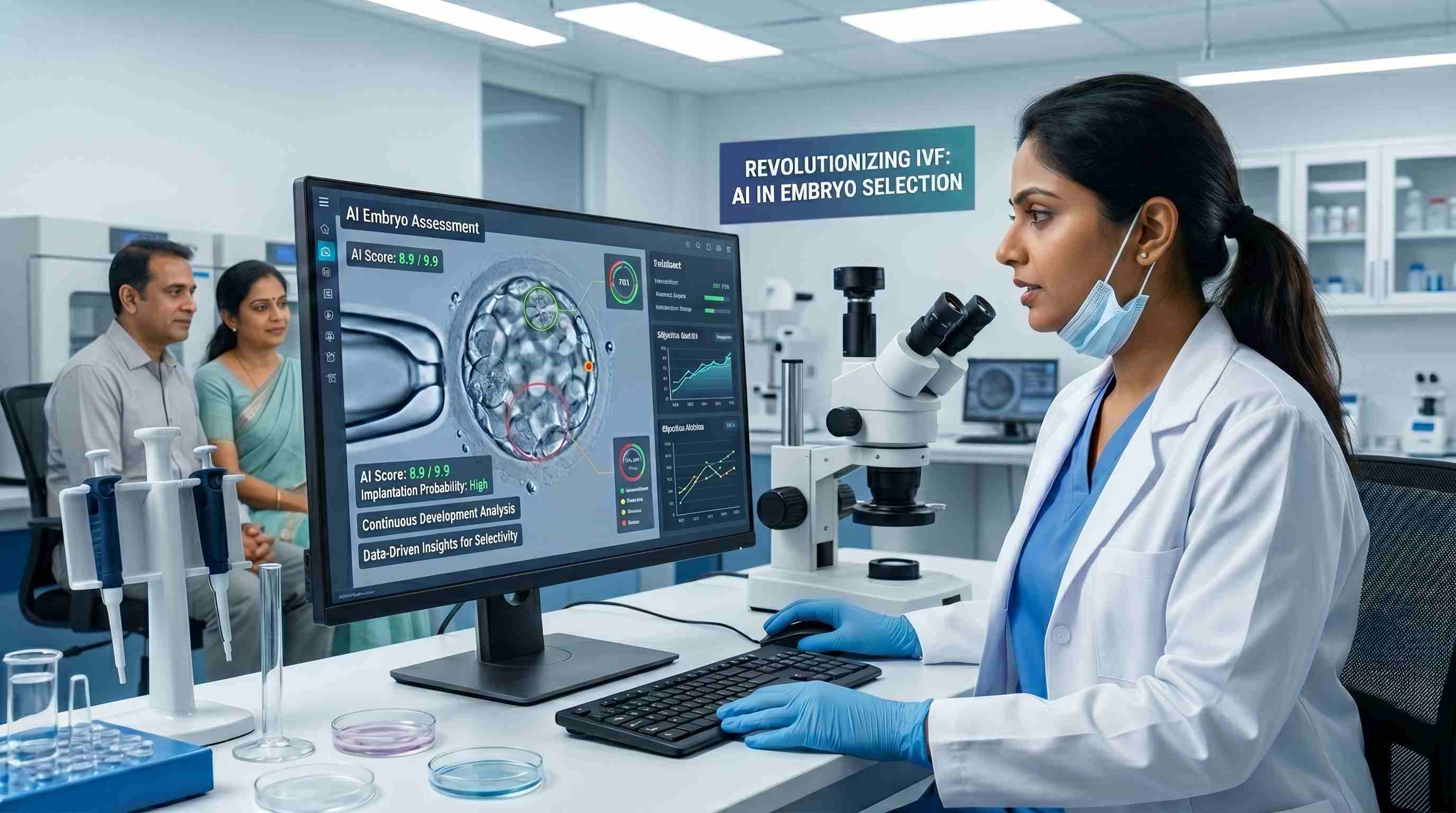
To understand how AI enhances embryo selection processes, we need to first grasp the importance of these selection processes. A standard IVF cycle begins with hormonal treatment that causes a woman to generate multiple eggs, which doctors will later fertilize in laboratory conditions. Researchers maintain the embryos in culture for three to five days until they achieve the blastocyst stage, which consists of approximately 200 cells that develop into future placenta and fetus structures.
The process of embryo generation results in different values among the created embryos. Certain chromosomes in some individuals display chromosomal defects that prevent their attachment to the uterus or result in spontaneous abortion. Some structures show a normal appearance, but their hidden development issues will cause unfavourable results. The remaining people will develop into successful individuals who achieve complete pregnancy.
The process of selecting the correct embryo through one transfer leads to better success rates while decreasing both emotional and physical strain from unsuccessful treatment attempts, improving the single embryo transfer success rate, and reducing the medical dangers that come with multiple pregnancy situations.
The traditional process for embryo grading requires embryologists to conduct their assessments of embryos through microscope examinations at predetermined time intervals, which forms the basis of embryo grading in IVF explained in clinical settings. The assessment process requires scientists to observe specific attributes, which include cell count, cell symmetry, fragmentation levels, zona pellucida thickness and complete morphological development.
Medical professionals observe that high-quality embryos sometimes fail to implant, while low-quality embryos can result in successful pregnancies. Researchers and clinicians have pursued better methods to assess embryo quality, but AI technology has become their most effective solution.
AI-based embryo selection systems depend on machine learning technology because they use deep learning models that train on thousands to millions of embryo images together with their corresponding results. The systems develop the ability to detect small visual details that human observers cannot see, which mark successful embryo development needed for successful implantation, making AI embryo selection in IVF one of the most promising advancements today
Time-lapse incubation functions as one of the most crucial technologies that enable scientific research to happen and is widely known as time-lapse IVF embryo monitoring. The traditional method for embryo culture required incubators to be opened for embryo evaluation through microscopic examination, which disrupted the optimal conditions necessary for embryonic development. The Embryoscope time-lapse incubators use embedded cameras to take photographs of embryos at 10 to 20 minute intervals, which occur without causing any interruptions to their development process.
The method of continuous monitoring creates a complete video archive which documents all stages of embryo growth through which thousands of pictures show every instance of cell division, every crucial developmental period and every abnormality. The entire developmental video is used by AI algorithms for analysis, which extends beyond analyzing isolated snapshots. They examine:
AI systems create complete developmental profiles of embryos by analyzing their moving characteristics, which they use to determine whether embryos will successfully implant into the body.
Multiple artificial intelligence systems have been created and have proven their effectiveness in medical environments. iDAScore, which researchers developed together with Aarhus University Hospital, stands out as one of the most extensively researched tools. The system evaluates each embryo by assigning it a score that ranges from 1 to 9.9 based on its time-lapse data assessment without needing any genetic testing. iDAScore demonstrates superior predictive abilities compared to conventional morphological assessments when it comes to determining live birth outcomes.
AI-powered deep learning embryo ranking systems, which scientists developed through clinical trials, demonstrate that their AI-selected embryos lead to higher implantation and live birth rates when compared with traditional selection techniques. The advancements bring more than tiny benefits because several studies demonstrated that live birth rates reached clinically meaningful levels, which created actual hope for couples to conceive after experiencing multiple failed IVF procedures.
The process of Preimplantation Genetic Testing for Aneuploidies known as PGT-A requires scientists to extract several embryonic cells, which they subsequently use to conduct chromosomal tests. This is commonly referred to as PGT-A embryo testing in India in clinical practice. The test determines whether embryos possess the correct chromosome count, which serves as a vital requirement for successful implantation and successful pregnancy development. The PGT-A test provides essential testing benefits for women aged 35 and older who have experienced multiple miscarriages and couples who face persistent challenges with IVF procedures.
The PGT-A test provides extensive testing benefits to medical professionals but creates additional expenses because of its requirement for invasive embryo testing and its need for result delays. The AI-based scoring systems provide a non-invasive testing method that works together with PGT-A testing, although it should not be seen as a complete testing method, but rather as an effective extra testing method. Research has studied the ability of AI assessment systems to forecast chromosomal conditions through their ability to produce favourable but complex outcomes.
AI models demonstrate their highest performance when they need to separate embryos into two categories, which include those that can survive and those that lack any chance of survival. AI scoring works with PGT-A to determine which euploid embryo should be transferred first when multiple normal embryos exist because traditional methods using morphology alone do not provide dependable results for this choice.
The field of non-invasive preimplantation genetic testing (niPGT) develops as scientists study spent culture media, which serves as the liquid base for embryo development, to detect DNA traces that embryos release. The method enables DNA genetic testing through the combination of AI-based developmental pattern analysis with non-invasive testing methods. Scientists are currently researching this area of study, but their initial findings show promise as they advance research toward AI-assisted reproductive medicine.
The implementation of AI-powered embryo selection methods provides couples undergoing IVF with both emotional support and medical improvements to their treatment.
The most important benefit from this system arises from its ability to produce better results with each transfer that doctors perform. The use of AI technology to choose the most suitable embryo for implantation helps couples achieve pregnancy faster, which leads to reduced need for additional treatment cycles. IVF treatments require patients to dedicate their physical strength, mental energy and financial resources. The process of increasing transfer success rates brings the advantage of decreased treatment needs for couples who require fewer treatment cycles.
AI selection improves the identification of embryos that develop normally through their selection process, which results in decreased miscarriage instances. Early pregnancy losses occur because of chromosomal or developmental problems in the embryo. The combination of improved embryo selection methods with genetic testing leads to a decreased risk of transferring embryos that cannot complete a full-term pregnancy.
The medical guidelines recommend single embryo transfer because it decreases the pregnancy risks that multiple births create. The recommendation causes anxiety because people worry about the outcome when doctors transfer only one embryo. AI-assisted selection gives clinicians and patients greater confidence in single embryo transfer by identifying the most viable candidate with much greater precision.
The AI systems establish a precise ranking system that remains constant throughout different operational situations and expert assessments. The system creates visual reports that embryologists and clinicians can examine together with their own observations to create a transparent system that uses evidence for decision-making. Patients can view the information that supports the recommendation because it enables them to comprehend their treatment options.
The use of artificial intelligence in embryo selection represents the most advanced and validated method for reproductive medicine applications, but the technology continues to develop throughout the entire IVF process.
AI algorithms use patient hormonal data, antral follicle counts, patient age and previous treatment results to create their optimal stimulation programs. The practice of personalized stimulation helps to decrease the chances of ovarian hyperstimulation syndrome (OHSS) occurring while it improves the quantity of high-quality eggs that get harvested for use in embryonic selection procedures. AI helps personalize treatment plans in modern artificial intelligence IVF treatment.
AI-powered systems are also being applied to sperm analysis. Computer-assisted sperm analysis (CASA) systems can assess motility, morphology, and velocity with far greater accuracy and speed than manual analysis. AI tools work to analyze sperm movement patterns and structural characteristics because they want to discover which sperm possess the highest chances of achieving fertilization and generating healthy embryos.
The process of successful implantation needs both a viable embryo and a uterine lining that can receive implantation. Researchers developed AI tools that can detect endometrial patterns through ultrasound analysis by examining thickness, texture and vascularization to determine which time period suits best for embryo transfer. AI systems are currently starting to enhance transfer timing through their ability to determine when endometrial receptivity reaches its highest point.
AI technology now assists healthcare professionals in guiding patients through counselling sessions. The predictive models create personalized success probability estimates through their combination of four variables, which include patient age and ovarian reserve markers, previous cycle results and embryo information. This method provides clinicians with evidence-based knowledge, which they can use to explain to patients what outcomes to expect and which treatment options to pursue.
The use of AI for embryo selection in medicine creates ethical challenges that require careful examination because of its status as a powerful medical technology.
All responsible fertility centres operate their diagnostic processes through Dr. Aravind's IVF Fertility & Pregnancy Centre, which uses AI as an advanced diagnostic instrument that assists medical professionals in making their assessments. Expert embryologists and reproductive specialists execute the final process of selecting embryos through their combined use of AI findings, their medical expertise, their understanding of the patient's comprehensive medical background and their ability to empathise with each couple's specific situation.
AI systems require large datasets to function effectively, which creates essential concerns regarding the methods used to collect, store and utilise patient information. The effective implementation of AI in IVF requires organizations to follow data protection laws while informing patients about the research and algorithm development processes, which will involve their embryo images and cycle data.
Equity and Access
Advanced AI tools, together with their time-lapse systems, create additional expenses that limit access to their benefits for patients in low-income medical facilities. The fertility community needs to solve its main challenge, which requires them to distribute technology benefits to all couples regardless of their economic status, in order to achieve effective technology distribution.
AI scoring systems show great potential, but they cannot deliver perfect results. The medical field has observed successful pregnancies through the use of embryos with lower AI scores, while high-scoring embryos have demonstrated their inability to successfully implant. AI provides probabilities, not certainties. Clinicians need to avoid using algorithmic scores as their primary decision-making tool because it leads to less accurate patient evaluations.
The Future of AI in Reproductive Medicine
The application of artificial intelligence to IVF procedures remains in its initial development stages. Researchers worldwide develop models that become more accurate through their access to extensive and varied datasets. The field presents two exciting new research areas that will develop into upcoming cutting-edge technology.
Multi-modal AI systems will create predictive models that combine multiple data sources, including embryo morphology data, genetic testing results, maternal health parameters, and genomic data, to produce models with unprecedented advanced capabilities. Federated learning approaches enable AI model development through training activities that occur in multiple clinics and countries without disclosing any confidential patient information, thereby accelerating model development while maintaining user confidentiality.
Clinicians utilize natural language processing technology to create treatment plans, which they develop by analyzing extensive details of patient's medical backgrounds. AI technology will control automated systems that handle embryos through IVF processes as robotics technology reaches its advanced development stage to minimise human errors during the procedure.
The vision is a future where every couple undergoing IVF benefits from a seamlessly integrated AI-enhanced pathway that uses data-driven decision-making to support their treatment from stimulation to transfer through the expertise of experienced clinicians who show them real compassion.
Artificial Intelligence is not a distant promise in reproductive medicine because it delivers concrete benefits to couples who work to achieve their goal of becoming parents. AI improves embryo selection for fertility specialists worldwide by delivering objective data and deep analysis, which enables them to boost success rates and decrease emotional stress while helping families who have lost hope to welcome their new child.
Dr Aravind's IVF Fertility and Pregnancy Centre uses advanced reproductive technology to provide our services and lead innovation in fertility treatment Tamil Nadu, because we exist to support every couple who comes to us with their dreams of parenthood. Our medical team combines its knowledge with state-of-the-art equipment, which includes AI-based analysis tools, to provide you with maximum benefits throughout your entire treatment process. Whether you are exploring treatment options or researching the best IVF clinic in Chennai, our experts are here to guide you.
Our centres in South India welcome you to schedule a consultation so you can learn about the advantages of advanced embryo selection technologies for your IVF treatment. Our specialists guide you through your needs using their expertise in medicine and scientific knowledge while providing you with authentic support.
Studies show that AI-assisted embryo selection can improve implantation and live birth rates by identifying embryos with higher developmental potential.
Yes, AI-based systems are non-invasive and analyze images or videos of embryos without disturbing their development, making them safe for use in IVF procedures.
AI and PGT-A work together effectively. While PGT-A checks chromosomal health, AI helps rank embryos based on development patterns, improving decision-making when multiple healthy embryos are available.
Time-lapse imaging continuously monitors embryo development using specialized incubators, allowing AI to analyze growth patterns without removing embryos from controlled conditions.
By helping identify embryos with better developmental potential, AI may reduce the likelihood of transferring embryos with abnormalities, thereby lowering miscarriage risk.


